




01. Edit your form online
Type text, add images, blackout confidential details, add comments, highlights and more.

Type text, add images, blackout confidential details, add comments, highlights and more.

Draw your signature, type it, upload its image, or use your mobile device as a signature pad.

Send it via email, link, or fax. You can also download it, export it or print it out.
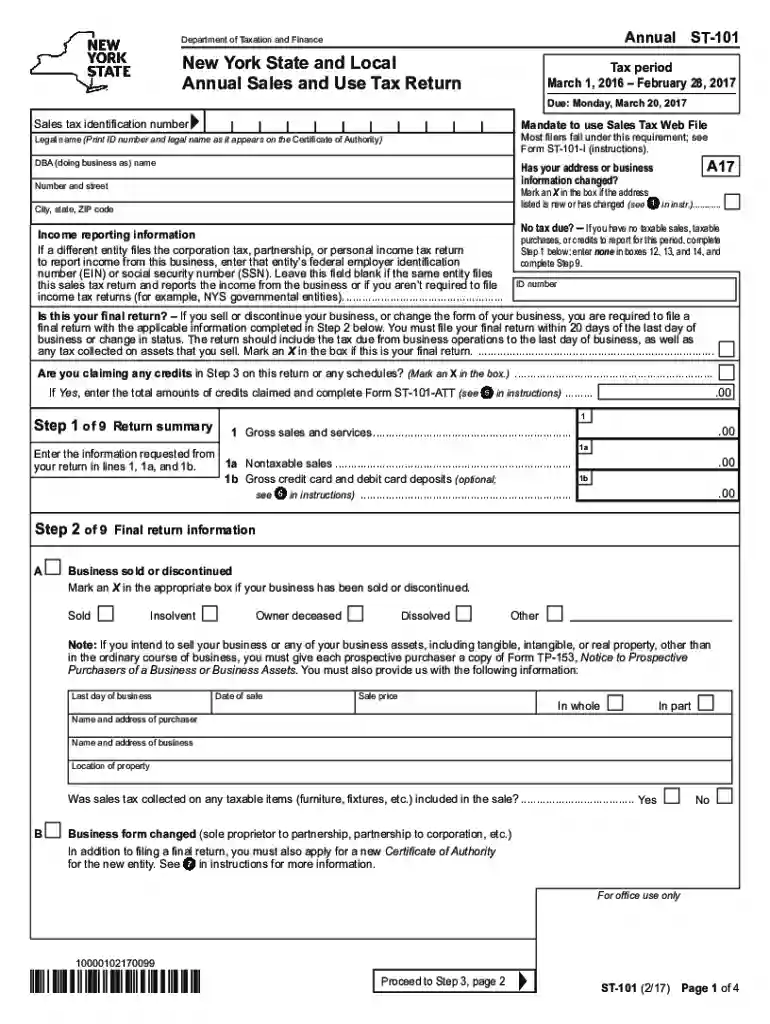
Form ST-101, also referred to as the New York State and Local Annual Sales and Use Tax Return, is essential for businesses operating within New York to report sales and use tax obligations. This form is particularly relevant to entities that are required to file annually, typically smaller businesses with a history of low sales volume.
Primary Use: This form serves as the year-end summary document for sales tax declarations, consolidating the tax liability accrued throughout the year. It is a mandatory submission to remain compliant with state tax regulations.
Content: It details gross sales, taxable sales, and any adjustments or credits applicable to the tax liabilities of the business.
Fiscal Year Coverage: The tax return for the period from March 1, 2016, to February 28, 2017, affirms the necessity for businesses to complete this document to avoid penalties.
Legal Obligation: Filing this form ensures adherence to New York State regulations, safeguarding businesses from audits and legal repercussions.
Sales Reporting: Captures the total gross receipts and delineates taxable sales from non-taxable sales.
Deductions and Credits: Allows for authorized deductions which reduce overall tax liability.
Failure to file the form may result in penalties, increased scrutiny from tax authorities, and potential audits.
Fines and interest may accrue on overdue tax amounts, compounding financial liabilities for businesses.
Digital Submission: Offers a faster, more efficient mode of submission with acknowledgment receipts provided immediately.
Paper Form Completion: While offering tactile control, it requires mailing and longer processing times for processing confirmations.
By following the structured guidelines and leveraging the flexibility of platforms like DocHub to complete and manage Form ST-101, businesses ensure compliance while optimizing their tax return processes in New York State.
We've got more versions of the Form ST-101:2 17:New York State and Local Annual Sales and form. Select the right Form ST-101:2 17:New York State and Local Annual Sales and version from the list and start editing it straight away!
| Versions | Form popularity | Fillable & printable |
|---|---|---|
| 2025 | 4.4 Satisfied (29 Votes) | |
| 2024 | 4.8 Satisfied (37 Votes) | |
| 2023 | 4.8 Satisfied (29 Votes) | |
| 2022 | 4.8 Satisfied (192 Votes) | |
| 2021 | 4.2 Satisfied (41 Votes) | |
| 2020 | 4.4 Satisfied (38 Votes) | |
| 2019 | 4.2 Satisfied (52 Votes) | |
| 2018 | 4.3 Satisfied (56 Votes) | |
| 2017 | 4.3 Satisfied (62 Votes) | |
| 2016 | 4.4 Satisfied (48 Votes) | |
| 2015 | 4.4 Satisfied (63 Votes) | |
| 2013 | 4 Satisfied (31 Votes) | |
| 2001 | 4 Satisfied (43 Votes) |
At DocHub, your data security is our priority. We follow HIPAA, SOC2, GDPR, and other standards, so you can work on your documents with confidence.
May 14, 2015 The retrospective application resulted in an increase in Railway operating expenses and therefore an increase to the Railway operating ratio
Sales and Income Tax Adoption Records . . . . . . . . . . . . Page 12. 17. Estimated General Personal Property Taxes Paid by Business. Firms to State and Local
Feb 28, 2017 New York State and Local. Annual Sales and Use Tax Return. Department of Taxation and Finance. Annual ST-101. Sales tax identification number.


