Ny st 101 2026

Get Form
ny st 101 Preview on Page 1

Here's how it works

01. Edit your form online
Type text, add images, blackout confidential details, add comments, highlights and more.

02. Sign it in a few clicks
Draw your signature, type it, upload its image, or use your mobile device as a signature pad.

03. Share your form with others
Send it via email, link, or fax. You can also download it, export it or print it out.

Definition & Meaning

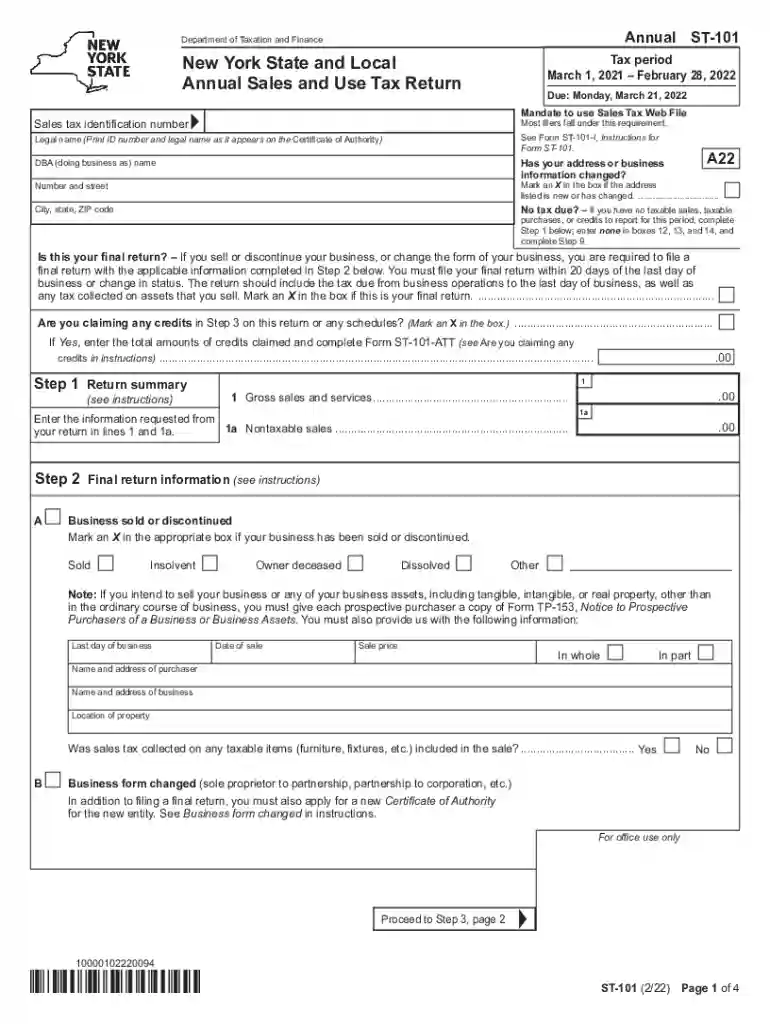
Form ST-101, officially known as the New York State and Local Annual Sales and Use Tax Return, is a crucial document for businesses operating in New York. It is designed to report taxable sales, calculate sales taxes due, and outline any applicable credits or special taxes. This form is integral for businesses to comply with state tax regulations, ensuring accurate reporting of sales and use tax obligations for the specified tax year.

How to Use the NY ST-101

Businesses utilize Form ST-101 to report annual sales tax activity. The form guides users through declaring the total taxable sales, calculating the appropriate sales tax, and applying any eligible credits. Additionally, it offers specific sections for reporting any business status changes, such as closures or changes in ownership. Filling out this form accurately is essential for businesses to maintain compliance and avoid potential penalties associated with incorrect filings.

  • Declare Total Taxable Sales: Input total sales subject to New York State sales tax.
  • Calculate Sales Tax: Utilize the provided rate charts to determine the correct tax amount.
  • Report Changes: Indicate any changes in business structure or operations within the tax year.

Steps to Complete the NY ST-101

To ensure accurate completion, businesses should follow a sequence of steps when handling the NY ST-101:

  1. Gather Necessary Information: Collect all financial records, including sales receipts and transaction summaries for the tax period.
  2. Review Filing Requirements: Familiarize yourself with New York State's sales tax rates and any applicable local tax rates.
  3. Complete Taxable Sales Section: Enter total taxable sales in the designated section.
  4. Apply Credits and Exemptions: List any applicable credits or exemptions based on business activities.
  5. Calculate Tax Due: Use provided formulae to compute total sales tax owed.
  6. Finalize and Review: Double-check all entries for accuracy before submission.
  7. Submit Form: Decide on submission method—either online through New York State's online portal or via traditional mail.

Required Documents

When preparing to file the NY ST-101, ensure the following documents are readily available:

  • Sales Receipts and Invoices: Detailed records of all sales transactions during the reporting period.
  • Business Registration Documents: Relevant certificates and IDs confirming business legitimacy.
  • Previous Returns: Copies of previously filed returns can be beneficial for reference and ensuring consistent reporting.
  • Financial Statements: Include profit and loss statements for an accurate financial overview.

Filing Deadlines / Important Dates

For the tax period spanning March 1, 2021, to February 28, 2022, Form ST-101 must be submitted by March 21, 2022. This deadline is critical; missing the deadline may result in penalties and interest. Businesses are encouraged to mark their calendars and set reminders to ensure timely filing.

  • Filing Period: March 1, 2021 - February 28, 2022
  • Submission Deadline: March 21, 2022
  • Extension Requests: In special cases, businesses may apply for filing extensions, though these are subject to approval and must adhere to strict application criteria set by New York tax authorities.

Key Elements of the NY ST-101

The ST-101 form incorporates several vital components, each playing a significant role in accurate tax reporting:

  • Taxable Sales Reporting: Core data concerning all taxable sales and services.
  • Tax Computation: Detailed calculations for sales tax owed, including regional variances.
  • Exemption and Credit Claims: Sections dedicated to reporting tax-exempt sales and applicable credits.
  • Finalization & Signature: Requires a valid signature to authenticate the data provided for state records.

Important Terms Related to NY ST-101

It's vital to understand specific terminology associated with this form for clarity and precision:

  • Taxable Sales: Sales transactions subject to state and local sales tax.
  • Credits: Tax allowances that reduce the total sales tax owed.
  • Exempt Sales: Transactions that are exempt from sales tax due to specific qualifying conditions.
  • Filing Period: The duration for which the tax return is being filed.

Penalties for Non-Compliance

Failure to file the NY ST-101 by the due date, or inaccuracies in reporting, can result in severe penalties, including:

  • Late Filing Penalty: Additional charges for submissions past the deadline.
  • Accuracy Penalty: Fines for submitting incorrect or incomplete information.
  • Interest on Unpaid Tax: Interest accruals on taxes owed but not paid by the deadline.

Businesses must pay close attention to detail and ensure timely submission to avoid these financial repercussions. Regular reviews of tax obligations and engaging professionals, if necessary, can safeguard against these risks.

See more ny st 101 versions

We've got more versions of the ny st 101 form. Select the right ny st 101 version from the list and start editing it straight away!
Versions Form popularity Fillable & printable
2023 4.8 Satisfied (29 Votes)
2022 4.8 Satisfied (192 Votes)
2021 4.2 Satisfied (41 Votes)
2020 4.4 Satisfied (38 Votes)
2019 4.2 Satisfied (52 Votes)
2018 4.3 Satisfied (56 Votes)
2017 4.3 Satisfied (62 Votes)
2016 4.4 Satisfied (48 Votes)
2015 4.4 Satisfied (63 Votes)
2013 4 Satisfied (31 Votes)
be ready to get more

Complete this form in 5 minutes or less

Get form

Got questions?

We have answers to the most popular questions from our customers. If you can't find an answer to your question, please contact us.
Contact us
Gas, electricity, refrigeration, steam, telephone, and television services. Barbers, beauticians, hair restoration, manicures, pedicures, electrolysis, massage, and other similar services. Occupancy of hotel and motel rooms. Cleaning, maintenance, and repair services.
Every person who sells taxable tangible personal property or taxable services (even if you make sales from your home, are a temporary vendor, or only sell once a year) must register with the Tax Department through New York Business Express before beginning business.
You can order forms using our automated forms order telephone line: 518-457-5431. Its compatible with TTY equipment through NY Relay (Dial 711) and with Internet and mobile relay services (see Assistance for the hearing and speech impaired for more information).
As a resident, you pay state tax (and city tax if a New York City or Yonkers resident) on all your income no matter where it is earned. As a nonresident, you only pay tax on New York source income, which includes earnings from work performed in New York State, and income from real property located in the state.
Sales tax - applies to retail sales of certain tangible personal property and services. Use tax - applies if you buy tangible personal property and services outside the state and use it within New York State. Clothing and footwear under $110 are exempt from New York City and NY State sales tax.

Security and compliance

At DocHub, your data security is our priority. We follow HIPAA, SOC2, GDPR, and other standards, so you can work on your documents with confidence.

Learn more
ccpa2
pci-dss
gdpr-compliance
hipaa
soc-compliance
be ready to get more

Complete this form in 5 minutes or less

Get form

People also ask

New York sales tax filing due dates Filing FrequencyDue Date Quarterly For quarterly filers, sales tax returns are due on the 20th of the month following the end of the reporting quarter. Yearly For yearly filers, sales tax returns are due on March 20 of the following year.1 more row
Form ST-120, Resale Certificate, is a sales tax exemption certificate. This certificate is only for use by a purchaser who: A is registered as a New York State sales tax vendor and has a valid. Certificate of Authority issued by the Tax Department and is making.
Depending on the state, these may include government entities, non-profits, and schools, to name a few. It is the buyers responsibility to provide their exemption certificates in order to not be charged sales tax, and sellers need to keep documentation of these exemptions on file.

Related links