




01. Edit your form online
Type text, add images, blackout confidential details, add comments, highlights and more.

Type text, add images, blackout confidential details, add comments, highlights and more.

Draw your signature, type it, upload its image, or use your mobile device as a signature pad.

Send it via email, link, or fax. You can also download it, export it or print it out.
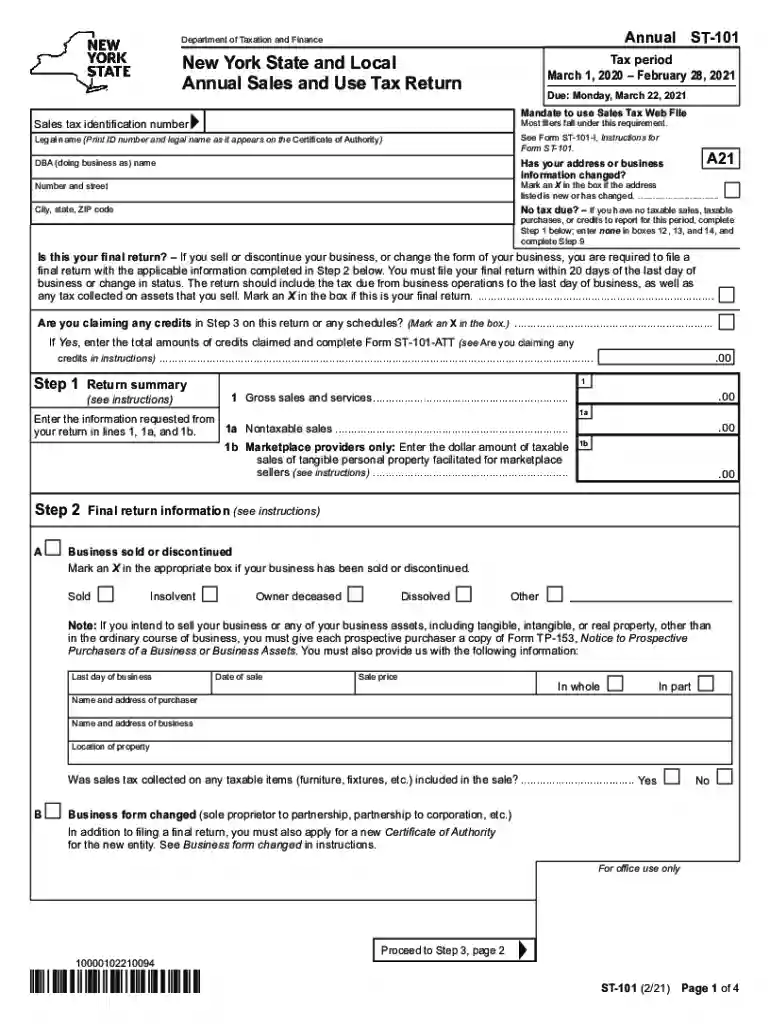
The New York State and Local Annual Sales and Use Tax Return, known as Form ST-101, is a key document for businesses operating in New York. This form is used to report all taxable sales, the amount of sales tax collected, and any use tax due. It requires detailed information on taxable sales, sales tax credits, and any special taxes that might apply. It is a crucial tool for businesses to comply with state tax legislation, ensuring they fulfill their fiscal obligations accurately and on time.
Businesses can access Form ST-101 through multiple channels. The form is available for download on the New York State Department of Taxation and Finance website. Alternatively, businesses may request a physical copy by contacting the Department's customer service. During the tax filing season, many accounting software platforms like TurboTax and QuickBooks provide integrated access to this form, allowing businesses to fill it out digitally as part of their tax software suite.
Enter Business Information: Start by providing your business name, address, EIN (Employer Identification Number), and sales tax ID.
Report Gross Sales: Include total sales made during the tax period; this should match your sales records to avoid discrepancies.
Calculate Taxable Sales: Deduct non-taxable sales, such as sales for resale, from your gross sales to determine taxable sales.
Determine Tax Amounts: Calculate the sales tax due based on taxable sales and applicable tax rates for relevant local jurisdictions.
Include Credits and Adjustments: Enter any allowable credits, such as bad debts, and adjust your total accordingly.
Finalize and Submit: Ensure all entries are correct before finalizing the form. Submission can be done online, by mail, or in-person at designated tax offices.
The ST-101 has specific filing deadlines businesses must adhere to. Generally, the form should be filed annually by March 20th. Failing to file by the deadline may result in penalties and interest on unpaid taxes. Businesses should mark this date and start preparing their returns early to avoid last-minute issues.
New York enforces specific rules concerning sales tax collection and reporting. Businesses must assess not just New York State tax but also local county taxes. Certain counties may have amended rates or specific exemptions, requiring thorough record-keeping. Additionally, businesses engaged in e-commerce with significant sales into New York may be required to file even without a physical presence in the state.
Different types of business entities, such as LLCs, corporations, and partnerships, may use the form. However, requirements might vary depending on the nature and scale of the business. For instance, small sole proprietorships could have fewer entries, while larger corporations might require detailed breakdowns of sales across multiple locations.
Filing Form ST-101 is a legal obligation for businesses in New York. Non-compliance can lead to significant penalties, including fines and interest on unpaid taxes. Additionally, persistent evasion might lead to audits or further legal action. Businesses should prioritize accurate and timely submission to maintain compliance and avoid legal complications.
Failure to file Form ST-101 can result in financial penalties. The interest is applied to unpaid taxes from the due date to the payment date. The state can impose additional fines for fraudulent entries or intentional underreporting. Businesses should consult tax professionals to ensure compliance and avoid these punitive measures.
Businesses have options for submitting Form ST-101 either digitally or using paper. The online submission through the New York State Department of Taxation and Finance portal is quick and often more secure. Nonetheless, paper forms sent by mail remain an option for those who prefer traditional filing. The online method provides prompt confirmation of receipt, which can be advantageous for record-keeping.
Consider a retail business operating with physical stores and online sales. They must report all sales across both channels, ensuring to separate taxable and non-taxable sales. Using accounting software linked to their sales systems can make the completion of Form ST-101 more efficient, reducing errors and ensuring conformity with state and local tax rates. Each business should tailor its approach based on its unique sales environment.
We've got more versions of the Form ST-101 New York State and Local Annual Sales and Use Tax Return Revised 2 21 form. Select the right Form ST-101 New York State and Local Annual Sales and Use Tax Return Revised 2 21 version from the list and start editing it straight away!
| Versions | Form popularity | Fillable & printable |
|---|---|---|
| 2025 | 4.4 Satisfied (29 Votes) | |
| 2024 | 4.8 Satisfied (37 Votes) | |
| 2023 | 4.8 Satisfied (29 Votes) | |
| 2022 | 4.8 Satisfied (192 Votes) | |
| 2021 | 4.2 Satisfied (41 Votes) | |
| 2020 | 4.4 Satisfied (38 Votes) | |
| 2019 | 4.2 Satisfied (52 Votes) | |
| 2018 | 4.3 Satisfied (56 Votes) | |
| 2017 | 4.3 Satisfied (62 Votes) | |
| 2016 | 4.4 Satisfied (48 Votes) | |
| 2015 | 4.4 Satisfied (63 Votes) | |
| 2013 | 4 Satisfied (31 Votes) | |
| 2001 | 4 Satisfied (43 Votes) |
At DocHub, your data security is our priority. We follow HIPAA, SOC2, GDPR, and other standards, so you can work on your documents with confidence.
Oct 1, 2010 Under the New York income tax, taxpayers who itemized deductions and chose to deduct state and local income taxes for federal purposes, must add
The return should include the tax due from business operations to the last day of business, as well as any tax collected on assets that you sell. Mark an X in
Aug 6, 2014 1. Includes $153 million of impairments relating to operating lease right-of-use and finance lease assets. Three months ended May 31, 2019.


