




01. Edit your form online
Type text, add images, blackout confidential details, add comments, highlights and more.

Type text, add images, blackout confidential details, add comments, highlights and more.

Draw your signature, type it, upload its image, or use your mobile device as a signature pad.

Send it via email, link, or fax. You can also download it, export it or print it out.
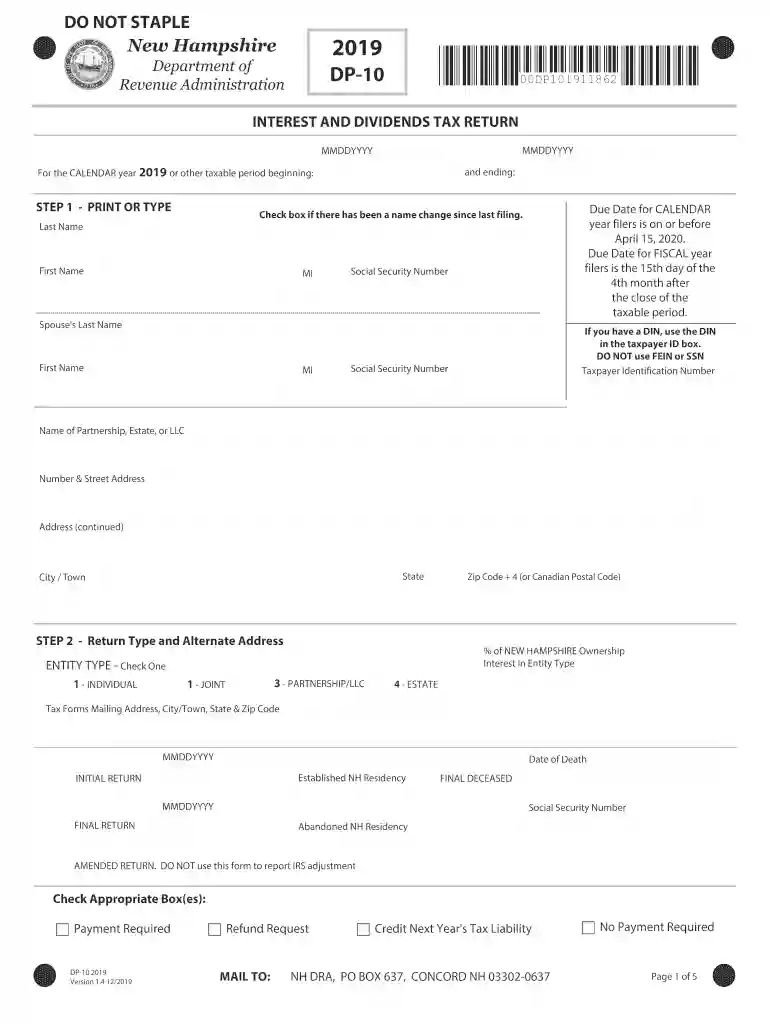
The phrase "For the CALENDAR year 2019 or other taxable period beginning:" refers to the starting point of a tax reporting period in which individuals or entities declare their income for tax purposes. This is a common provision on tax forms to establish the exact timeframe for which the taxpayer is recapping income, expenses, and other financial details that determine their tax liability. Most individuals use the calendar year as their tax year, but some businesses and entities may have different fiscal periods depending on their accounting methods.
Using the form involves declaring interest and dividend income received during the specified period. Taxpayers must provide comprehensive details of their income and ensure that all relevant sections of the form are accurately completed.
Completing the form involves a structured approach to accurately report financial information. Here's how you can systematically complete the form:
This form is typically used by taxpayers who fall within the jurisdiction where reporting of interest and dividend income is mandatory.



The form is used to ensure that taxpayers comply with legal obligations to report taxable income and pay the prescribed taxes.
Understanding deadlines ensures timely submission and avoids penalties.
A successful submission requires supporting documentation to verify declared income.
There are different avenues for submitting the form, each with its procedural details.
Understanding the complexities and required attention to detail when filling out the "For the CALENDAR year 2019 or other taxable period beginning:" form ensures compliance and avoids any potential legal issues or penalties.
We've got more versions of the For the CALENDAR year 2019 or other taxable period beginning: form. Select the right For the CALENDAR year 2019 or other taxable period beginning: version from the list and start editing it straight away!
| Versions | Form popularity | Fillable & printable |
|---|---|---|
| 2024 | 4.8 Satisfied (40 Votes) | |
| 2023 | 4.2 Satisfied (48 Votes) | |
| 2023 | 4.3 Satisfied (31 Votes) | |
| 2022 | 4.1 Satisfied (57 Votes) | |
| 2021 | 4.7 Satisfied (119 Votes) | |
| 2020 | 4.3 Satisfied (33 Votes) | |
| 2019 | 4 Satisfied (32 Votes) | |
| 2018 | 4.2 Satisfied (27 Votes) | |
| 2017 | 4.2 Satisfied (35 Votes) | |
| 2016 | 4 Satisfied (35 Votes) | |
| 2015 | 4 Satisfied (62 Votes) | |
| 2014 | 4 Satisfied (35 Votes) | |
| 2013 | 4.2 Satisfied (49 Votes) | |
| 2012 | 4.4 Satisfied (55 Votes) | |
| 2011 | 4.3 Satisfied (43 Votes) |
At DocHub, your data security is our priority. We follow HIPAA, SOC2, GDPR, and other standards, so you can work on your documents with confidence.
Apr 15, 1976 A quarter of a full 12-month tax year is a period of 3 months. The first quarter in a year begins on the first day of the tax year. The
Feb 12, 2020 Calendar year starts with January 1 and ends with December 31. For instance, Calendar year 2019 starts with 1/1/2019 and ends with 12/31/2019.


