




01. Edit your form online
Type text, add images, blackout confidential details, add comments, highlights and more.

Type text, add images, blackout confidential details, add comments, highlights and more.

Draw your signature, type it, upload its image, or use your mobile device as a signature pad.

Send it via email, link, or fax. You can also download it, export it or print it out.
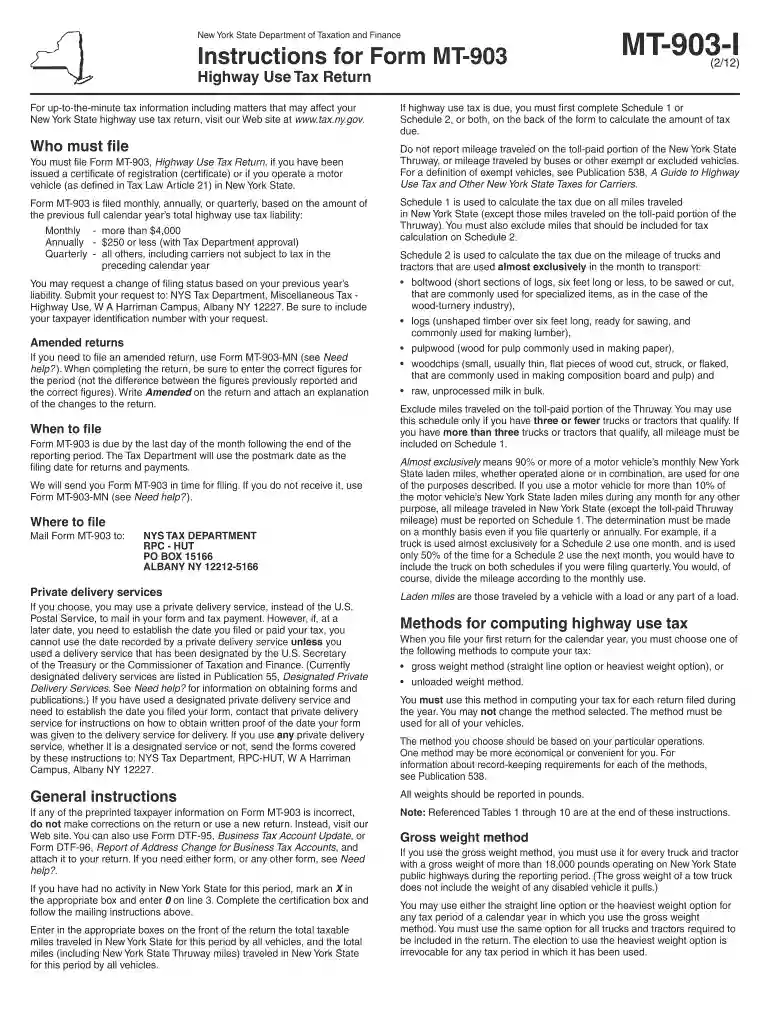
The MT-903 I 2012 Form, known formally as the Highway Use Tax Return, is a critical document for motor vehicle operators in New York State. It serves the purpose of reporting and remitting taxes imposed on the use of public highways due to wear and tear caused by vehicles with a weight of over 18,000 pounds. This form ensures operators contribute fairly to the upkeep and maintenance of highways. The tax calculation involves vehicle weight and mileage, reflecting usage's impact on infrastructure. Understanding its purpose helps operators comply with state tax laws, avoiding penalties and contributing to public resource maintenance.
Before filing, it's essential to determine eligibility. The form is mandatory for any operator with vehicles exceeding a gross weight of 18,000 pounds traveling on New York public roads. It includes trucks, tractors, and other heavy vehicles operating within state boundaries, excluding those used exclusively for farming or exempted by specific regulations. Enterprises operating such vehicles must understand this requirement to ensure accurate tax return submission, avoiding legal repercussions. Eligibility confirmation can save operators from inaccurate filings and subsequent penalties.
Completing the MT-903 I 2012 Form involves several precise steps:
Gather Information: Collect details on vehicle weight, mileage, and identification numbers.
Calculate Tax Liability: Based on the collected data, compute the highway use tax using provided tables and formulas.
Fill Out Identification Information: Enter business name, address, and tax identification number.
Complete Tax Calculation Section: Input vehicle-specific details and calculated tax amounts for each relevant section.
Provide Declaration: Sign and date the form to certify the accuracy of the information provided.
Attach Required Documents: Include any supporting documentation required for verification.
Accurate information entry ensures compliance and avoids processing delays or errors, which can result in fines or additional audits.
Filing the MT-903 I 2012 Form necessitates supporting documents to substantiate data. These include:
Providing complete and accurate documentation supports the veracity of filed data, reducing the risk of audits and ensuring the smooth processing of tax returns.
Adhering to the filing requirements of the MT-903 I 2012 Form is not just procedural but legally binding. Non-compliance can result in several penalties:
Fines can be avoided through timely, accurate submissions, demonstrating adherence to state requirements and contributing to highway maintenance funding.
Understanding specific terms related to the MT-903 I 2012 Form is crucial for accurate submission. Key terms include:
Familiarity with terms enhances understanding of form instructions and requirements, facilitating accurate completion.
Several methods exist for submitting the MT-903 I 2012 Form:
Key deadlines include quarterly and annual submission dates, aligning with fiscal schedules. Meeting these deadlines is pivotal to avoid late penalties, supporting administrative efficiency.
Detailed instructions provided with the MT-903 I 2012 Form guide operators through the filing process:
Following instructions ensures accurate tax computation and compliance, preventing penalties and supporting infrastructure funding.
Including these blocks offers comprehensive guidance for understanding and completing the MT-903 I 2012 Form. Each section delivers critical information, contributing to an accurate, compliant filing process.
We've got more versions of the mt 903 i 2012 form form. Select the right mt 903 i 2012 form version from the list and start editing it straight away!
At DocHub, your data security is our priority. We follow HIPAA, SOC2, GDPR, and other standards, so you can work on your documents with confidence.
May 20, 2024 Highway Use Tax (HUT) Web File is the easiest and fastest way to file a highway use tax return and make a payment.
You may be eligible for benefits under the Post-Vietnam Era Non-Contributory Veterans Educational Assistance Program, also known as. Non-Contributory VEAP or
Revenue Procedure 2012-32, Requirements for Completing and Submitting Form. 8655, Reporting Agent Authorization. Publication 1474, Technical Specification


