




01. Edit your form online
Type text, add images, blackout confidential details, add comments, highlights and more.

Type text, add images, blackout confidential details, add comments, highlights and more.

Draw your signature, type it, upload its image, or use your mobile device as a signature pad.

Send it via email, link, or fax. You can also download it, export it or print it out.
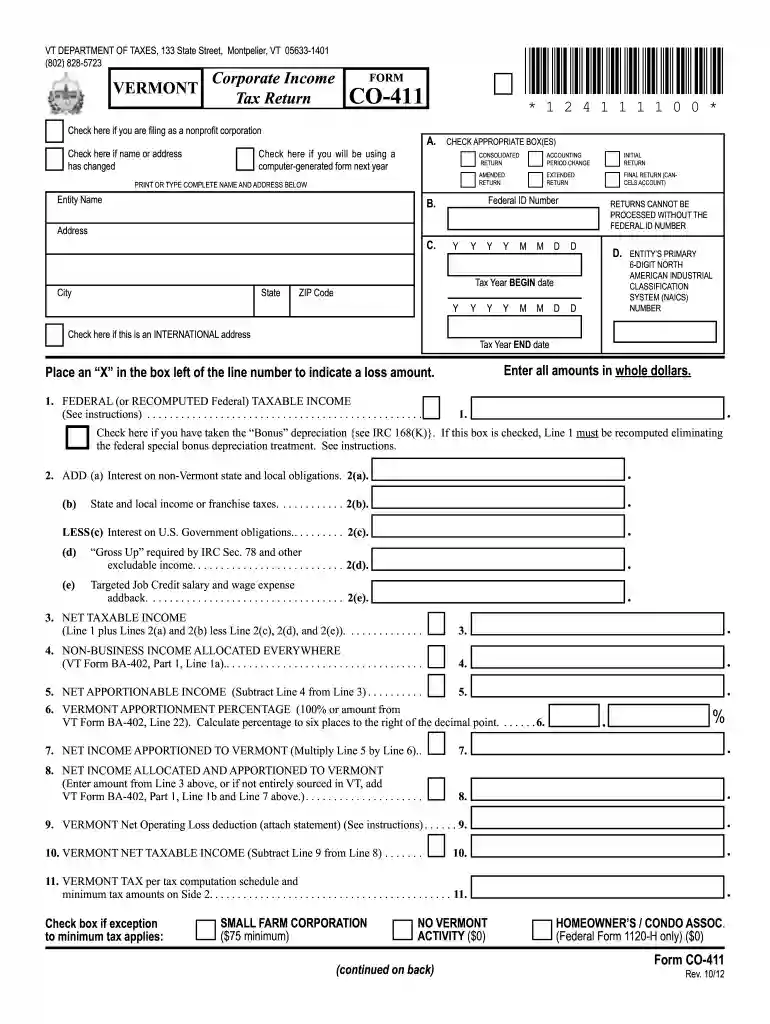
The CO-411 form is known as the Vermont Corporate Income Tax Return form, used by corporations to report taxable income, deductions, and tax liabilities to the Vermont Department of Taxes. This form is essential for corporations conducting business in Vermont, as it facilitates the calculation and declaration of state tax obligations for the specified fiscal year. The form typically includes sections for income calculations, applicable tax rates, and detailed instructions for filing and paying taxes.
Corporations operating in Vermont are the primary users of the CO-411 form. This includes various business entities such as C corporations, S corporations, and Limited Liability Companies (LLCs) that are taxed as corporations. The form is relevant for businesses of all sizes that have income taxable by the state of Vermont and ensures their compliance with state tax laws. These corporations might encompass diverse industries, indicating a broad application of the form across different sectors.


Using the CO-411 form involves a series of steps to accurately report a corporation's financial activities. Corporations must accurately input information related to taxable income, deductions, and any applicable credits. Key steps include:
The CO-411 form contains several critical elements that corporations must address:
Completing the CO-411 form involves meticulous attention to financial details:
Understanding key terminology related to the CO-411 form can aid in its completion:
The deadline for filing the CO-411 form typically aligns with the federal corporate tax filing deadline on April 15. For fiscal year filers with different tax years, the deadline falls on the 15th day of the fourth month after the close of their fiscal year. It's crucial to meet these dates to avoid penalties and interest.
Failure to file or accurately complete the CO-411 form within the stipulated timeframe can result in significant penalties. These penalties often include fines calculated based on a percentage of the underpaid taxes and interest on the outstanding balance. It is imperative to file timely and accurately to avoid additional costs and potential legal complications related to state tax compliance.
We've got more versions of the 2011 fill in co 411 2012 form form. Select the right 2011 fill in co 411 2012 form version from the list and start editing it straight away!
| Versions | Form popularity | Fillable & printable |
|---|---|---|
| 2024 | 4.2 Satisfied (48 Votes) | |
| 2022 | 4.1 Satisfied (45 Votes) | |
| 2021 | 4.8 Satisfied (183 Votes) | |
| 2019 | 4.2 Satisfied (101 Votes) | |
| 2018 | 4.4 Satisfied (241 Votes) | |
| 2015 | 4.3 Satisfied (116 Votes) | |
| 2014 | 4.4 Satisfied (461 Votes) | |
| 2012 | 4 Satisfied (48 Votes) | |
| 2011 | 4 Satisfied (23 Votes) | |
| 2010 | 4.2 Satisfied (68 Votes) |
At DocHub, your data security is our priority. We follow HIPAA, SOC2, GDPR, and other standards, so you can work on your documents with confidence.
Feb 3, 2012 Recognition of Exemption Under Section 501(a), with the IRS. A Who Must File . . . . . . . . . . . . . . . . . . . . . . . . . . . . . . 3.
FORM CMS-2552-10. 4030.1 (Cont.) Effective for discharges occurring during Federal fiscal years 2011 and 2012, enter on lines 70.97 through 70.99 the


