
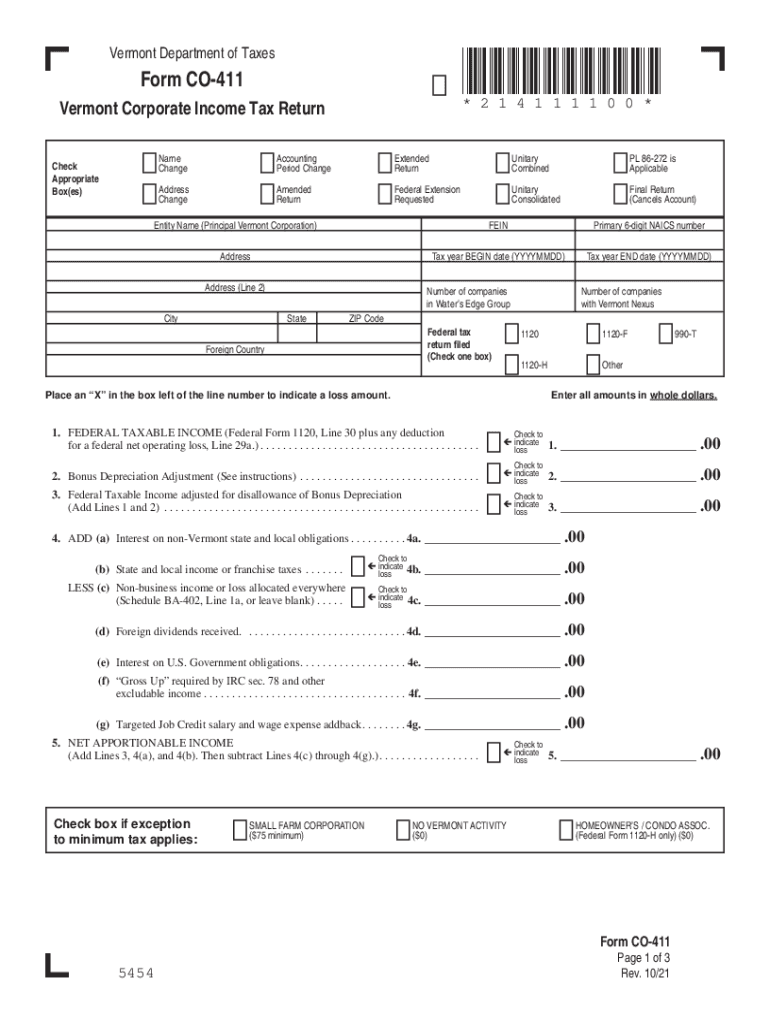







Definition and Purpose of Vermont CO-411
The Vermont Corporate Income Tax Return Form CO-411 is essential for corporations operating within the state of Vermont. This form is used to report corporate taxable income, calculate the state taxes owed, and disclose entity details. It includes sections for adjusting federal taxable income to align with Vermont tax regulations, calculating statewide apportionable income, and instructional guidelines for tax payments. Completing this form is mandatory for corporations to remain compliant with Vermont’s tax laws.
Completing the Vermont CO-411: Steps and Guidelines
-
Gather Necessary Documents:
- Obtain financial statements and relevant accounting records.
- Ensure access to past federal tax return (Form 1120) data for accurate adjustments.
-
Calculate Federal Taxable Income Adjustments:
- Assess income and deductions for Vermont-specific regulations.
- Follow the form's guidance for making precise federal adjustments.
-
Compute Vermont Apportionable Income:
- Determine out-of-state business income for fair apportionment.
- Apply apportionment factors as outlined to calculate the Vermont portion.
-
Determine Tax Rates and Payments:
- Assess your tax liability based on the taxable income.
- Follow instructions for calculating payments to avoid underpayment or overpayment.
-
Check for Applicable Deductions:
- Review potential state-specific deductions and credits.
- Complete the deductions section to lower taxable income.
Obtaining the Vermont CO-411 Form
Corporations can obtain the Vermont CO-411 form through the Vermont Department of Taxes website. Alternatively, businesses may request a physical form by mailing the department or visiting a local tax office. Utilizing available digital options ensures access to the most recent and accurate versions of the form and instructions.
Key Elements of the Vermont CO-411
- Entity Information: Detailed identification of the corporation, including name, address, federal ID number, and fiscal period.
- Federal Taxable Income Adjustments: Sections for modifying income to reflect state-specific regulations.
- Apportionment Calculation: Instructions and worksheets to determine the income attributable to Vermont activities.
- Tax Rates and Payment Instructions: Details on current rates applicable to different income levels and methods for submitting payments.
- Disclosure Requirements: Required statements and backup for designated income and deductions.
State-Specific Guidelines
Vermont imposes unique requirements that might differ from federal and other states’ rules. Ensure comprehension of Vermont-specific guidelines to prevent incorrect filings or penalties. Attention to detail in areas such as apportionment and deduction eligibility can vastly impact your tax responsibilities.
Submission Methods: Online and Mail Options
Form CO-411 can be submitted electronically through the Vermont Department of Taxes' e-file service, providing convenience and timely processing. Alternatively, paper forms can be mailed directly to the department, though this process may have longer processing times.
Penalties for Non-Compliance
Failing to file Form CO-411 or submitting erroneous information can result in penalties and interest accruals from the Vermont Department of Taxes. Ensure diligent completion and timely submission to avoid financial consequences. Additional penalties may apply for fraudulent or intentional misrepresentation.
Important Submission Deadlines
The CO-411 typically shares the same due date with the federal corporate income tax return, usually within three and a half months after the close of the corporate fiscal year. Extensions are available but must be requested before the initial deadline.
Software Compatibility and Integration
Form CO-411 is supported by several popular tax software platforms, such as TurboTax and QuickBooks, facilitating easier data entry, calculations, and submission. Verify compatibility with your selected program to leverage features like auto-filing and data import efficiencies.




