



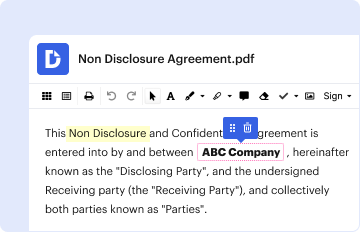
01. Edit your form online
Type text, add images, blackout confidential details, add comments, highlights and more.

Type text, add images, blackout confidential details, add comments, highlights and more.

Draw your signature, type it, upload its image, or use your mobile device as a signature pad.

Send it via email, link, or fax. You can also download it, export it or print it out.
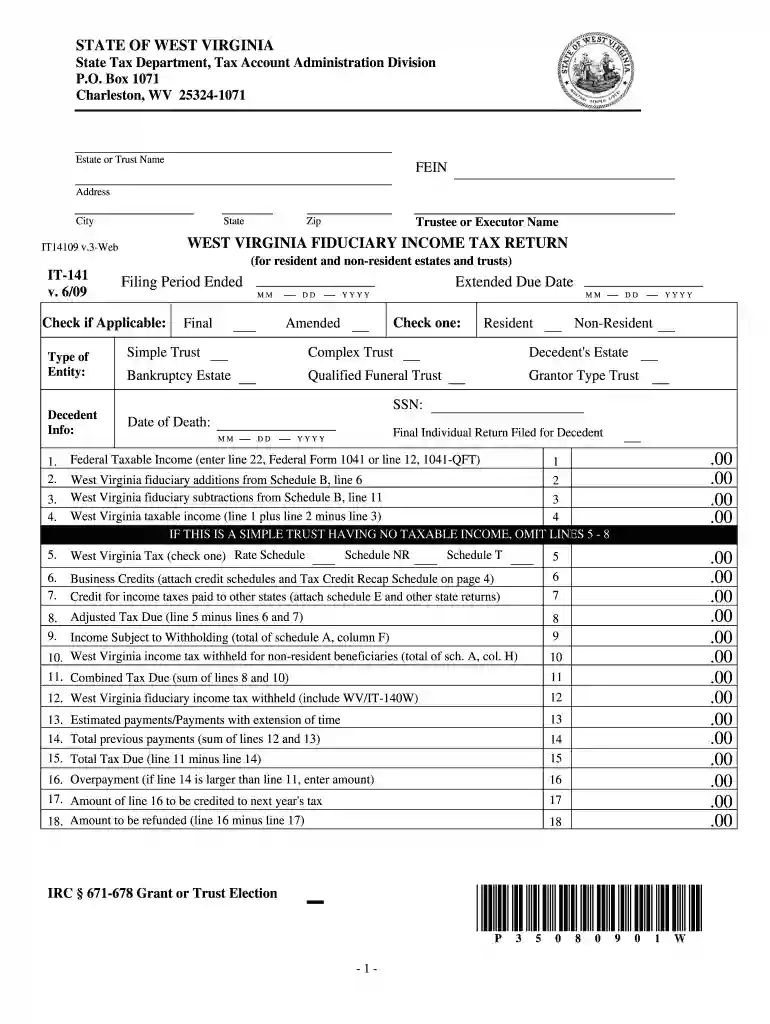
The "WV State Tax Department Fiduciary Estate Tax Return Forms 2009" is a tax document used primarily for reporting the income of estates and trusts within West Virginia for the year 2009. This form ensures that the fiduciary, who oversees the trust or estate, correctly calculates and reports taxable income in accordance with state regulations.
Filing this form is essential for compliance with West Virginia state tax laws concerning estates, trusts, and qualified funeral trusts (QFTs). It requires accurate reporting of income, deductions, and other relevant financial transactions that occurred during the tax year.
The West Virginia Fiduciary Estate Tax Return form for 2009 can be obtained through multiple channels:
When obtaining the form, ensure that you have the correct version for the year 2009 to avoid errors in filing.
Completing the WV Fiduciary Estate Tax Return for 2009 involves several key steps:
Gather Required Information: Collect all necessary details regarding the estate or trust’s income, expenses, distributions, and tax payments.
Fill Out Personal Information: Enter the name, address, and taxpayer identification number of the estate or trust.
Report Income and Deductions: Accurately include all sources of income and allowable deductions on the form’s respective sections.
Calculate Tax: Use the form’s guidelines to compute the tax liability, ensuring all exemptions and credits are correctly applied.
Review and Submit: Double-check all entries for accuracy before signing and submitting the form to the West Virginia State Tax Department.
The WV State Tax Department Fiduciary Estate Tax Return forms are primarily used by:
These users require a detailed understanding of both estate management and tax laws applicable to fiduciaries.


Understanding key terms is crucial for accurately completing the form:
These terms play vital roles in determining the financial information required for the form.
For the 2009 tax year, it is important to be aware of specific deadlines to ensure compliance:
Adhering to these dates helps avoid late fees and penalties.
To successfully file the 2009 form, gather all pertinent documents, including:
Ensure that all documentation is accurate and complete to support the reported figures on the form.
Failure to file the WV State Tax Department Fiduciary Estate Tax Return by the due date can result in:
Understanding these penalties emphasizes the importance of timely and accurate filing.
The 2009 WV Fiduciary Estate Tax Return form can be submitted through different avenues:
Always verify submission methods to ensure the form reaches the state tax department promptly.
When choosing between digital and paper versions of the form:
Consider the most suitable option based on personal preference and technical capability.
We've got more versions of the wv state tax department fiduciary estate tax return forms 2009 form. Select the right wv state tax department fiduciary estate tax return forms 2009 version from the list and start editing it straight away!
| Versions | Form popularity | Fillable & printable |
|---|---|---|
| 2024 | 4.4 Satisfied (21 Votes) | |
| 2023 | 4.7 Satisfied (21 Votes) | |
| 2022 | 4.8 Satisfied (37 Votes) | |
| 2021 | 4.8 Satisfied (67 Votes) | |
| 2020 | 4.4 Satisfied (224 Votes) | |
| 2019 | 4.1 Satisfied (39 Votes) | |
| 2018 | 4.3 Satisfied (90 Votes) | |
| 2017 | 4.3 Satisfied (100 Votes) | |
| 2016 | 4.4 Satisfied (542 Votes) | |
| 2015 | 4.3 Satisfied (50 Votes) | |
| 2014 | 4 Satisfied (29 Votes) | |
| 2013 | 4 Satisfied (58 Votes) | |
| 2012 | 4.3 Satisfied (73 Votes) | |
| 2009 | 4.3 Satisfied (183 Votes) | |
| 2008 | 4 Satisfied (57 Votes) |
At DocHub, your data security is our priority. We follow HIPAA, SOC2, GDPR, and other standards, so you can work on your documents with confidence.
West Virginia Personal Income Tax Forms Instructions 2023 PERSONAL INCOME TAX IS DUE APRIL 15, 2024. Tips on Filing a Paper Return 16 General Information 17
Apr 15, 2021 Check or Money Order payable to the WV State Tax Department - Enclose check or money order with your return. . Electronic Payment - May beRead more


