It 141 2014 form-2026

Get Form
it 141 2014 form Preview on Page 1

Here's how it works

01. Edit your form online
Type text, add images, blackout confidential details, add comments, highlights and more.

02. Sign it in a few clicks
Draw your signature, type it, upload its image, or use your mobile device as a signature pad.

03. Share your form with others
Send it via email, link, or fax. You can also download it, export it or print it out.

Definition and Purpose of the IT-141 Form

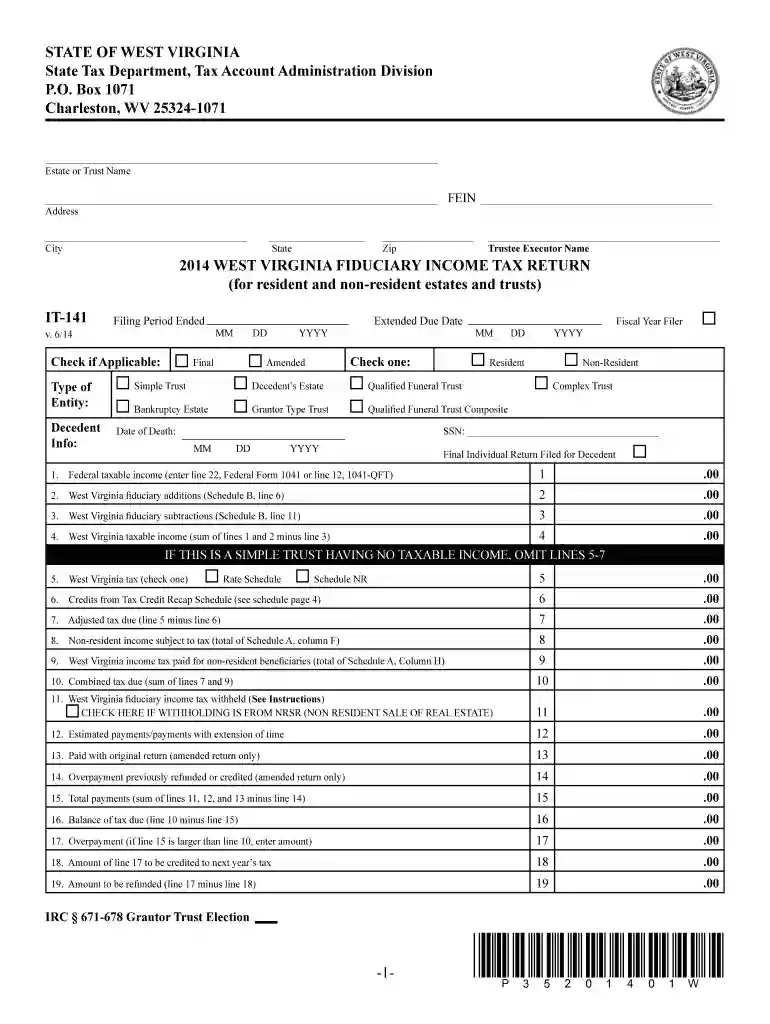
The IT-141 form is the West Virginia fiduciary income tax return used by resident and non-resident estates and trusts. This form is paramount for fiduciaries who need to report taxable income generated by estates or trusts. It involves calculations detailing income, tax modifications, and credits. Serving as a financial record, this document assists in ensuring compliance with state tax regulations.

Key Components of the IT-141 Form

Understanding the structure of the IT-141 form helps in completing it accurately. Key elements include:

  • Estate or Trust Identification: This section captures essential information about the entity filing the return, such as the name, address, and federal employer identification number (FEIN).
  • Income Calculations: Fiduciaries must report all income generated by the estate or trust, including taxable interest, dividends, and capital gains.
  • Tax Modifications and Credits: This part includes any adjustments to the income and applicable tax credits, which can affect the final tax liability.

How to Obtain the IT-141 Form

Filing the IT-141 form begins by obtaining the document. There are several ways to access it:

  1. Online: You can download the form from the West Virginia State Tax Department's official website. Using the online version allows for electronic submissions.
  2. Physical Copies: Traditional paper versions are available at local tax offices or by requesting mail delivery.
  3. Tax Preparation Software: Some tax software programs, such as TurboTax or QuickBooks, might include the IT-141 form, offering convenience and automated calculations.

Steps to Complete the IT-141 Form

Filling out the IT-141 form requires attention to detail to ensure accuracy:

  1. Gather Required Documents: Collect all financial records pertinent to the estate or trust’s income.
  2. Complete the Income Section: Log all income from relevant sources. Ensure no discrepancies between financial records and reported amounts.
  3. Adjust for Modifications and Credits: Accurately report all tax deductions and credits, which can reduce the taxable income.
  4. Review and Verify: Double-check all entries for consistency and correctness before submission.
  5. Submit the Form: Depending on your preference, submit either digitally through an online portal or send a completed paper form via mail.

Legal Use and Compliance

Compliance with state regulations is crucial when handling fiduciary responsibilities:

  • Adherence to Deadlines: Filing the form before the stipulated deadline avoids penalties and interest charges. Typically, the deadline aligns with federal income tax deadlines.
  • Record Retention: Maintain a copy of the submitted form and all related documents for future reference or audits.
  • Detailed Reporting: Ensure that all income, modifications, and expenses are clearly detailed and backed by accurate financial documentation.

Penalties for Non-Compliance

Failing to comply with filing requirements can result in several consequences:

  • Late Fee Penalties: There may be financial penalties for missed deadlines.
  • Interest Accrual: Interest is charged on any unpaid taxes due post-deadline.
  • Audit Potential: Non-compliance heightens the risk of an audit, necessitating extensive justification for previous tax years.

Who Typically Uses the IT-141 Form?

The IT-141 form is predominantly filled out by fiduciaries tasked with managing the tax responsibilities of estates and trusts. This may include:


  • Executors of Estates: Individuals managing the estate of a deceased person, ensuring their financial affairs are settled posthumously.
  • Trustees: Persons or institutions given control over the administration of trust assets for the benefit of designated beneficiaries.
decoration image ratings of Dochub

Important Terms Related to the IT-141 Form

Familiarity with pertinent terms can simplify the filing process:

  • Fiduciary: An individual or institution legally appointed to manage assets for another party.
  • Estate: All the money, property, and other assets owned by an individual, especially at death.
  • Trust: A fiduciary relationship where one party (trustor) gives another party (trustee) the right to hold title to property or assets for a third party’s benefit (beneficiary).

State-Specific Rules and Regulations

West Virginia imposes particular rules on fiduciary income tax returns:

  • Residency Considerations: Distinctions are made between resident and non-resident requirements, affecting tax liability and filing obligations.
  • State-Specific Deductions: There might be unique deductions or credits applicable only to West Virginia estates and trusts.

Understanding these state-specific nuances enables fiduciaries to fulfill their responsibilities accurately and in compliance with local tax laws.

See more it 141 2014 form versions

We've got more versions of the it 141 2014 form form. Select the right it 141 2014 form version from the list and start editing it straight away!
Versions Form popularity Fillable & printable
2022 4.8 Satisfied (37 Votes)
2021 4.8 Satisfied (67 Votes)
2020 4.4 Satisfied (224 Votes)
2019 4.1 Satisfied (39 Votes)
2018 4.3 Satisfied (90 Votes)
2017 4.3 Satisfied (100 Votes)
2016 4.4 Satisfied (542 Votes)
2015 4.3 Satisfied (50 Votes)
2014 4 Satisfied (29 Votes)
2013 4 Satisfied (58 Votes)
2012 4.3 Satisfied (73 Votes)
2009 4.3 Satisfied (183 Votes)
2008 4 Satisfied (57 Votes)
be ready to get more

Complete this form in 5 minutes or less

Get form

Got questions?

We have answers to the most popular questions from our customers. If you can't find an answer to your question, please contact us.
Contact us
If the estate generates more than $600 in annual gross income, you are required to file Form 1041, U.S. Income Tax Return for Estates and Trusts. An estate may also need to pay quarterly estimated taxes. See Form 1041 instructions for information on when to file quarterly estimated taxes.
The fiduciary of a domestic decedents estate, trust, or bankruptcy estate files Form 1041 to report: The income, deductions, gains, losses, etc. of the estate or trust.
If you are domiciled in West Virginia and spent more than 30 days in the state, you must file a resident return and report all of your income to West Virginia.
More In File If the estate generates more than $600 in annual gross income, you are required to file Form 1041, U.S. Income Tax Return for Estates and Trusts. An estate may also need to pay quarterly estimated taxes. See Form 1041 instructions for information on when to file quarterly estimated taxes.
Get federal tax forms for current and prior years Download them from IRS.gov. Order online and have them delivered by U.S. mail. Order by phone at 1-800-TAX-FORM (1-800-829-3676)

Security and compliance

At DocHub, your data security is our priority. We follow HIPAA, SOC2, GDPR, and other standards, so you can work on your documents with confidence.

Learn more
ccpa2
pci-dss
gdpr-compliance
hipaa
soc-compliance

People also ask

The fiduciary (or one of the joint fiduciaries) must file Form 1041 for a domestic estate that has: Gross income for the tax year of $600 or more, or. A beneficiary who is a nonresident alien.
An estate tax return (Form 706) must be filed if the gross estate of the decedent (who is a U.S. citizen or resident), increased by the decedents adjusted taxable gifts and specific gift tax exemption, is valued at more than the filing threshold for the year of the decedents death, as shown in the table below.
Who should file this form This certificate, Form IT-2104, is completed by an employee and given to the employer to instruct the employer how much New York State (and New York City and Yonkers) tax to withhold from the employees pay. The more allowances claimed, the lower the amount of tax withheld.

Related links