Tc 721 form 2026

Get Form
tc 721 form Preview on Page 1

Here's how it works

01. Edit your form online
Type text, add images, blackout confidential details, add comments, highlights and more.

02. Sign it in a few clicks
Draw your signature, type it, upload its image, or use your mobile device as a signature pad.

03. Share your form with others
Send it via email, link, or fax. You can also download it, export it or print it out.

Definition and Meaning of the TC-721 Form

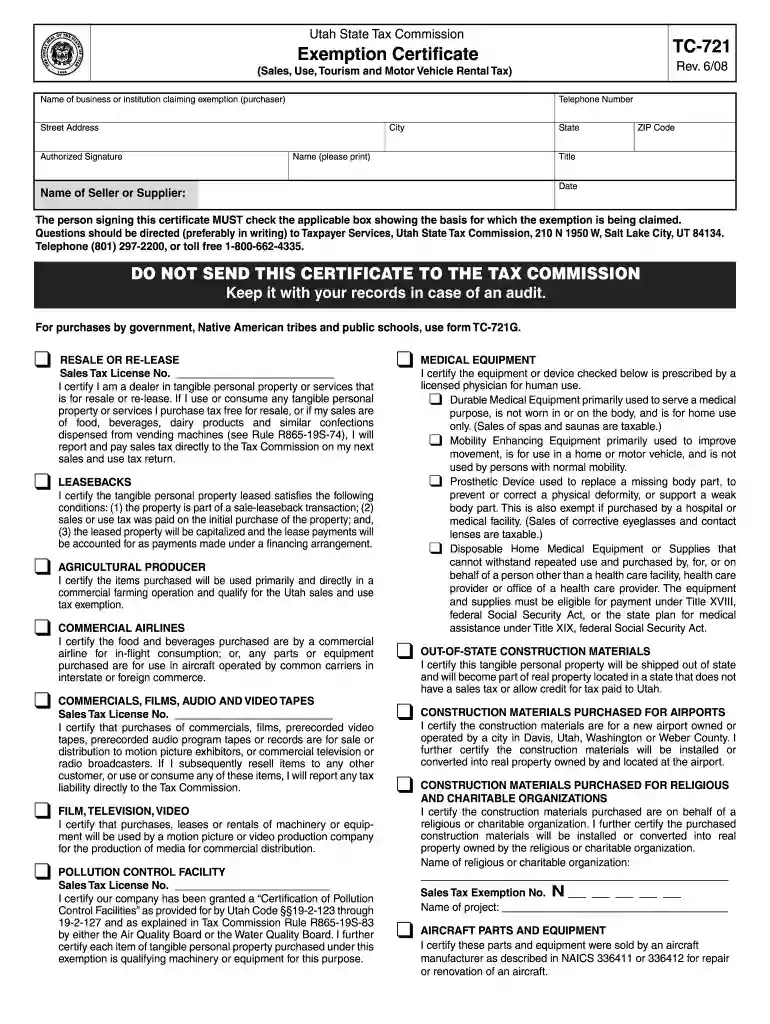
The TC-721 form, officially known as the Utah State Tax Commission Exemption Certificate, is utilized by businesses and institutions to claim exemptions from specific taxes. These exemptions include sales, use, tourism, and motor vehicle rental taxes. The document is essential for qualifying entities such as resale businesses, agricultural producers, and organizations involved in certain construction projects, allowing them to operate without bearing the full tax burden associated with their purchases.

Purposes and Benefits

  • Resale Exemptions: Businesses purchasing goods meant for resale can claim exemptions using this form, reducing upfront costs and improving cash flow.
  • Agricultural Production: Entities engaged in farming can leverage the form to exempt necessary equipment from taxes, ultimately lowering operational expenses.
  • Specialized Construction: Companies involved in specific types of construction benefit through material exemptions, aiding in project cost management.

How to Use the TC-721 Form

To effectively use the TC-721 form, businesses must follow a precise sequence of steps, ensuring all relevant sections are accurately completed. Each step corresponds to a section; the correct compilation of these sections supports a successful exemption claim.

  1. Identify the Applicable Exemptions:

    • Review categories that apply to your business or project.
    • Match your needs with the exemptions outlined on the form.
  2. Complete the Form Clearly:

    • Insert your business details, ensuring accuracy.
    • Specify the exemption reason, linking it back to your eligibility.
  3. Maintain Documentation:

    • Keep completed forms with your tax records.
    • These are crucial for audits and verifying exemption eligibility.

Practical Tips

  • Consistent Updates: Regularly verify tax commission guidelines as exemption categories may change.
  • Internal Reviews: Implement a periodic review process of forms and exemption statuses to remain compliant.

Key Elements of the TC-721 Form

The TC-721 form is comprised of several critical sections, each capturing essential information required for processing an exemption claim. Understanding and completing these sections accurately is vital for approval.

Major Components

  • Business Identification: Includes business name, address, and state tax account number.
  • Exemption Categories: Selection from a predefined list based on qualifying criteria such as resale, agriculture, or production.
  • Certification Statement: An assertion by the signatory that the information provided is accurate and truthful.

Detailed Insights

  • Drop-down Selections: Ensures uniform responses for exemption types, simplifying processing.
  • Authorized Signatures: Credentials of the signatory, substantiating authority to request exemptions.

Steps to Complete the TC-721 Form

Completing the TC-721 form requires diligence and an understanding of business operations in relation to tax exemptions. The following step-by-step guide details the process:

  1. Gather Information:

    • Collect business records including tax account numbers and transaction details.
  2. Select Exemption Reasons:

    • Use guidelines to select applicable exemption reasons for your activities.
  3. Accurate Data Entry:

    • Enter required data meticulously to prevent processing delays.
  4. Ignore Submission to Tax Commission:

    • Retain the form for your records instead of sending it to the Tax Commission.

Compliance Assurance

  • Regular Audits: Conduct internal audits to verify form accuracy and exemption usage.
  • Training Programs: Educate staff involved in form preparation about exemption criteria and documentation requirements.

Legal Use of the TC-721 Form

The legal validity of using the TC-721 form is grounded in compliance with Utah State Tax Laws. Following the correct use of the form is paramount to maintaining legal and tax-paying responsibilities.

Key Legal Aspects

  • Record-Keeping: Businesses are legally obligated to retain completed forms for a potential audit by the Utah State Tax Commission.
  • Misuse Consequences: Inaccuracies or falsifications can result in penalties, including repayment of taxes saved and applicable fines.

Best Practices

  • Legal Consultation: Periodically engage with a tax advisor to ensure alignment with current tax laws and compliance protocols.
  • Annual Reviews: Have legal experts review practices annually to adapt to changes in tax regulations.

Penalties for Non-Compliance

Failure to properly use the TC-721 form can attract significant penalties, which underscores the importance of proper adherence to instructions and filing procedures.

Types of Penalties

  • Financial Penalties: Repayment of tax amounts that were wrongfully exempted, plus interest.
  • Administrative Sanctions: Possible restrictions on future exemption claims, impacting business operations.

Mitigation Strategies

  • Corrective Measures: Prompt action to remedy errors if discovered can mitigate penalties significantly.
  • Documentation Protocols: Establish clear protocols for documentation to forestall issues during audits.

Important Terms Related to the TC-721 Form

Understanding key terminologies associated with the TC-721 form streamlines the preparation process and ensures that businesses can maximally benefit from exemptions.

Essential Definitions

  • Exempt Entity: This term describes an individual or organization entitled to tax exemptions under specified conditions.
  • Audit Trail: Refers to documentation that businesses must maintain to substantiate the legitimacy of their exemption claims.

Clarification Practices

  • Glossary of Terms: Include a glossary in internal documentation for staff to reference, minimizing misunderstandings during form completion.
  • Regular Updates: Ensure all terminologies in use are up-to-date with regulations to prevent non-compliance issues.

State-Specific Rules for the TC-721 Form

An understanding of state-specific guidelines associated with the TC-721 form will ensure compliance with all applicable tax laws. Utah's tax laws may differ from other jurisdictions, necessitating awareness among businesses operating within the state.

Utah-Specific Guidelines

  • Form Retention: Unlike elsewhere, businesses in Utah are required to keep the form rather than file it with the commission.
  • Category Applicability: Industries eligible for exemptions may vary, impacting the form's use.

Compliance Improvements

  • State Workshops: Attend state-offered workshops on tax compliance for direct updates and procedural clarification.
  • Local Partnerships: Collaborate with local tax professionals familiar with state-specific exemptions to enhance compliance efforts.

See more tc 721 form versions

We've got more versions of the tc 721 form form. Select the right tc 721 form version from the list and start editing it straight away!
Versions Form popularity Fillable & printable
2022 4.4 Satisfied (44 Votes)
2020 4.8 Satisfied (76 Votes)
2018 4.3 Satisfied (156 Votes)
2018 4.3 Satisfied (102 Votes)
2017 4.2 Satisfied (50 Votes)
2017 4.3 Satisfied (45 Votes)
2015 4.3 Satisfied (96 Votes)
2014 4.2 Satisfied (54 Votes)
2011 4.1 Satisfied (70 Votes)
2010 4.4 Satisfied (151 Votes)
2008 4.4 Satisfied (66 Votes)
be ready to get more

Complete this form in 5 minutes or less

Get form

Got questions?

We have answers to the most popular questions from our customers. If you can't find an answer to your question, please contact us.
Contact us
TC-721 Exemption Certificate. TC-721A Sales and Use Tax Exemption Affidavit for Exclusive Use Outside Utah (motor vehicles and boats) TC-721DP Sales and Use Tax Exemption Certificate for Direct Payment Permit.
An exemption is a dollar amount that can be deducted from an individuals total income, thereby reducing the taxable income.
What does tax-exempt mean? Being tax-exempt means that some or all of a persons or businesss income is free from federal, state or local tax. Tax-exempt organizations are typically charities or religious organizations recognized by the IRS. Internal Revenue Service. Exempt Organization Types.
A tax exemption excludes certain income, revenue, or even taxpayers from tax altogether. For example, nonprofits that fulfill certain requirements are granted tax-exempt status by the Internal Revenue Service (IRS), preventing them from having to pay income tax.
Some customers are exempt from paying sales tax under Oklahoma law. Examples include government agencies, some nonprofit organizations, and merchants purchasing goods for resale. Sellers are required to collect a valid exemption or resale certificate from buyers to validate each exempt transaction.

Security and compliance

At DocHub, your data security is our priority. We follow HIPAA, SOC2, GDPR, and other standards, so you can work on your documents with confidence.

Learn more
ccpa2
pci-dss
gdpr-compliance
hipaa
soc-compliance

People also ask

Tax exempt means you expect to have 0 liability at the end of the year so nothing is withheld from your paycheck. A situation like, you are extremely low income and have several dependents. Your past refunds have nothing to do with your tax exempt status.
Information for exclusively charitable, religious, or educational organizations; governmental bodies; and certain other tax-exempt organizations. Qualified organizations, as determined by the Illinois Department of Revenue (IDOR), are exempt from paying sales taxes in Illinois.
Each exemption reduces the income subject to tax. The exemption amount is a set amount that generally changes annually. Amount taxpayers can claim for themselves, their spouses, and eligible dependents. There are two types of exemptions-personal and dependency.

Related links