




01. Edit your schedule m online
Type text, add images, blackout confidential details, add comments, highlights and more.

Type text, add images, blackout confidential details, add comments, highlights and more.

Draw your signature, type it, upload its image, or use your mobile device as a signature pad.

Send schedule m form via email, link, or fax. You can also download it, export it or print it out.
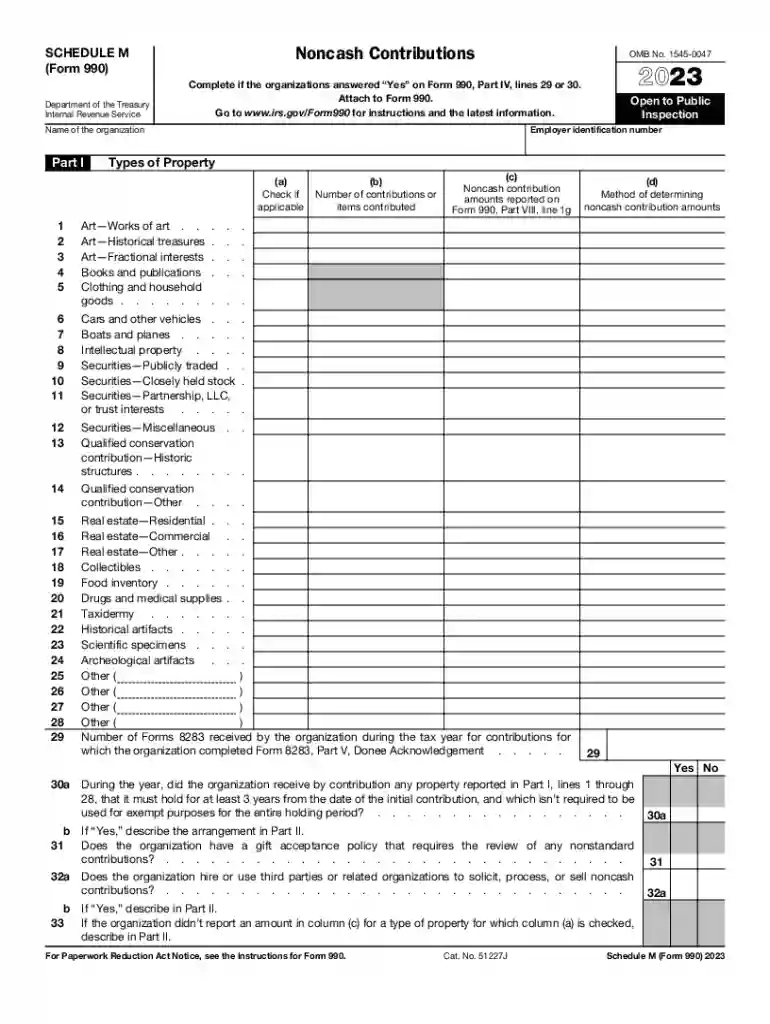
Schedule M (Form 990) Noncash Contributions is a form used by organizations to report noncash contributions valued over $25,000 received within a year. It is part of the IRS Form 990, which tax-exempt organizations file annually. The schedule requires detailed disclosure about the types and numbers of assets donated, including art, real estate, and securities, as well as the methods used to value these contributions. It ensures transparency and compliance with IRS regulations by providing a comprehensive record of significant noncash contributions.
Using the 2023 Schedule M involves a series of steps to accurately disclose noncash contributions:
Identify Noncash Contributions: Start by listing all noncash donations received during the fiscal year. This includes tangible items and other non-cash assets.
Valuation Methodologies: Document and describe the methods used to value each type of noncash contribution. This could involve fair market value assessments, appraisals, or industry standards.
Complete the Form: Enter each contribution's details into the form, including asset type and valuation. Ensure all entries are accurate to prevent issues during IRS review.
Attach to Form 990: Once completed, attach Schedule M to your primary Form 990 submission.
Completing the 2023 Schedule M requires attention to detail and comprehensive documentation:
Gather Documentation: Accumulate all records of noncash contributions including donor information, asset descriptions, and valuations.
Fill Out Sections: Detailed fields must be accurately completed. List types and numbers of assets received and the method of valuation used.
Review Requirements: Familiarize yourself with specific IRS instructions for the form to ensure accurate completion.
Attach to Main Filing: Attach the completed Schedule M to the Form 990 before filing it with the IRS either electronically or via mail.
The IRS provides specific guidelines for the 2023 Schedule M to ensure compliance:
Organization must adhere to filing deadlines to avoid penalties:
When preparing the Schedule M, the following documents are critical:
Practical examples help illustrate common scenarios:
Several key elements define how to complete the form effectively:
Failure to comply with requirements can result in penalties:
We've got more versions of the schedule m form. Select the right schedule m version from the list and start editing it straight away!
| Versions | Form popularity | Fillable & printable |
|---|---|---|
| 2025 | 4.8 Satisfied (28 Votes) | |
| 2024 | 4.1 Satisfied (41 Votes) | |
| 2023 | 4.9 Satisfied (21 Votes) | |
| 2022 | 4.1 Satisfied (55 Votes) | |
| 2021 | 4.8 Satisfied (37 Votes) | |
| 2020 | 4.3 Satisfied (49 Votes) | |
| 2019 | 4.4 Satisfied (221 Votes) | |
| 2018 | 4.3 Satisfied (183 Votes) | |
| 2017 | 4.3 Satisfied (131 Votes) | |
| 2016 | 4.3 Satisfied (138 Votes) |
At DocHub, your data security is our priority. We follow HIPAA, SOC2, GDPR, and other standards, so you can work on your documents with confidence.
is exempt from registration or licensing. SCHEDULE M (Form 990) Part I Types of Property Noncash Contributions 2023. Provide the information required by Part I
Report noncash donated items even if sold immediately after received. Dont report noncash contributions received by the organization in a prior year. DontRead more


