
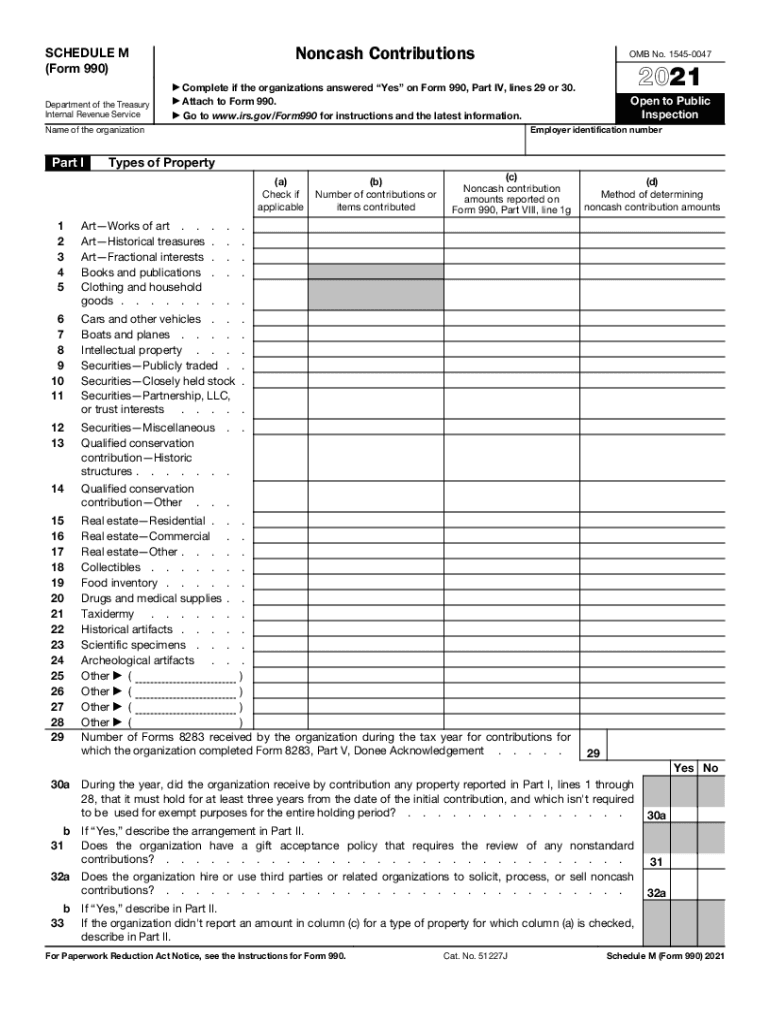







Definition & Meaning
The "M Form" refers to a specific reporting form used by organizations to disclose certain types of noncash contributions received during a fiscal year. This document is important for maintaining transparency in financial disclosures, particularly in contexts such as tax filings or organizational reporting. Its primary function is to provide detailed information about the types and values of noncash contributions, which could include assets like real estate, vehicles, artwork, or securities. Organizations that receive these kinds of donations must use the M Form to ensure clarity and compliance with regulatory requirements.
How to Obtain the M Form
To obtain the M Form, organizations can usually download it directly from official websites managed by relevant authorities, such as the IRS for tax-related forms. This ensures that the form is up-to-date and accurate according to the latest regulations. In some cases, accounting software or document workflow platforms like DocHub can provide access to these forms, allowing for integration with existing document management systems. Access through these platforms often facilitates the process of filling out, managing, and submitting the form electronically, offering a seamless experience for users who rely on digital document management.
Steps to Complete the M Form
-
Gather Required Information: Collect detailed information about the noncash contributions received, including types, quantities, and valuation methods used.
-
Fill in Donor Details: Enter information about the donors, including their names, addresses, and contact information, if required.
-
Specify Contribution Details: Clearly outline each noncash contribution's categories, such as real estate or valuable securities, and utilize standardized valuation methods.
-
Review IRS Guidelines: Ensure compliance with IRS guidelines on reporting noncash contributions to avoid common errors that might lead to audits or penalties.
-
Check for Completeness: Verify that all sections of the form are accurately filled out, and cross-reference with the required attachments or additional documents.
-
Submit the Form: Depending on the availability of submission methods, either file the form electronically through an authorized platform or mail the completed paper form to the designated address.
Key Elements of the M Form
-
Donation Types: Involves categorization of contributions into items such as art, vehicles, and intellectual property.
-
Valuation Methods: Details on how the value of each contribution was determined, using acceptable accounting principles or market valuations.
-
Recipient Details: Information on the recipient organization, including EIN (Employer Identification Number) and contact information.
-
Supporting Documents: Attach any documents that substantiate the reported contributions, such as appraisal reports or donor acknowledgements.
-
Certification and Signature: Required signatures from authorized personnel to validate the accuracy and honesty of the reported information.
IRS Guidelines
The IRS provides specific instructions on how to report noncash contributions using forms like the M Form. Key guidelines include the requirement to use fair market value in estimating contribution worth, maintaining documentation for these valuations, and adhering to particular filing deadlines to ensure compliance. The guidelines also provide definitions of what constitutes a noncash contribution and outline which taxpayer entities are obligated to file and report these contributions. Organizations are advised to review these guidelines annually, as updates may alter compliance requirements.
Required Documents
To accurately complete the M Form, organizations must gather various supporting documents:
-
Appraisal Documents: Required for tangible contributions such as real estate or vehicles.
-
Receipts from Donors: To confirm the transaction and establish the contribution's legitimacy.
-
Internal Records: Inventory logs or previous financial statements referencing the contributions.
-
Legal Documents: Any legal paperwork associated with the acquisition or transfer of donated assets, such as titles or deeds.
Form Submission Methods
-
Online Submission: Many prefer the convenience of submitting the M Form online through platforms that support digital filing, offering real-time validation and instant submission confirmation.
-
Mail-In Submission: Alternatively, organizations can opt to print and mail the form to a designated IRS address. This traditional method may still be preferred when online access is limited.
-
In-Person Submission: In certain circumstances, especially for organizations requiring physical confirmation, documents might be submitted in person at IRS offices or through legal representatives.
Penalties for Non-Compliance
Failing to accurately complete and submit the M Form can lead to significant penalties, including monetary fines or extended audits by the IRS. The severity of non-compliance penalties often depends on the material impact of the undisclosed contributions and any prior history of noncompliance by the organization. It is crucial for entities that deal extensively with noncash contributions to maintain diligent records and adhere strictly to filing requirements.
Software Compatibility with DocHub
DocHub is compatible with various commonly used software tools and platforms, such as Google Workspace, enabling users to easily integrate the M Form into their existing digital workflows. This flexibility is valuable for individuals or organizations relying on robust document management systems to ensure efficient data handling and compliance with regulatory requirements. Users can directly edit, save, and manage forms within a unified platform, minimizing manual errors and enhancing workflow efficiency.




