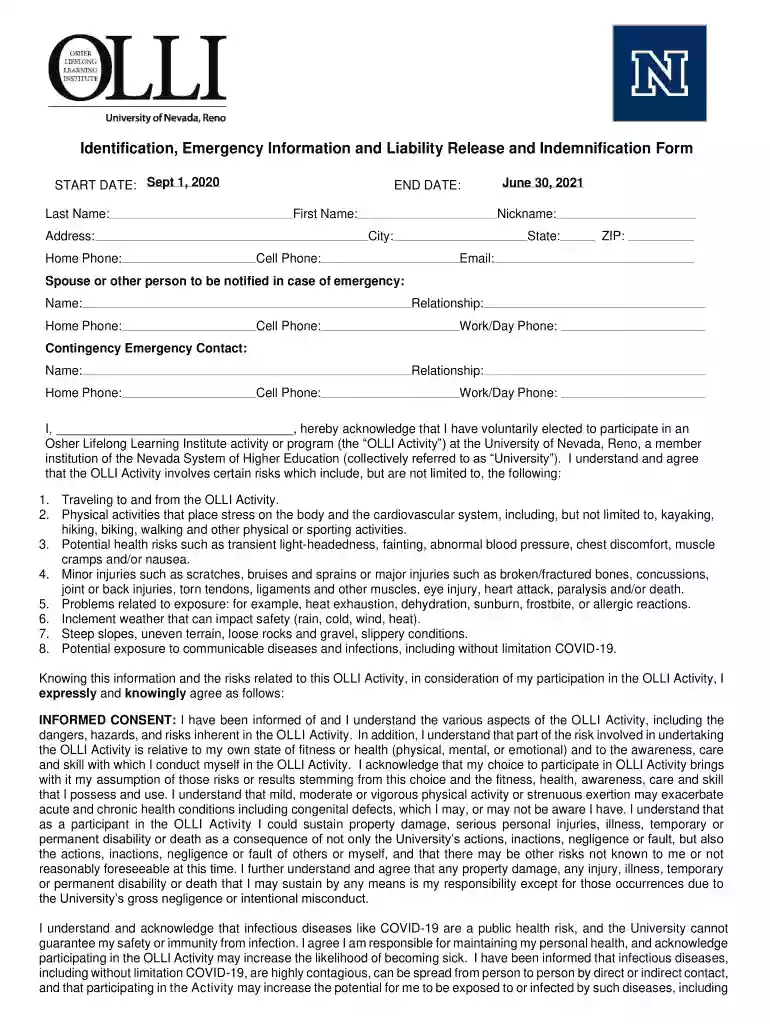
Identification, Emergency Information and Liability Release and Indemnification Form 2026

Get Form
Identification, Emergency Information and Liability Release and Indemnification Form Preview on Page 1

Here's how it works

01. Edit your form online
Type text, add images, blackout confidential details, add comments, highlights and more.

02. Sign it in a few clicks
Draw your signature, type it, upload its image, or use your mobile device as a signature pad.

03. Share your form with others
Send it via email, link, or fax. You can also download it, export it or print it out.

How to use or fill out Identification, Emergency Information and Liability Release and Indemnification Form

Form edit decoration
9.5
Ease of Setup
DocHub User Ratings on G2
9.0
Ease of Use
DocHub User Ratings on G2
  1. Click ‘Get Form’ to open it in the editor.
  2. Begin by filling in your personal identification details. Enter your last name, first name, nickname, address, home phone, cell phone, email, and other contact information accurately.
  3. Next, provide emergency contact information. Fill in the name, relationship, and phone numbers for both your primary emergency contact and a contingency contact.
  4. Read through the informed consent section carefully. Acknowledge your understanding of the risks associated with participating in the OLLI Activity by signing your name and dating the form.
  5. Review the release and waiver of liability section. Ensure you understand that you are waiving certain legal rights before finalizing your submission.

Start using our platform today to complete your form easily and for free!

See more Identification, Emergency Information and Liability Release and Indemnification Form versions

We've got more versions of the Identification, Emergency Information and Liability Release and Indemnification Form form. Select the right Identification, Emergency Information and Liability Release and Indemnification Form version from the list and start editing it straight away!
Versions Form popularity Fillable & printable
2022 4.1 Satisfied (31 Votes)
2022 4.8 Satisfied (116 Votes)
2022 4.1 Satisfied (60 Votes)
2022 4.8 Satisfied (112 Votes)
2022 4.5 Satisfied (52 Votes)
2021 4.5 Satisfied (41 Votes)
2021 4.9 Satisfied (26 Votes)
2021 4.8 Satisfied (66 Votes)
2021 4.9 Satisfied (40 Votes)
2021 4.8 Satisfied (179 Votes)
2020 4.4 Satisfied (24 Votes)
2020 4.7 Satisfied (56 Votes)
2020 4.8 Satisfied (127 Votes)
2020 4.7 Satisfied (43 Votes)
2020 4.2 Satisfied (44 Votes)
be ready to get more

Complete this form in 5 minutes or less

Get form

Got questions?

We have answers to the most popular questions from our customers. If you can't find an answer to your question, please contact us.
Contact us
A release and indemnity agreement, also called an indemnity agreement or a hold harmless agreement, is a legal contract that releases a party from specific liabilities. Essentially, one party in the contract agrees to pay for all potential losses or damages caused by the other party.
The release and indemnity clause typically absolves one party from liability and requires the other party to compensate for any losses, damages, or claims arising from the agreement.
This form of a Release Agreement, Indemnity Agreement and Hold Harmless Agreement releases a party from certain specified liabilities. Releases are used to transfer risk from one party to another and protect against the released party or reimburse the released party for damage, injury, or loss.
If you are looking to resolve a dispute, a Deed of Waiver, Release Indemnity enables you and the other party to mutually agree to release each other from any further actions or liabilities. This clear contractual stepping‑stone is essential in avoiding future legal complications.
It is primarily intended to protect the person who is providing goods or services from being held legally liable for the consequences of actions taken or not taken in providing that service to the person who signs the form.

Security and compliance

At DocHub, your data security is our priority. We follow HIPAA, SOC2, GDPR, and other standards, so you can work on your documents with confidence.

Learn more
ccpa2
pci-dss
gdpr-compliance
hipaa
soc-compliance

People also ask

Its very important that when anyone settles out of court with anybody over money, a claim, or a dispute, that the other party sign a general release of liability with a notarized document.
Not involving legal counsel: many people attempt to draft waivers without consulting a legal professional. This can result in documents that do not comply with legal standards or local laws. To prevent this, consider seeking legal advice to ensure that the waiver meets all necessary legal requirements.

Related links