Psychosocial evaluation 2026

Get Form
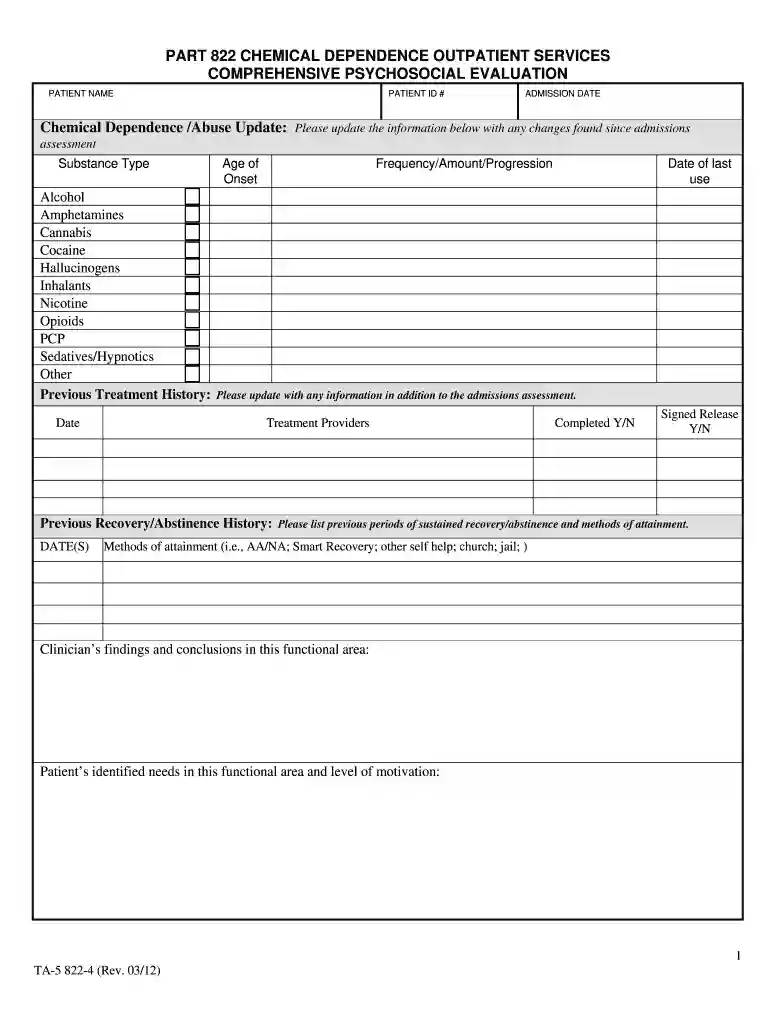
psychosocial evaluation Preview on Page 1

Here's how it works

01. Edit your psychosocial evaluation online
Type text, add images, blackout confidential details, add comments, highlights and more.

02. Sign it in a few clicks
Draw your signature, type it, upload its image, or use your mobile device as a signature pad.

03. Share your form with others
Send psychosocial evaluation online via email, link, or fax. You can also download it, export it or print it out.

How to use or fill out psychosocial evaluation with our platform

Form edit decoration
9.5
Ease of Setup
DocHub User Ratings on G2
9.0
Ease of Use
DocHub User Ratings on G2
  1. Click ‘Get Form’ to open the psychosocial evaluation in the editor.
  2. Begin by entering the patient’s name and ID number at the top of the form. This information is crucial for identifying the patient throughout their treatment.
  3. In the 'Chemical Dependence / Abuse Update' section, update any changes since admission. Fill in details such as substance type, age of onset, frequency, and date of last use.
  4. Proceed to 'Previous Treatment History' and document any past treatments, including dates and providers. Indicate whether a signed release is available.
  5. Continue through each section, including Physical Health, Mental Health History, and Vocational/Educational Assessment. Ensure all fields are filled accurately to reflect the patient's current status.
  6. Review your entries for completeness and accuracy before saving or sharing the document. Utilize our platform's features to sign or distribute as needed.

Start using our platform today for free to streamline your psychosocial evaluation process!

See more psychosocial evaluation versions

We've got more versions of the psychosocial evaluation form. Select the right psychosocial evaluation version from the list and start editing it straight away!
Versions Form popularity Fillable & printable
2012 4.9 Satisfied (468 Votes)
2011 3.9 Satisfied (35 Votes)
be ready to get more

Complete this form in 5 minutes or less

Get form

Got questions?

We have answers to the most popular questions from our customers. If you can't find an answer to your question, please contact us.
Contact us
The health professional, usually a psychologist, who administers the tests and conducts the interview may or may not be the treating therapist. Once a diagnosis is made, the testing clinician may refer the client to another specialist for treatment.
Psychological assessments may be written or given orally, or administered via a computer. They may involve a series of questions to determine how often you or a loved one experience certain symptoms, or you may be prompted to choose statements that best describe how you think, feel, and behave.
Examples of Psychosocial Hazards Work Organization. Management and supervisory practices that influence work processes, production, and performance. Shiftwork. Long Work Hours. Fatigue. Violence. Bullying. Incivility.
Such formal psychological testing may involve the administration of standardized interviews, questionnaires, surveys, and/or tests, selected with regard to the specific examinee and his or her circumstances, that offer information to respond to an assessment question.
About the Psychosocial Assessment Tool (PAT) Using a social ecological framework, PAT allows for identification of a familys areas of risk and resiliency across multiple domains (e.g., family structure and resources, family problems, social support, child problems, acute stress, sibling problems).

Security and compliance

At DocHub, your data security is our priority. We follow HIPAA, SOC2, GDPR, and other standards, so you can work on your documents with confidence.

Learn more
ccpa2
pci-dss
gdpr-compliance
hipaa
soc-compliance

People also ask

The FPE typically consists of four parts: clinical interview, psychological testing, medical history review, and collateral information gathering. The clinical interview is the primary way that information is gathered during the FPE.

Related links