




01. Edit your form online
Type text, add images, blackout confidential details, add comments, highlights and more.

Type text, add images, blackout confidential details, add comments, highlights and more.

Draw your signature, type it, upload its image, or use your mobile device as a signature pad.

Send it via email, link, or fax. You can also download it, export it or print it out.
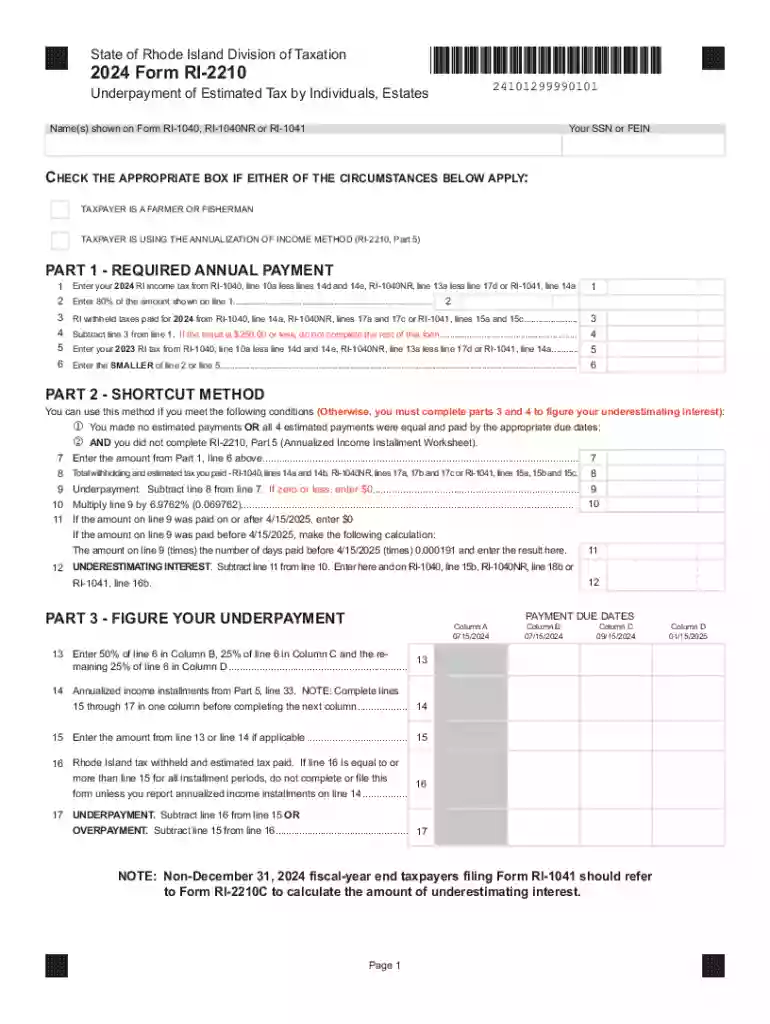
The RI-2210A, known as the "RI Underpayment of Estimated Tax by Individuals," is a specific tax form used by individuals in Rhode Island to report and rectify underpayment of their estimated taxes. This form helps taxpayers to calculate the interest owed if the estimated tax payments throughout the year are less than the total tax liability for the year. The document is crucial for avoiding penalties related to underpayment, ensuring taxpayers fulfill their obligations accurately and timely.
Individuals must employ the RI-2210A to check their estimated tax payments against what they owe for the year. Users should follow these steps:
Completing the RI-2210A involves understanding and performing specific calculations across several sections of the form:
Annual Payment Calculation:
Underpayment Determination:
Interest Calculation:
Submit the Resulting Total:
The primary users of the RI-2210A are Rhode Island residents who pay estimated taxes, which often includes:


Adhering to deadlines is vital to avoid penalties:
Before beginning the RI-2210A, ensure you have:
The RI-2210A is integral for complying with Rhode Island tax laws. Proper use of the form mitigates potential legal ramifications such as:
Tax software like TurboTax or QuickBooks can facilitate the completion of the RI-2210A by:
Failing to file the RI-2210A, or filing inaccurately, may result in:
Consider the following scenarios:
Self-Employed Professionals: A freelance consultant underpaid their estimated tax due to fluctuating income. They use the RI-2210A to calculate the shortfall and submit the owed amount.
Investors: A retiree with significant dividends failed to adjust estimated payments as investment income increased. The RI-2210A helps in assessing and paying the underestimated tax.
The form includes several critical areas:
Each section contributes to ensuring taxpayer compliance with Rhode Island's tax laws, preventing future financial and legal issues.
We've got more versions of the RI-2210A - RI Underpayment of Estimated Tax by Individuals form. Select the right RI-2210A - RI Underpayment of Estimated Tax by Individuals version from the list and start editing it straight away!
At DocHub, your data security is our priority. We follow HIPAA, SOC2, GDPR, and other standards, so you can work on your documents with confidence.


Jan 20, 2026 RI-2210 (2025) Underpayment of Estimated Tax by Individuals PDF file, RI-2210A (2025) Underpayment of Estimated Tax by Individuals - Shortcut
RI-2210A (2022). Underpayment of Estimated Tax by Individuals Shortcut Method. PDF file, less than 1mb. RI-2848. Power of Attorney. PDF file, less than 1mb. RI-Read more


