231 Pa Code Chapter 400 Service Of Original Process 2026

Get Form
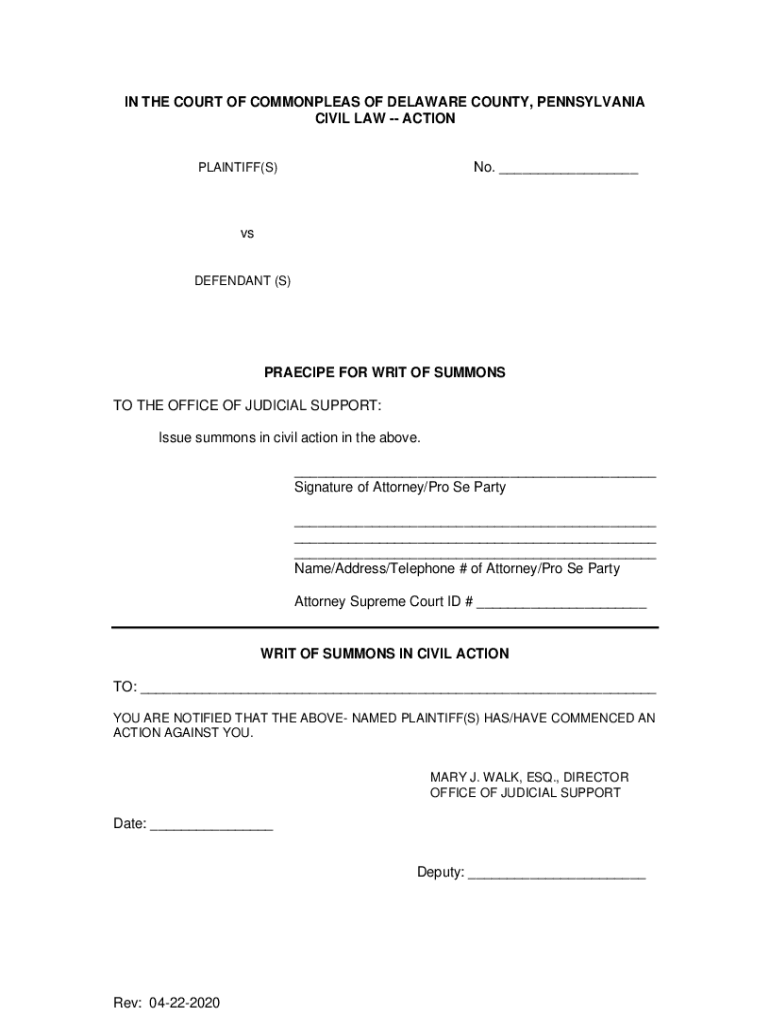
231 Pa Code Chapter 400 Service Of Original Process Preview on Page 1

Here's how it works

01. Edit your form online
Type text, add images, blackout confidential details, add comments, highlights and more.
02. Sign it in a few clicks
Draw your signature, type it, upload its image, or use your mobile device as a signature pad.
03. Share your form with others
Send it via email, link, or fax. You can also download it, export it or print it out.

How to use or fill out 231 Pa Code Chapter 400 Service Of Original Process with our platform

Form edit decoration
9.5
Ease of Setup
DocHub User Ratings on G2
9.0
Ease of Use
DocHub User Ratings on G2
  1. Click ‘Get Form’ to open the 231 Pa Code Chapter 400 Service Of Original Process in the editor.
  2. Begin by entering the case number in the designated field at the top of the form. This is crucial for identifying your specific civil action.
  3. Fill in the names of the plaintiff(s) and defendant(s) in their respective sections. Ensure accuracy to avoid any legal complications.
  4. In the 'Praecipe for Writ of Summons' section, provide your signature as either an attorney or pro se party. Include your name, address, and telephone number below your signature.
  5. Complete the 'Writ of Summons in Civil Action' section by filling in the notification details for the defendant, ensuring all information is clear and legible.
  6. Finally, enter the date and deputy information at the bottom of the form before saving or exporting your completed document.

Start using our platform today to streamline your document editing and ensure a smooth process!

See more 231 Pa Code Chapter 400 Service Of Original Process versions

We've got more versions of the 231 Pa Code Chapter 400 Service Of Original Process form. Select the right 231 Pa Code Chapter 400 Service Of Original Process version from the list and start editing it straight away!
Versions Form popularity Fillable & printable
2020 4.2 Satisfied (56 Votes)
2008 4.2 Satisfied (25 Votes)
be ready to get more

Complete this form in 5 minutes or less

Get form

Got questions?

We have answers to the most popular questions from our customers. If you can't find an answer to your question, please contact us.
Contact us
The common-enemy doctrine is a legal principle that allows landowners to manage surface water, such as during floods, without considering the impact on neighboring properties. This doctrine is primarily applied in urban areas and grants individual landowners the unrestricted right to dispose of water.
Rule 236 governs the notice to be given by the prothonotary of the entry of an order or judgment.
The parties may by agreement (1) provide that depositions may be taken before any person, at any time or place, upon any notice, and in any manner, and when so taken may be used like other depositions, and (2) modify the procedures provided by these rules for methods of discovery.
Service by Mail. If a rule of civil procedure authorizes original process to be served by mail, a copy of the process shall be mailed to the defendant by any form of mail requiring a receipt signed by the defendant or his authorized agent. Service is complete upon delivery of the mail.
Interrogatories which are to be served prior to service of the complaint shall be limited to the purpose of preparing a complaint and shall contain a brief statement of the nature of the cause of action.

Security and compliance

At DocHub, your data security is our priority. We follow HIPAA, SOC2, GDPR, and other standards, so you can work on your documents with confidence.

Learn more
ccpa2
pci-dss
gdpr-compliance
hipaa
soc-compliance

People also ask

231 - Second Action. (a) After a discontinuance or voluntary nonsuit the plaintiff may commence a second action upon the same cause of action upon payment of the costs of the former action. (b) After the entry of a compulsory nonsuit the plaintiff may not commence a second action upon the same cause of action.
Discontinuance. (a) A discontinuance shall be the exclusive method of voluntary termination of an action, in whole or in part, by the plaintiff before commencement of the trial.
(a) In actions pending in different counties which involve a common question of law or fact or which arise from the same transaction or occurrence, any party, with notice to all other parties, may file a motion requesting the court in which a complaint was first filed to order coordination of the actions.

Related links