




01. Edit your connecticut standby guardian form online
Type text, add images, blackout confidential details, add comments, highlights and more.

Type text, add images, blackout confidential details, add comments, highlights and more.

Draw your signature, type it, upload its image, or use your mobile device as a signature pad.

Send ct standby via email, link, or fax. You can also download it, export it or print it out.
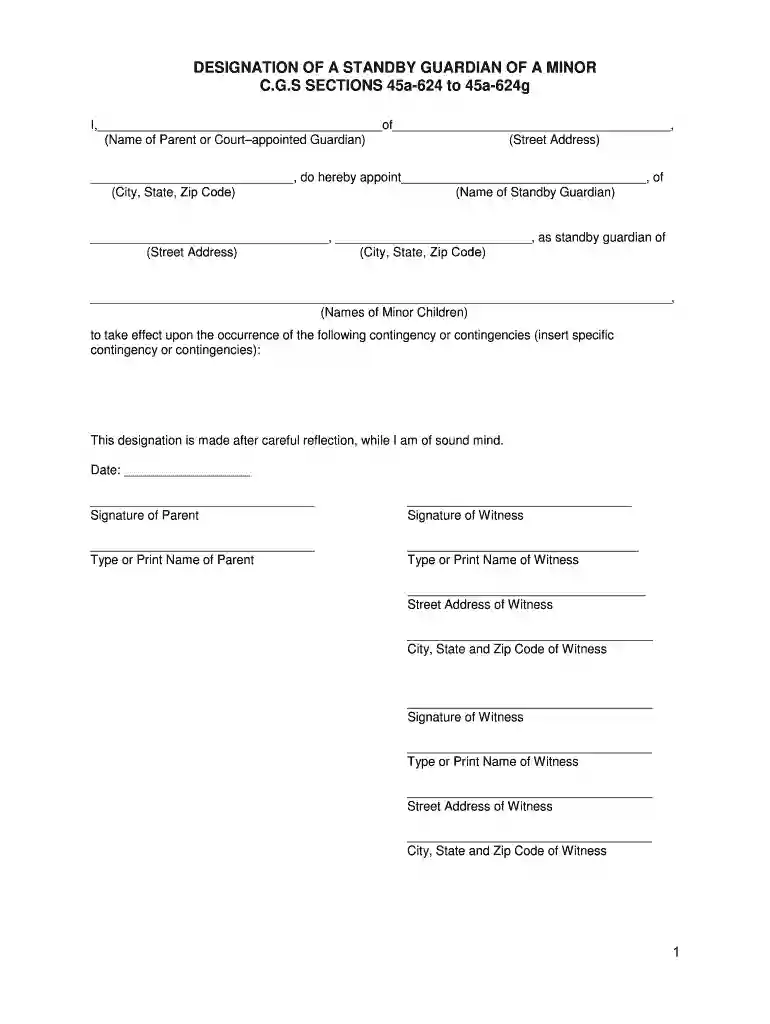
The standby guardian form is a legal document utilized to designate a standby guardian for a minor child. This form ensures that a trusted individual can assume guardianship under specific conditions, such as the incapacitation, illness, or death of the child's parents. The standby guardian form acts as a preventative measure, allowing parents or current guardians to secure a caregiver for their child without delay or legal complications in times of crisis.
Filling out the standby guardian form involves several critical steps to ensure its legality and effectiveness. Adhering to the specific procedural requirements is essential for the form to be enforceable.
Collecting Information: Gather necessary information about the child, parents, and the designated standby guardian, including full names, addresses, and contact details.
Clarifying Conditions for Activation: Clearly outline the conditions under which the standby guardian will assume duties (e.g., in cases of specific illnesses, incapacitation, or upon a parent’s death).
Obtaining Consent: Secure the consent of the designated standby guardian, ideally documented within the form to avoid any future disputes.
Completing the standby guardian form requires attentiveness to ensure all legal requirements are met. Follow these steps to properly fill out the form:
Fill in Personal Details: Begin by entering the child's information followed by details of both parents and the prospective standby guardian.
Detail the Conditions and Powers: Specify the scenarios triggering the standby guardianship and outline the scope of the guardian’s powers over the child. These should align with state laws to ensure enforceability.
Parental Signatures: Acquire signatures from both parents. This is often a mandatory requirement to validate the designation.
Notarization: Many states require the form to be notarized to confirm its authenticity. Arrange for a notary public to witness the signing.
File Copies: Keep several copies of the completed form. Share these with involved parties such as the standby guardian, any relevant legal representatives, and store one in a secure location.
Understanding the terminology associated with standby guardianship is crucial for completing the form accurately and effectively.
The standby guardian form carries legal implications that ensure child custody transitions smoothly and with minimal legal hurdles.
When using the standby guardian form, several critical components must be included to ensure it meets legal standards:
While standby guardian forms have common elements, state-specific rules may vary. Some states may have additional requirements or different protocols regarding the execution or activation of the guardian’s duties:
These variations underscore the importance of consulting a legal expert familiar with local laws to navigate the process smoothly.
Standby guardian forms may differ slightly based on state regulations, reflecting variations in legal stipulations and activation procedures. It is crucial to understand these differences to ensure the form’s enforceability in each jurisdiction.
Seeking guidance from a legal professional with expertise in your state's guardianship statutes will help in preparing a legally robust standby guardian form.
We've got more versions of the connecticut standby guardian form form. Select the right connecticut standby guardian form version from the list and start editing it straight away!
At DocHub, your data security is our priority. We follow HIPAA, SOC2, GDPR, and other standards, so you can work on your documents with confidence.
Appointment by written designation; form. (a) A designator may designate a standby guardian by means of a written designation, signed by the designator in theRead more
1. A parent may use this form to designate a standby guardian of his or her child upon the occurrence of a specified contingency (for example, theRead more


