Instruction entrapment 2026

Get Form
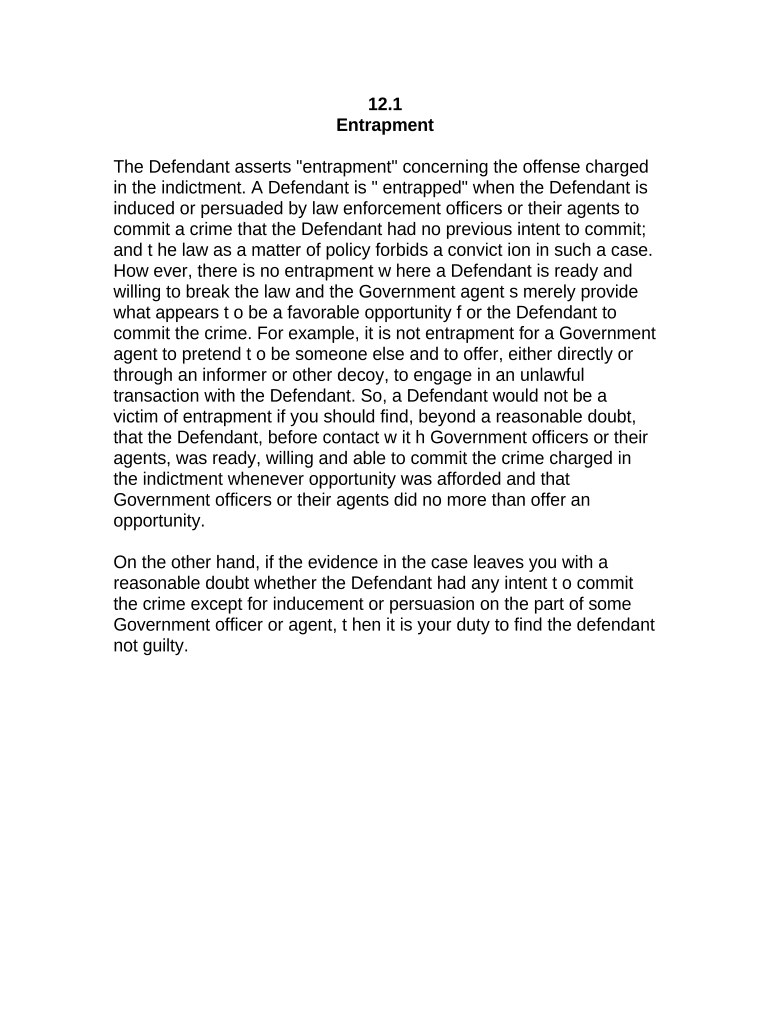
instruction entrapment Preview on Page 1

Here's how it works

01. Edit your form online
Type text, add images, blackout confidential details, add comments, highlights and more.
02. Sign it in a few clicks
Draw your signature, type it, upload its image, or use your mobile device as a signature pad.
03. Share your form with others
Send it via email, link, or fax. You can also download it, export it or print it out.

How to use or fill out instruction entrapment with our platform

Form edit decoration
9.5
Ease of Setup
DocHub User Ratings on G2
9.0
Ease of Use
DocHub User Ratings on G2
  1. Click ‘Get Form’ to open it in the editor.
  2. Begin by reviewing the definition of entrapment provided in the document. This section outlines what constitutes entrapment and sets the foundation for understanding the subsequent fields.
  3. Next, focus on the section that describes the criteria for determining whether a defendant was entrapped. Fill in any relevant details regarding the defendant's intent and actions prior to contact with law enforcement.
  4. Proceed to complete any fields related to examples of entrapment scenarios. This may involve selecting options or providing specific instances that illustrate your understanding of the concept.
  5. Finally, review your entries for accuracy and completeness before submitting. Ensure that all necessary information is included to support your case effectively.

Start using our platform today for free to streamline your document editing and form completion!

be ready to get more

Complete this form in 5 minutes or less

Get form

Got questions?

We have answers to the most popular questions from our customers. If you can't find an answer to your question, please contact us.
Contact us
What are different types of entrapment? Persuasive entrapment. Persuasive entrapment means using convincing arguments to make someone commit a crime. Coercive entrapment. Coercive entrapment uses threats, intimidation or blackmail to make someone commit a crime. Deceptive entrapment. Exploitative entrapment.
Entrapment is a legal defense that can be used when law enforcement officers persuade or induce a person to commit a crime they otherwise would not have committed. While police are allowed to conduct sting operations, they are not allowed to coerce or pressure someone into committing an offense.
Nerve impingement is commonly called a pinched nerve. The two types of impingement are entrapment and compression. Entrapment results when soft tissue (e.g., muscles and ligaments) exerts inappropriate pressure on nerves; compression occurs when hard tissue (e.g., bone) exerts inappropriate pressure on nerves. Compression Injury of Nerve - an overview | ScienceDirect Topics ScienceDirect.com medicine-and-dentistry ScienceDirect.com medicine-and-dentistry
Entrapment may involve any form of crime, from drug offenses to theft to financial crimes: Example 1: A young man is tried on drug charges after being induced to sell to an undercover narcotics officer who threatens to have the boy jumped by his gang if the defendant does not supply the drugs.
In US law, it is defined as the conception and planning of an offense by an officer or agent, and the procurement of its commission by one who would not have perpetrated it except for the trickery, persuasion or fraud of the officer or state agent.
be ready to get more

Complete this form in 5 minutes or less

Get form

People also ask

Entrapment focuses on the actions of law enforcement and whether they created the criminal intent. Instigation involves encouraging or provoking someone to commit a crime, regardless of whether the instigator is a government agent or not.
Examples include: Drug offenses: Undercover officers sometimes pose as drug buyers or sellers. Theft and property crimes: Entrapment may apply when pressure has been asserted on someone to steal an item. Bribery: Entrapment often occurs in the form of bribery. Common examples of entrapment | Law Offices of Thomas C. Mooney Law Offices of Thomas C. Mooney blog 2025/02 commo Law Offices of Thomas C. Mooney blog 2025/02 commo
Entrapment is a practice in which a law enforcement agent or an agent of the state induces a person to commit a crime that the person would have otherwise been unlikely or unwilling to commit. Entrapment - Wikipedia Wikipedia wiki Entrapment Wikipedia wiki Entrapment

Related links