




01. Edit your 911 form online
Type text, add images, blackout confidential details, add comments, highlights and more.

Type text, add images, blackout confidential details, add comments, highlights and more.

Draw your signature, type it, upload its image, or use your mobile device as a signature pad.

Send form 911 via email, link, or fax. You can also download it, export it or print it out.
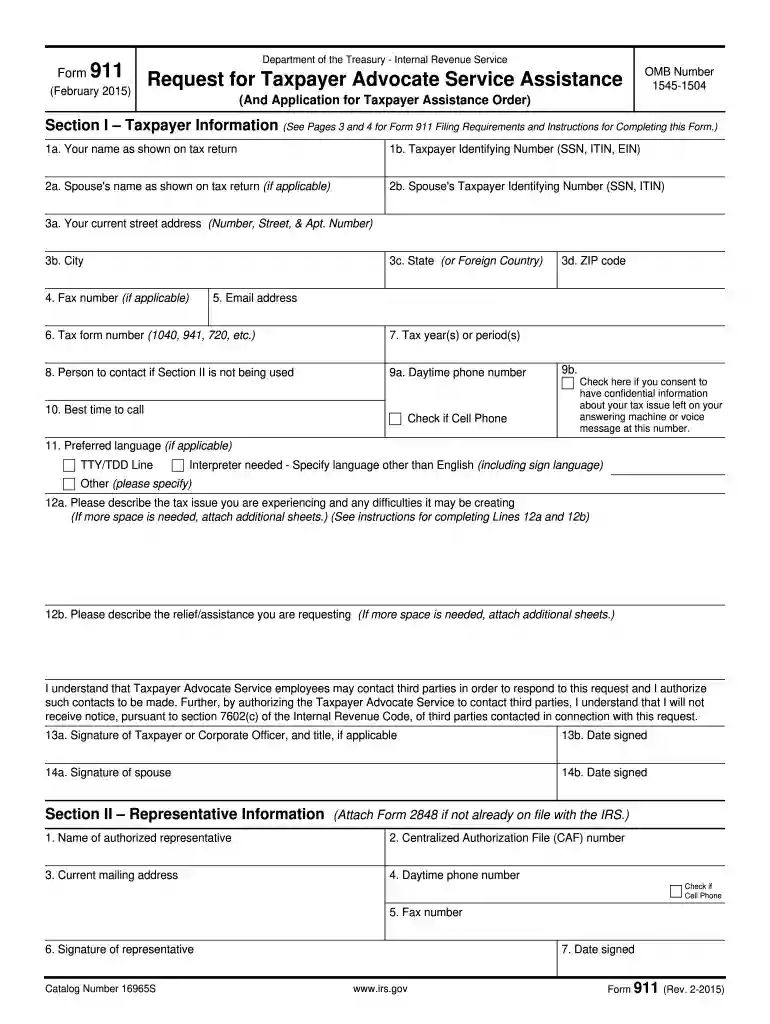
Form 911, also known as the Request for Taxpayer Advocate Service Assistance, serves as a lifeline for taxpayers experiencing significant issues with the IRS. This form is especially pertinent for individuals whose tax problems cause financial hardship or imminent threats of adverse action. By filing Form 911, taxpayers formally request support from the Taxpayer Advocate Service (TAS), an independent organization within the IRS designed to ensure fair treatment. The form captures crucial information about the taxpayer's identity, the nature of the tax issue, and the relief sought.
Utilizing Form 911 from 2015 through 2019 requires a clear understanding of its purpose as a problem-resolution tool. Taxpayers should ensure they accurately detail their IRS-related challenges, explicitly stat any adverse actions threatening their finances or well-being. This submission involves specifying the tax years affected by the issue and any prior attempts to resolve the matter with the IRS. It's essential to maintain a factual, concise presentation of the circumstances, allowing TAS representatives to assess the situation effectively and provide optimal support.
It's crucial to double-check all inputted data to avoid delays in processing.
Form 911 is designed for taxpayers encountering significant financial or procedural distress. Eligibility aligns with TAS criteria, where cases involve:
Employees, self-employed individuals, retirees, and students facing systemic challenges with the IRS are among those who should consider using the form.


Understanding key terms involved in Form 911 can aid in its precise completion and use:
These terms build needed context for engaging with TAS processes effectively.
Examples of situations warranting Form 911 utilization include:
Each case showcases how systemic IRS issues might disproportionately affect certain taxpayer groups.

Strict adherence to IRS guidelines for Form 911 is crucial for efficient processing. These guidelines require:
Ensuring full compliance increases a taxpayer's chance of receiving timely and effective TAS help.
Once completed, you can submit Form 911 through multiple channels:
Each method offers its advantages, with online submissions typically offering the fastest engagement with TAS.
Failure to engage with IRS issues through appropriate channels like Form 911 may result in increasing adverse measures:
Proactively using Form 911 mitigates such risks by formalizing taxpayer requests for help.
Various businesses, including LLCs, corporations, and partnerships, often find Form 911 beneficial, particularly in cases of:
Navigating these challenges through TAS assistance can safeguard business continuity.
Tax preparation software, such as TurboTax or QuickBooks, typically does not facilitate direct filling of Form 911. However, using these tools to maintain organized financial records simplifies IRS form completion processes. Comprehensive record-keeping supports TAS representatives' evaluations, contributing to an effective advocacy process.
State variations can affect the interpretation and application of tax-related processes, which may influence Form 911 engagements. Some states may impose additional considerations or have distinct procedures for interacting with federal IRS guidelines. Understanding state-specific nuances ensures realistic expectations during TAS involvement.
Occasionally, alternative measures or documents might parallel the objectives of Form 911. For example, directly contacting the relevant IRS office or using other advocacy channels might provide supplementary aid. Nonetheless, Form 911 remains the primary structured resource for delineating formal assistance requests.
We've got more versions of the 911 form form. Select the right 911 form version from the list and start editing it straight away!
At DocHub, your data security is our priority. We follow HIPAA, SOC2, GDPR, and other standards, so you can work on your documents with confidence.


Nov 9, 2020 2015-2019. Violation. E-Citation. Judiciary of Guam-. Traffic Court Division. 2015-2019. Seat Belt Use. Observation Data. DPW-Office of. HighwayRead more
Form A. 3. Page 4. 2015-2019 CAPITAL IMPROVEMENT PLAN ($ Thousands). CITY OF HOUSTON - STORM DRAINAGE SYSTEM. Project No. M-000247. Project: NottinghamRead more
Emergency Department; Dial 911 in the event of a medical emergency. Explore Health Care. Learn how we are healing patients through science compassion. Back.Read more


