
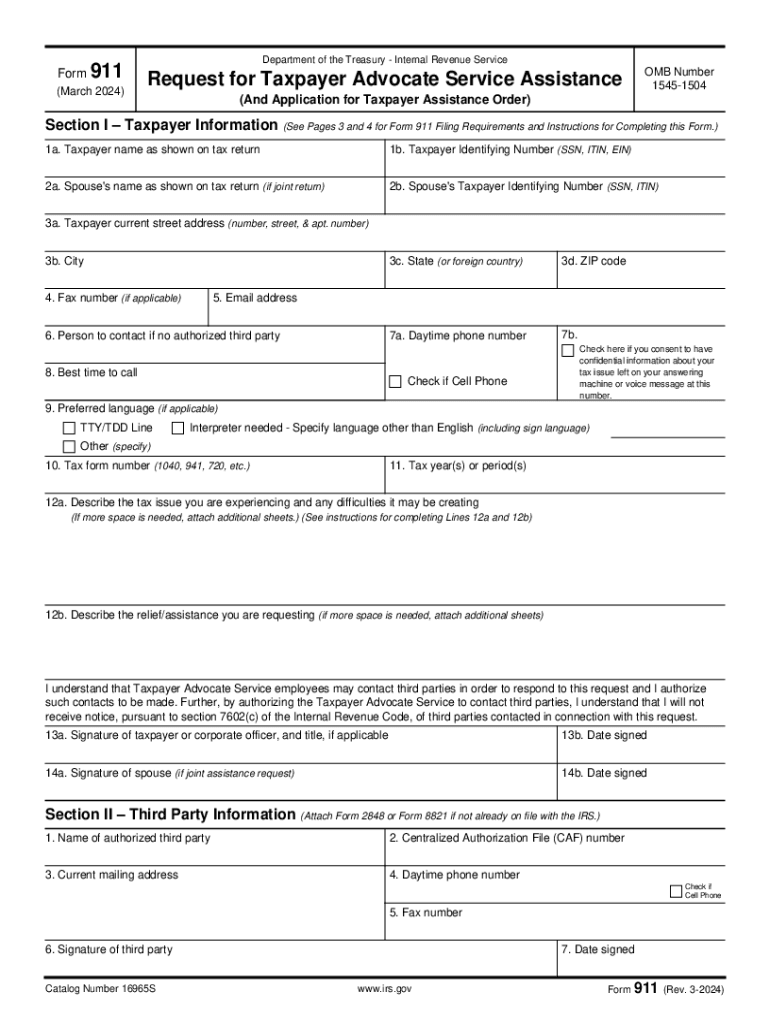







Definition and Purpose of Form 911 - Request for Taxpayer Advocate Service
Form 911, officially known as "Request for Taxpayer Advocate Service Assistance," is a document utilized by taxpayers facing unresolved issues with the Internal Revenue Service (IRS). The Taxpayer Advocate Service (TAS), an independent organization within the IRS, uses this form to provide personalized assistance to taxpayers encountering hardships or significant delays in resolving their tax disputes. The primary aim is to ensure taxpayer rights are protected and to offer additional support when standard IRS channels fail.
Importance and Role of the Taxpayer Advocate Service
- Independent Assistance: TAS operates independently within the IRS, ensuring that taxpayer concerns are handled without bias in favor of IRS positions.
- Protection of Taxpayer Rights: The organization focuses on safeguarding taxpayer rights, providing free help, and preventing financial distress caused by unresolved tax issues.
How to Use Form 911 - Request for Taxpayer Advocate Service
When navigating tax complexities with the IRS, it's essential to correctly fill out Form 911 to seek TAS assistance. This form requires detailed information about your tax issue, previous interactions with the IRS, and the specific resolution you are seeking.
Step-by-Step Completion Guide
- Taxpayer Information: Provide personal details including name, address, and Social Security number (SSN) or taxpayer identification number (TIN).
- Description of the Issue: Elaborate on the tax problem, including attempts to resolve it through standard IRS channels and the impact on your financial situation.
- Assistance Requested: Clearly state the type of assistance required from TAS and any specific outcome you are hoping to achieve.
Common Use Cases
- Delay in Refunds: Taxpayers experiencing delays in receiving their tax refunds can use Form 911 to expedite the process.
- Complex Disputes: Cases involving multifaceted tax disputes where typical resolution paths have been exhausted also benefit from TAS intervention.
Eligibility Criteria for Utilizing Form 911
Not all tax issues warrant the use of Form 911. Specific eligibility criteria set by the IRS determine who can request TAS assistance through this form.


Who Can Use the Form
- Financial Hardship Cases: Individuals or businesses facing severe financial distress due to unresolved tax issues are eligible.
- Adverse IRS Actions: Taxpayers subjected to detrimental IRS actions despite efforts to comply with tax obligations can apply using Form 911.
IRS Determination of Eligibility
- The IRS evaluates cases based on criteria such as the potential for a significant negative impact on the taxpayer financially or life events that prevent normal tax issue resolution.
Key Elements of Form 911 - Request for Taxpayer Advocate Service
Successfully navigating Form 911 requires an understanding of its core components. The form assists in gathering all necessary information for TAS representatives to assess and address the taxpayer's situation effectively.
Mandatory Components
- Taxpayer Identification: Accurate inclusion of identifying information such as SSN or TIN is critical for processing the request.
- Detailed Issue Description: A comprehensive explanation of the tax problem and its ramifications enhances the likelihood of receiving timely and effective assistance.
How to Obtain the Form 911 - Request for Taxpayer Advocate Service
Acquiring Form 911 is a straightforward process facilitated through multiple channels, ensuring ease of access for all taxpayers needing TAS assistance.
Available Acquisition Methods
- IRS Website: The form is downloadable from the IRS's official website.
- Local IRS Offices: Printed forms can be obtained from physical IRS locations or TAS offices.
- Tax Professional Services: Some tax professionals provide Form 911 as part of their advisory services for dealing with IRS issues.
State-Specific Rules for Form 911 Usage
While the IRS provides general guidelines for Form 911, taxpayers should be aware of state-specific rules that might influence its use and processing.
Unique Considerations by State
- Variations in State Tax Policies: Certain state tax policies may impact how TAS assistance is rendered or the kinds of issues eligible under Form 911.
- Differential State Support: Some states offer additional support channels that complement the services provided by TAS.
IRS Guidelines for Completing and Submitting Form 911
The IRS provides detailed instructions on effectively using Form 911 to maximize the assistance from TAS. Adhering to these guidelines ensures a smoother resolution process.
Submission Guidelines
- Completeness: Ensure all sections of the form are thoroughly completed before submission. Missing information could delay processing.
- Document Attachments: Attach necessary documentation supporting your case, such as previous IRS correspondence or financial records demonstrating hardship.
Filing Deadlines and Important Dates for Form 911
Understanding the filing deadlines for Form 911 is crucial for timely intervention in tax matters that remain unresolved.
Key Dates to Consider
- Situational Urgency: While no strict deadline exists, submitting promptly as soon as difficulties arise maximizes the potential for prompt assistance.
- Tax Year Considerations: Allowances for processing times need to be made based on current tax year timelines and ongoing IRS activities.
By understanding and effectively utilizing Form 911, taxpayers can resolve outstanding issues more rapidly, receiving the support needed from the Taxpayer Advocate Service to navigate challenging IRS interactions.




