




01. Edit your 911 form online
Type text, add images, blackout confidential details, add comments, highlights and more.

Type text, add images, blackout confidential details, add comments, highlights and more.

Draw your signature, type it, upload its image, or use your mobile device as a signature pad.

Send 911 form irs via email, link, or fax. You can also download it, export it or print it out.
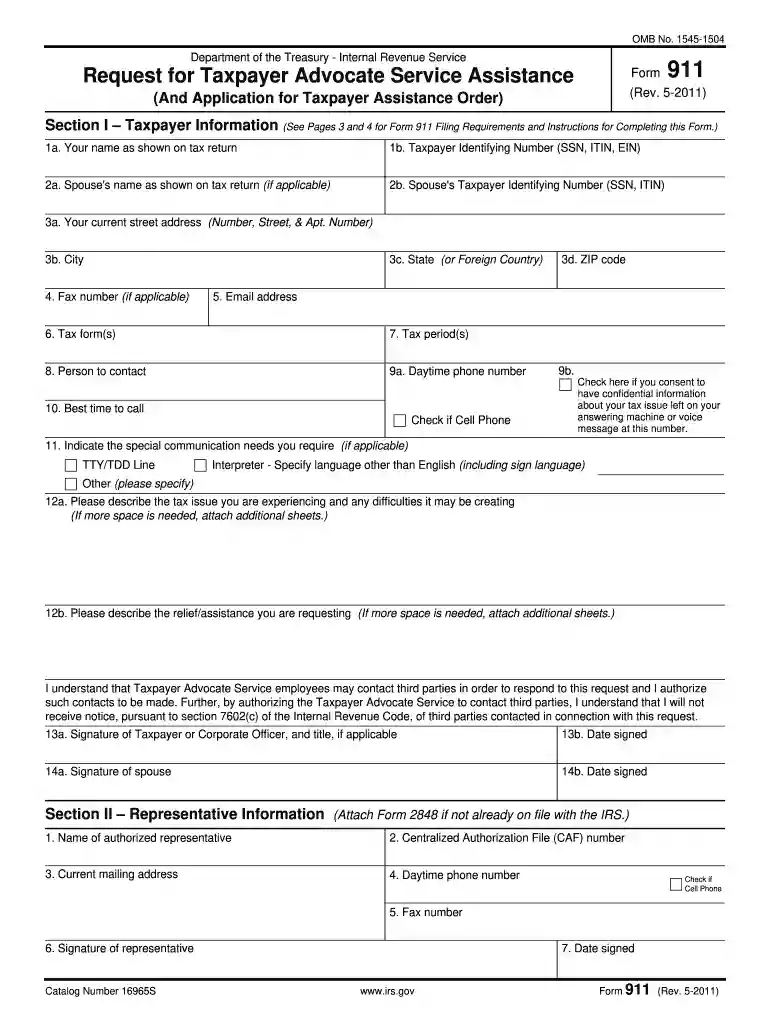
IRS Form 911, also known as the Request for Taxpayer Advocate Service Assistance, is designed to help taxpayers address issues they are facing with the Internal Revenue Service (IRS). This form is intended for individuals who are experiencing financial difficulties or who are subject to potential adverse actions by the IRS. The document serves as a means for taxpayers to request relief and advocacy from the Taxpayer Advocate Service (TAS). By providing your taxpayer information and details of the specific tax issue, you can seek assistance in situations where previous attempts to resolve the matter directly with the IRS have failed.
Filling out IRS Form 911 accurately is crucial to ensure you receive the help you need. The process involves several key steps:
Gather Necessary Information: Before beginning, collect all pertinent information, such as your personal details, taxpayer identification number, and relevant IRS notice numbers.
Complete Taxpayer Information Section: Enter your name, address, contact details, and taxpayer identification number. This information is critical for the TAS to identify your case.
Describe the Tax Issue: Clearly outline the specific issue you are facing with the IRS, including any notices received or actions being contested. Be concise but comprehensive in your description.
Financial Hardship Explanation: If applicable, explain any financial hardship caused by the tax issue. This section should reflect how the problem affects your ability to meet necessary living expenses.
Request for Specific Relief: Indicate the type of assistance or relief you are seeking from the TAS. Be as specific as possible to streamline the assistance process.
Review and Sign: Double-check all entered information for accuracy, then sign and date the form to validate your request.
There are multiple ways to access IRS Form 911, ensuring convenient availability for taxpayers:
Official IRS Website: The form can be downloaded as a fillable PDF directly from the IRS website. This version allows for electronic completion and submission.
Local IRS Offices: Physical copies can be obtained at IRS Taxpayer Assistance Centers. Visiting these centers can also provide an opportunity for in-person guidance.
Tax Professionals or Advisors: Consulting with tax professionals can provide access to the form and advice on filling it out accurately.
Utilizing Form 911 is beneficial in multiple scenarios, primarily revolving around unresolved tax disputes with the IRS. It provides several advantages:
Access to Specialized Assistance: By engaging the TAS, you gain access to advocates dedicated to resolving complex tax issues that may not be managed effectively through standard IRS procedures.
Expedited Resolution: TAS intervention can expedite the processing of your case, particularly when time-sensitive issues arise, such as liens or property seizures.
Stress Reduction: Engaging the TAS can alleviate stress associated with handling tax issues independently, providing you a structured pathway for resolution.
Not everyone qualifies for assistance through IRS Form 911. Specific criteria determine eligibility:
Ineffectual Previous IRS Contacts: You must demonstrate past unsuccessful attempts to resolve the issue directly with the IRS.
Immediate Economic Harm: Presence of considerable financial difficulties that warrant urgent intervention by an advocate.
Fair and Equitable Treatment Concerns: Evidence that you have not been treated fairly or equitably by the IRS is an important eligibility factor.


Understanding the main sections of IRS Form 911 can enhance clarity and accuracy when completing it:
Taxpayer Information: Captures essential personal and contact details necessary for case identification.
Issue Description: Provides a detailed narrative of the tax problem, including any documentation or notices received from the IRS.
Hardship Details: Specifies financial difficulties exacerbated by the IRS issue, aiding in prioritizing your case.
Relief Requested: Clearly outlines the type of assistance or resolution you are seeking, allowing the TAS to tailor their approach accordingly.
IRS Form 911 plays a crucial role legally by serving as an official request for taxpayer advocate assistance:
Compliance with Legal Protocols: Submitting the form ensures adherence to IRS procedures for taxpayer disputes.
Documentation of Escalation: Provides a formal record of your efforts to engage IRS structures and seek advocate intervention.
Safeguard against Adverse Actions: Filing Form 911 can pause detrimental IRS actions, such as wage garnishments, while your case is being assessed.
For maximum convenience, IRS Form 911 offers multiple submission avenues:
Online Submission: Digital forms can be emailed or submitted via secure IRS portals.
Mail: Forms filled out on paper may be mailed to designated IRS Taxpayer Advocate offices.
In-Person Submission: Personal delivery to local TAS offices may afford immediate attention, especially for urgent cases.
We've got more versions of the 911 form form. Select the right 911 form version from the list and start editing it straight away!
At DocHub, your data security is our priority. We follow HIPAA, SOC2, GDPR, and other standards, so you can work on your documents with confidence.


The Form 911 is a request for taxpayer assistance for taxpayers who have been unable to resolve their tax issues through normal channels and are facing undueRead more
Jan 26, 2026 HONORABLE MEMBERS OF CONGRESS: It is my privilege to submit for your consideration the National Taxpayer Advocates 2025 Annual Report to.Read more


