






Definition and Purpose of the 2012 Form Injured Spouse
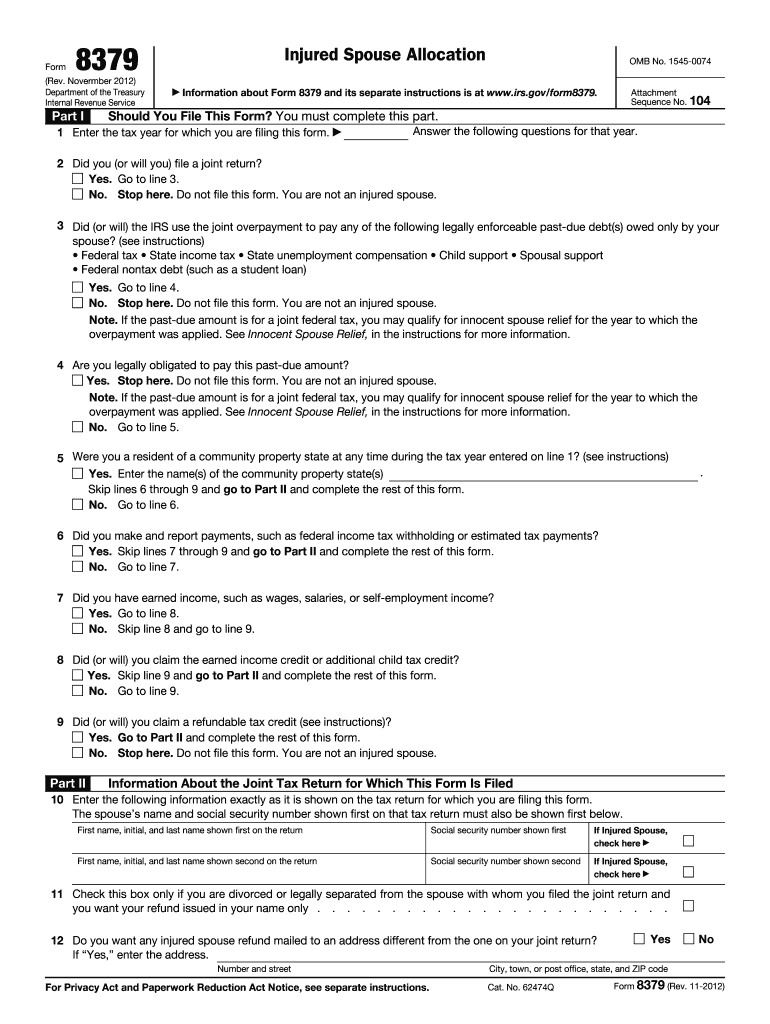
The 2012 Form Injured Spouse, formally known as IRS Form 8379, is a tax document used by one spouse to reclaim their portion of a tax refund when the refund is partially or fully applied to a past-due obligation of the other spouse. It primarily serves individuals who wish to protect their share of a tax refund from being used to cover a spouse’s separate debts, including but not limited to, child support, federal student loans, or state income tax. This form allows for the fair allocation of tax refunds to the spouse not responsible for the debt, ensuring they receive their rightful share.
Examples of Use Cases
- A husband and wife file a joint tax return, but the husband's unpaid child support leads to a refund seizure.
- A joint return is filed during a year when one spouse had defaulted on student loans, prompting the IRS to divert the refund.
- A spouse experiencing garnishment on their wages may use this form to preserve their portion of a tax refund.
How to Use the 2012 Form Injured Spouse
Completing the 2012 Form Injured Spouse involves several steps to ensure accuracy and eligibility. Begin by assessing the refund’s allocation—determine which portion belongs to the filer claiming injured spouse relief. The injured spouse may only claim their own share of the tax refund.
Step-by-Step Process
- File your Joint Tax Return: Submit your federal income tax return jointly. The form is most often submitted alongside the return.
- Complete Form 8379: Use the form to indicate your marital status, provide personal information, and specify the reasons for claiming injured spouse.
- Allocate Income and Deductions: List both spouses' incomes and deductions separately on the form.
- Detail Refund Allocation: Clearly state how the refund should be divided according to each spouse's tax contributions.
- Attach Necessary Documentation: Include copies of W-2s, the joint return, and any supporting debt statements if needed.
- Submit to the IRS: Send the completed Form 8379 to the IRS either electronically or through mail.
Additional Tips
- Attach Form 8379 to your joint return to speed up processing.
- If the return has already been filed, you may submit Form 8379 separately, but it might take about 14 weeks to process.
Obtaining the 2012 Form Injured Spouse
Where to Find
- IRS Website: The form can be downloaded directly from the IRS official site.
- Tax Software Platforms: Software like TurboTax and H&R Block often include the capability to generate and file Form 8379.
- Physical Copies: Available at local IRS offices, libraries, or post offices.
Online vs. Mail
- Online Submission: This method is faster and preferred for those who are comfortable with electronic transactions.
- Mail Submission: Suitable for individuals who prefer a tangible record or do not require immediate processing.
Eligibility Criteria for the 2012 Form Injured Spouse
Filing Form 8379 is contingent on specific eligibility criteria to determine if relief is warranted under the injured spouse rules.


Requirements
- Joint Filing: The couple must have filed a joint tax return.
- Non-Responsible for Debt: The injured spouse must not be responsible for the debt causing the refund offset.
- Income Contribution: The injured spouse must have generated income reported on the joint return.
Considerations
- Verify that the debt is indeed separate. Joint debts do not typically qualify unless allocations detail specific cases.
- The injured spouse must be able to prove they were unaware of or disproving of the debt liability.
Important Terms Related to the 2012 Form Injured Spouse
Understanding key terminologies is vital for effective utilization of the form.
- Offset: A term used when the IRS diverts a tax refund to pay off outstanding debt.
- Joint Liability: A situation in which both spouses are responsible for a debt, affecting the ability to file as an injured spouse unless detailed allocation is provided.
- Separate Liability: Relates to debts attributable solely to one spouse allowing the other to claim their share of tax refunds.
Usage in Common Scenarios
- A refund may be offset in cases of outstanding federal tax liabilities or non-tax federal debts.
- Student loans in default and overdue child support are frequent cases leading to refund offsets.
Steps to Complete the 2012 Form Injured Spouse
Proper completion of the 2012 Form Injured Spouse requires detailed attention to both individual and joint financial situations.
Necessary Steps
- Gather Financial Indication: Ensure all financial documents, such as earnings statements and tax documents, are current and accurate.
- Fill Out Personal Information: Accurately input the involved parties' personal and contact information on the form.
- Income and Tax Allocation: Break down individual incomes, deductions, and credits per spouse.
- Justify the Claim: Provide adequate reason and documentation for filing as an injured spouse.
Document Essentials
- Copies of paychecks and income sources
- Previous year’s tax returns for adjustment references
- Proof of separate ownership of debt by documentation from creditors or financial institutions
Filing Deadlines and Important Dates for the 2012 Form Injured Spouse
Understanding timelines and submission dates is crucial to avoiding delays.
Key Deadlines
- Regular Tax Filing Deadline: Typically the 15th of April annually.
- Extended Deadline: October 15 for those who obtained filing extensions, but remember, interest might accrue on any debt honored through refunds during this period.
Submission Timing
- Timely delivery ensures quicker processing and resolution, mitigating delays due to refund offsets.
- Filing with the initial tax return is advisable for prompt processing.
IRS Guidelines for the 2012 Form Injured Spouse
The IRS provides specific directives to govern how Form 8379 should be handled and processed.
Key IRS Directives
- Follow IRS Publication 971 for comprehensive guidance on injured spouse allocations.
- Maintain a copy of all documentation submitted, including proof of submission especially if sending via mail.
Correspondence
- Utilize IRS channels such as hotlines or local offices for form status inquiries or submission support to ensure compliance with all directives.
Legal Implications and Compliance
Legal Considerations
- Filing inaccurately can result in delays or denial of claims, occasional penalties, or audits.
- Consult IRS officials or tax professionals for cases involving convoluted financial situations or previous disputes over similar claims.
Legal compliance ensures that procedural loopholes are addressed, and injured party interests are properly advocated during tax disputes.