
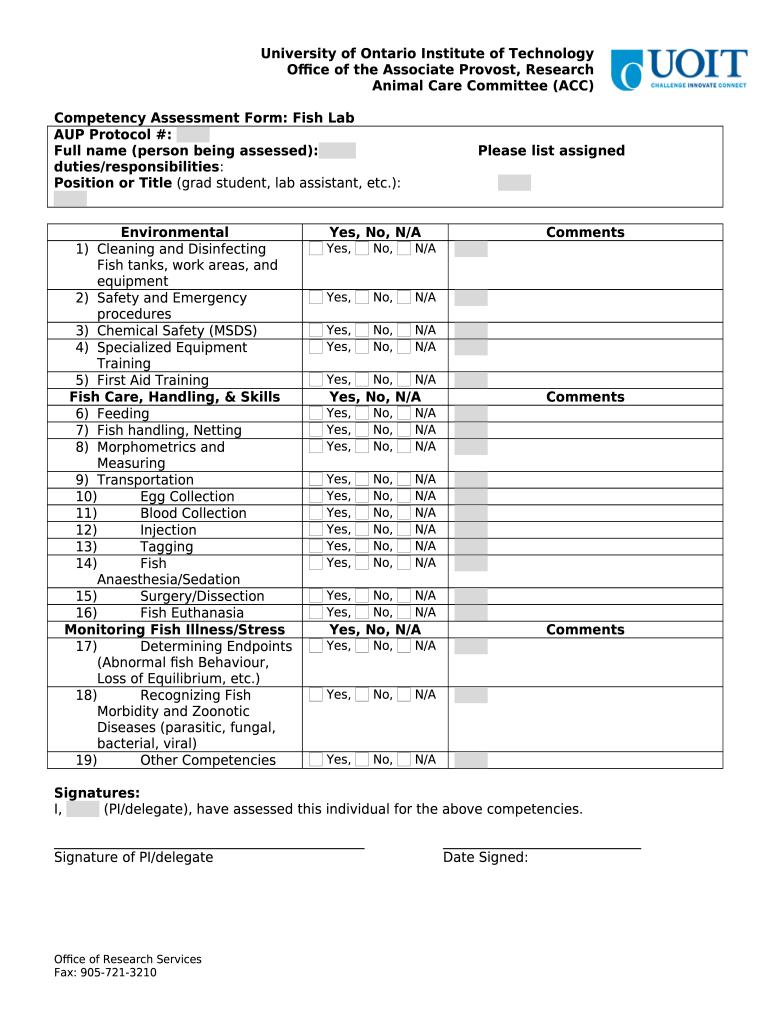







Definition and Meaning of the Laboratory Competency Assessment Checklist
A laboratory competency assessment checklist is a structured tool designed to evaluate the skills and proficiency of laboratory personnel in various essential tasks. This checklist serves as a vital framework for ensuring that staff members adhere to safety protocols, maintain quality standards, and follow best practices in laboratory settings.
The checklist typically includes a range of competencies that may encompass areas such as:
- Technical Skills: These include the ability to operate laboratory equipment, conduct experiments, and analyze results accurately.
- Safety Protocols: Knowledge of laboratory safety measures, including the proper handling of chemicals and biological materials.
- Record Keeping: Maintaining accurate and complete documentation of experimental procedures and results.
- Quality Control: Understanding the importance of quality assurance processes to ensure reliability and validity in lab results.
Using this checklist, laboratories can systematically assess their staff's capabilities, identify areas for improvement, and ensure compliance with industry standards and regulations.
Key Elements of the Laboratory Competency Assessment Checklist
The laboratory competency assessment checklist includes several essential elements that facilitate a comprehensive evaluation of staff competencies. These elements can vary by laboratory type but generally encompass the following components:
-
Competency Areas: The checklist should outline specific areas of competency, such as sample preparation, equipment maintenance, and data analysis. This segmentation allows for targeted assessments.
-
Performance Criteria: Each competency area may have defined performance criteria that establish acceptable skill levels or benchmarks for evaluation.
-
Evaluation Methods: The checklist often specifies methods for assessing competency, such as direct observation, performance evaluations, or written tests. This ensures that assessments are objective and consistent.
-
Documentation of Results: It is crucial to have a section within the checklist for recording the assessors' findings. This documentation provides a historical record of employee performance and development over time.
-
Reviewer Sign-Off: Inclusion of a space for the reviewer’s signature and date reinforces accountability for maintaining high standards within the laboratory.
-
Periodic Review Dates: Setting regular intervals for competency reassessment ensures that staff maintains and updates their skills, thus promoting ongoing professional development.
By incorporating these key elements, the laboratory competency assessment checklist serves not just as an evaluation tool but also as a roadmap for personnel development and compliance adherence.
Important Terms Related to Laboratory Competency Assessment Checklist
Understanding key terminology associated with the laboratory competency assessment checklist is essential for effective usage. Familiarity with these terms can ensure clearer communication and implementation among laboratory personnel:
- Competency: A combination of knowledge, skills, and behaviors that enable an individual to perform tasks effectively in a specific context.
- Assessment: The process of evaluating an individual's competencies, which can include direct observations, testing, and more formalized methods.
- Proficiency: A measure of an individual's capability to perform assigned tasks to a predetermined quality standard.
- Quality Assurance: A system of procedures and protocols designed to ensure that laboratory results are reliable and adhere to established standards.
- Regulatory Compliance: Adhering to laws, regulations, and guidelines established by governing bodies, crucial for laboratory operations.
By understanding these essential terms, laboratory staff can more effectively apply the competency assessment checklist and engage in meaningful discussions about professional development and standards.
Who Typically Uses the Laboratory Competency Assessment Checklist
The laboratory competency assessment checklist is widely utilized across various sectors, making it an integral part of laboratory operations in numerous settings. Typical users include:
- Clinical Laboratory Staff: Physicians, medical technologists, and laboratory technicians use the checklist to evaluate skills pertinent to patient care and diagnostic testing.
- Research Laboratories: Scientists and researchers may utilize the checklist to ensure that their teams possess the necessary skills for conducting experiments and analyzing data accurately.
- Quality Assurance Departments: Personnel responsible for ensuring compliance and maintaining standards within laboratories utilize the checklist as a means to assess staff competency regularly.
- Educational Institutions: Colleges and universities may employ the checklist in lab courses to evaluate students’ competencies in using laboratory equipment and following safety protocols.
By engaging with this checklist, users from various professional backgrounds can promote skill development, improve laboratory safety, and enhance the quality and reliability of laboratory outputs.


Steps to Complete the Laboratory Competency Assessment Checklist
Completing the laboratory competency assessment checklist involves a systematic approach, ensuring thorough and objective evaluation of each staff member's competencies. Here is a recommended step-by-step process:
-
Preparation: Before conducting assessments, gather all relevant documentation, including the checklist, procedures, and equipment specifications.
-
Schedule Assessments: Arrange a time when employees can be evaluated without disruptions. Inform them about the competencies being assessed.
-
Conduct Assessments:
- Observe the staff member performing their tasks, noting their adherence to protocols and competency criteria.
- Utilize performance criteria defined in the checklist to guide your evaluation.
-
Record Results: Document observations directly on the checklist, providing specific comments and scores for each competency area.
-
Review Findings: After the assessment is completed, review the results with the staff member. Discuss strengths and areas for improvement, and outline any necessary training or further development.
-
Ensure Follow-Up: Set a timeline for re-assessment to confirm competency retention over time and schedule any required additional training.
Following these steps ensures a structured approach to competency assessment, ultimately fostering skill enhancement and compliance within laboratory environments.




