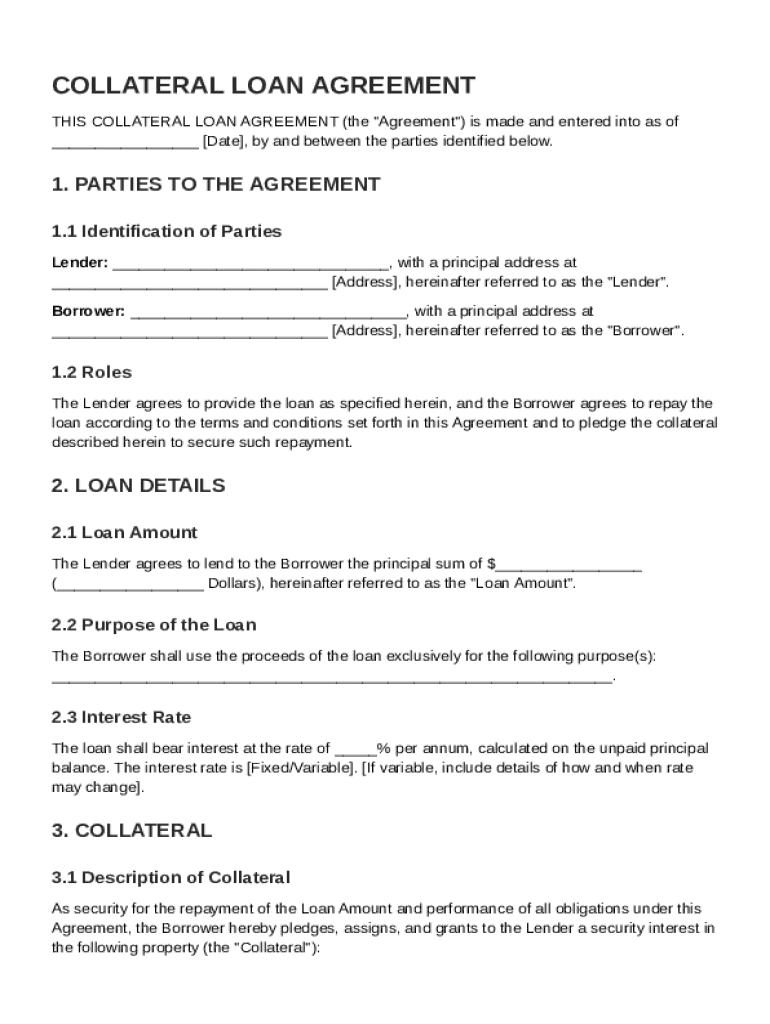







Definition & Meaning
A collateral loan agreement is a legal document that outlines the terms of a loan involving collateral, which is an asset the borrower pledges to the lender to secure the loan. Commonly used when borrowing significant sums, such collateral could include real estate, vehicles, or other valuable assets. The agreement establishes the lender’s right to claim the collateral if the borrower defaults on the repayment. Additionally, the document specifies crucial terms such as the loan amount, interest rate, and repayment schedule. This agreement serves as both a security measure for the lender and a formalized commitment for the borrower.
How to Use the Collateral Loan Agreement Template
To effectively use the collateral loan agreement template, both parties—the lender and the borrower—should carefully review each section of the document.
-
Input Basic Information: Begin by filling in the personal and contact details of both parties involved in the loan. This includes names, addresses, and any necessary identification numbers.
-
Define Loan Terms: Clearly specify the loan amount, interest rate, and repayment schedule. Include specific deadlines for installment payments or balloon payments if applicable.
-
Detail Collateral Information: Identify the asset being pledged as collateral. Provide a detailed description, including any relevant registration numbers or identifiers.
-
Include Default Conditions: Clearly define what constitutes a default by the borrower. Standard conditions include missed payments or misrepresentation of facts by the borrower.
-
Review with Legal Counsel: Both parties should have the opportunity to review the agreement with legal counsel to ensure all terms are fair and legally sound.
-
Finalize and Sign: Ensure that both parties sign the document in the presence of a notary public if required by local laws to make the agreement legally binding.
Key Elements of the Collateral Loan Agreement Template
-
Loan Details: Includes the principal amount, interest rate, and overall term of the loan.
-
Payment Terms: Specifies the schedule for repayment, including the frequency and amount of each installment.
-
Collateral Description: Detailed information about the asset, such as its current market value and any unique identifiers.
-
Default Provisions: Outlines scenarios that would trigger borrower default and the lender's right to seize the collateral.
-
Governing Law: The agreement should specify which state’s laws govern the contract, which can affect enforcement and interpretation.
-
Signatures and Witness Information: Areas for signatures and, if necessary, the witnessing parties to authenticate the document.
Steps to Complete the Collateral Loan Agreement Template
Completing a collateral loan agreement template involves several structured steps to ensure that all necessary information is accurately included and understood by both parties.
-
Gather Necessary Information: Ensure you have access to all relevant details, such as personal identification for both parties and the description of the collateral.
-
Draft Agreement: Use the template to input specific loan terms and conditions, tailoring the language to reflect the mutual understanding of both parties.
-
Review and Edit: Carefully review the document for clarity and completeness. Amend any sections that may be ambiguous or lacking necessary detail.
-
Seek Legal Advice: Have an attorney review the agreement to ensure it complies with applicable state laws and sufficiently protects each party's interests.
-
Sign and Notarize: Once all parties agree to the terms, sign the agreement. In some jurisdictions, a notary’s seal is required for the document to be legally binding.
-
Store Securely: Keep copies of the finalized, signed agreement in a safe place accessible to both parties for future reference.
Legal Use of the Collateral Loan Agreement Template
This template is a legally binding document, ensuring the lender's right to reclaim the pledged asset in the event of a borrower default. To serve its legal purpose, the agreement must comply with state laws where the loan originates. Terms must be clear, fair, and equitable to both parties, preventing disputes and facilitating resolution in court if necessary. It is crucial that all parties understand their rights and obligations as outlined in the agreement.
Important Terms Related to Collateral Loan Agreement Template
-
Principal: The initial amount of money borrowed.
-
Interest Rate: The percentage of the loan amount charged by the lender for borrowing money.
-
Amortization Schedule: A detailed timetable covering each loan installment.
-
Lien: The legal right of the lender to seize the pledged collateral if the borrower defaults.
-
Covenant: Additional terms or clauses included to further delineate conditions or borrower obligations.
State-Specific Rules for the Collateral Loan Agreement Template
Collateral agreements must comply with the laws of the state in which they are executed. These laws govern aspects such as usury limits (maximum interest rates), enforceability of liens, and requirements for notarization and witnesses. For example, some states may mandate specific disclosures or terms unique to their jurisdiction. It is advisable for parties to check with their state’s regulations or consult with a lawyer to ensure compliance and legal soundness.
Examples of Using the Collateral Loan Agreement Template
-
Small Business Loan: A business owner pledges machinery as collateral to secure a loan used for expansion.
-
Automobile Purchase: A borrower uses an auto loan secured by the vehicle itself, providing the lender with a lien on the car.
-
Real Estate Investment: An investor uses a property as collateral to acquire funds for another real estate development project.
These examples illustrate the template’s application in real-world scenarios, demonstrating its versatility and utility in various financial transactions.
Versions or Alternatives to the Collateral Loan Agreement Template
Several versions and alternatives of collateral loan agreements are available, each tailored to specific needs:
-
Simple Loan Agreement: For straightforward, smaller loans without complex terms.
-
Chattel Mortgage Agreement: Used when personal property is pledged as collateral.
-
Secured Promissory Note: A condensed version that focuses primarily on the repayment terms and conditions.
These alternatives allow parties to select an agreement format that best fits their particular transaction, ensuring legality and clarity.