
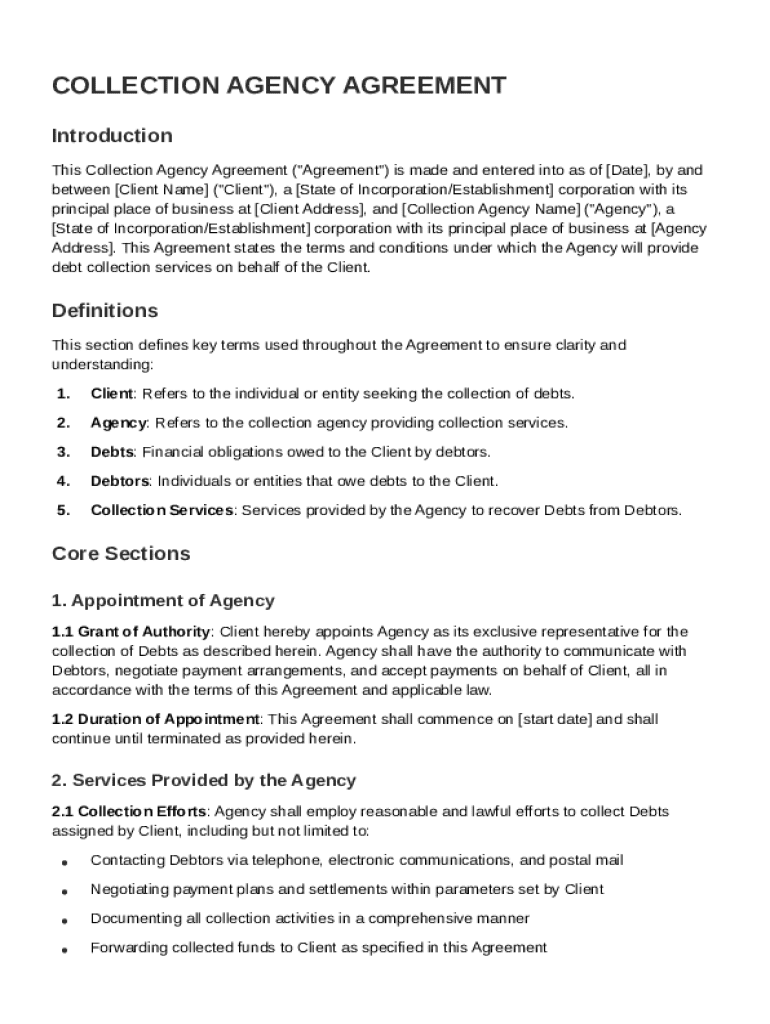







Definition & Meaning
A Collection Agency Agreement Template serves as a formal document establishing the terms under which a collection agency operates on behalf of a client to recover outstanding debts. This agreement outlines the agency's responsibilities, the scope of work, and compliance with relevant debt collection laws. It is a crucial tool for setting defined expectations between the client and the agency, ensuring that all activities conducted align with legal standards and the agreed-upon operational framework.
Key Elements of the Collection Agency Agreement Template
The template typically includes several critical components essential for clarity and mutual understanding:
- Parties Involved: Identification of the client and the collection agency.
- Scope of Services: Detailed description of services provided, including strategies for debt recovery.
- Compensation Structure: Information on how and when the agency will be compensated, potentially involving commission-based payments.
- Compliance Requirements: Adherence to local, state, and federal regulations governing debt collection practices.
- Confidentiality Obligations: Assurance that all sensitive information will be protected.
How to Use the Collection Agency Agreement Template
Utilizing the Collection Agency Agreement Template involves several structured steps:
- Download and Review: Obtain the template and thoroughly review each section to ensure it matches your business's requirements.
- Customization: Customize the template by adding specific details related to parties involved, services, and payment terms.
- Legal Consultation: Consult with a legal expert to verify compliance with applicable laws and regulations.
- Execution: Once finalized, both parties should sign the document to make it legally binding.
Steps to Complete the Collection Agency Agreement Template
- Identify Parties: Clearly specify the names and details of the client and agency.
- Outline Terms: Define the duration of the agreement and specific conditions under which it can be extended or terminated.
- Detail Services: Include specifics on what collection actions will be undertaken.
- Agreement on Fees: Describe in detail the fee structure, including percentage of collections or flat fees.
- Signatures: Ensure both parties provide signatures to validate the agreement.
Important Terms Related to the Collection Agency Agreement Template
Understanding the terminology within the template is vital for effective utilization:
- Debtor: The individual or entity from whom the debt is to be collected.
- Fee Schedule: A detailed list of fees the agency will collect for services rendered.
- Compliance Clause: Ensures adherence to laws such as the Fair Debt Collection Practices Act (FDCPA).
- Indemnification: A provision protecting the client from claims arising from the agency’s collection actions.
Legal Use of the Collection Agency Agreement Template
The template's legality revolves around its ability to comply with industry standards and regulations:
- Federal Compliance: It must align with federal laws like the FDCPA, which governs debt collection practices.
- State Laws: Adapt the template to accommodate state-specific requirements, as these can vary significantly.
- Confidentiality Provisions: Legal stipulations regarding the protection of debtor information.
State-Specific Rules for the Collection Agency Agreement Template
Adapting the template to comply with state-specific legislation is necessary. Some states have unique requirements regarding:
- Licensure of Agencies: Agencies may need specific licenses to operate within certain states.
- Notarization: Some jurisdictions require agreements to be notarized for added legal validity.
- Regulatory Bodies: States may have designated agencies overseeing debt collection practices.
Examples of Using the Collection Agency Agreement Template
Consider several practical application scenarios:
- Small Business Owner: A small business enlists a collection agency to recover unpaid invoices, using the agreement to formally establish roles and expectations.
- Legal Firms: Law firms may incorporate this template to streamline partnerships with debt recovery services, ensuring all actions are legally compliant.
- Corporate Enterprises: Large companies employing collection agencies to manage numerous delinquent accounts efficiently utilize the agreement to ensure operational consistency.
Versions or Alternatives to the Collection Agency Agreement Template
Though the template is comprehensive, variations exist based on specific needs:
- Custom Agreements: Tailored versions that incorporate additional clauses specific to a particular business requirement.
- Simplified Templates: Streamlined versions for smaller operations requiring fewer legal complexities.
- Sector-Specific Documents: Templates adjusted to meet the requirements of specific industries, such as healthcare or banking.
Business Types that Benefit Most from Collection Agency Agreement Template
Certain businesses are inherently more reliant on these agreements due to the nature of their operations:
- Financial Institutions: Banks and credit unions regularly utilize such agreements to manage defaulted loans.
- Healthcare Providers: Often engage collection agencies to recover unpaid medical bills.
- Retail Companies: Use these templates to address overdue payments for goods and services rendered.
Digital vs. Paper Version
While both digital and paper versions have their advantages, the digital version offers significant benefits:
- Ease of Access: Can be easily stored and shared electronically, enhancing communication between parties.
- Real-Time Editing: Allows for faster revisions and updates.
- Environmentally Friendly: Reduces paper usage, aligning with corporate sustainability initiatives.




