
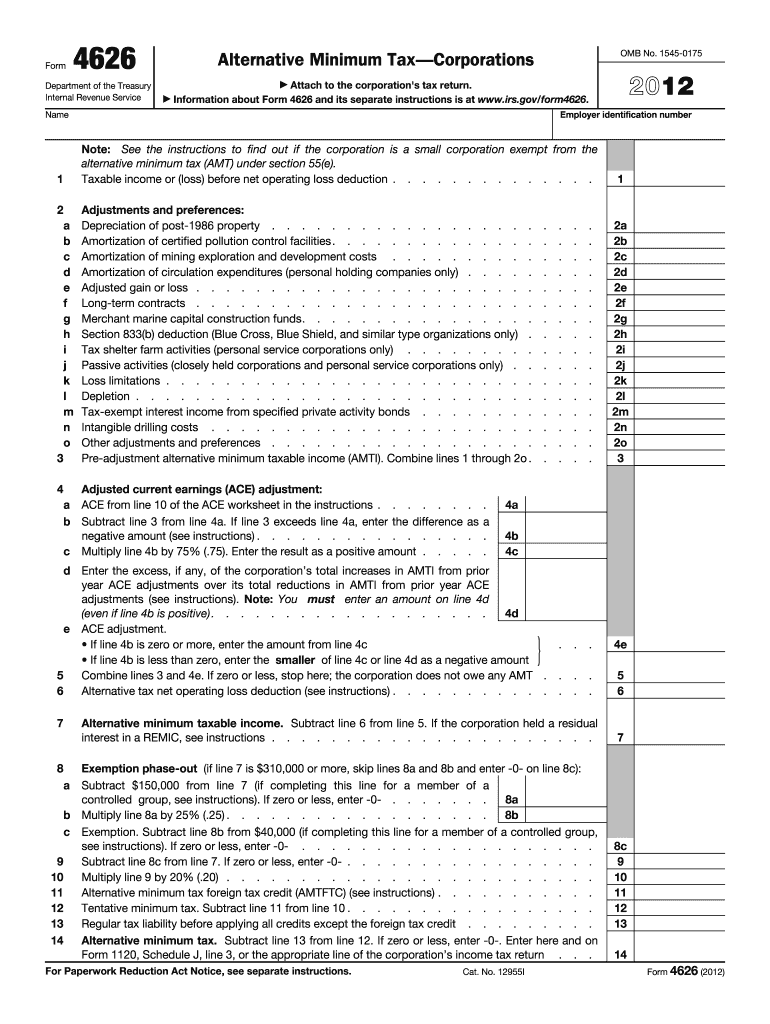







Understanding 2012 IRS Form 4626
Form 4626 is a crucial document for corporations to calculate the Alternative Minimum Tax (AMT) for the tax year 2012. It helps corporations determine their alternative minimum taxable income (AMTI) and ensures they meet tax obligations as per the IRS regulations. The form includes sections for reporting taxable income, adjustments, preferences, exemptions, and credits related to AMT.
How to Use the 2012 IRS Form 4626
Using Form 4626 involves several steps, which are essential for accurately calculating AMT obligations. Corporations must report taxable income and apply adjustments and preferences to calculate the AMTI. This process ensures that all taxable elements are accounted for, reflecting the true economic income of a corporation.
- Report Taxable Income: Start by entering your regular taxable income from corporate tax returns.
- Make Adjustments: Adjust the reported income by including or excluding various income and expense items as specified by the IRS.
- Calculate Preferences: Apply preference items that affect the AMT. These often involve benefits that the IRS requires to be adjusted.
- Determine AMTI: Combine adjusted taxable income and preferences to determine the AMTI.
- Apply Exemptions and Credits: Assess if any exemptions apply, and factor in any available AMT credits to reduce the final tax liability.
Steps to Complete the 2012 IRS Form 4626
Complete Form 4626 with precision to ensure compliance with tax laws. Below are the steps involved:
- Gather Information: Collect all necessary financial data from corporate accounts and financial statements.
- Fill Out Income and Deductions: Enter all income, deductions, and book tax differences.
- Complete Adjustments and Preferences: Fill in sections for adjustments and preference items according to IRS instructions.
- Calculate AMTI: Sum up adjusted income and preferences to arrive at the AMTI.
- Apply Tax Rate: Use the applicable AMT rate to calculate the tentative minimum tax, compare it with the regular tax, and determine liability.
- Finalize the Form: Review for accuracy, sign, and retain a copy for corporate records.
Key Elements of the 2012 IRS Form 4626
Form 4626 consists of several vital elements designed to report and calculate AMT effectively.
- Part I - Income and Adjustments: This section captures basic income details and applicable adjustments.
- Part II - Preference Items: Contains fields to declare any income and deductions not subject to the regular tax.
- Part III - Exemptions and Credits: Lists any applicable exemptions or credits to mitigate tax liabilities.
- Part IV - AMTI and Tax Computation: The final section where AMTI is calculated, and the tax liability is determined.
Business Entity Types Utilizing Form 4626
Form 4626 is primarily used by corporations subject to AMT. Specific business entities that frequently engage with this form include:
- C Corporations: Most common users due to AMT applicability.
- S Corporations: Generally exempt, but might require filing under specific conditions.
- Public Corporations: Must file to ascertain AMT liabilities, affecting shareholders.
Eligibility Criteria for Filing 2012 IRS Form 4626
Eligibility to file Form 4626 depends on corporate financial status and operational structure. Corporations must evaluate:
- Income Thresholds: Corporations with substantial gross receipts must consider this form due to AMT triggers.
- AMT Exemption Levels: Understand specific exemptions based on operational scale and income levels.
- Status Changes: Corporations facing structural changes, like mergers, may need to assess AMT requirements.


Penalties for Non-Compliance
Failing to file Form 4626 or filing incorrectly can lead to severe penalties. Corporations must adhere to filing deadlines to avoid:
- Monetary Penalties: Substantial fines for underpayment or failure to calculate AMT accurately.
- Interest Charges: Accrued interest on missed payments or incorrect assessments.
- Legal Repercussions: Potential IRS audits and legal actions for non-compliance.
Software Compatibility for Filing
Corporations use various accounting software solutions to streamline filing Form 4626. Popular software includes:
- TurboTax and QuickBooks: Provide modules specific to AMT calculations.
- TaxAct: Offers robust analytical tools to manage and report tax liabilities.
Form Submission Methods
Corporations can submit Form 4626 through various channels, ensuring convenience and compliance:
- Electronic Filing: Encouraged for speed and efficiency, reducing errors through software checks.
- Mail Submission: Traditional submission with physical records sent to the IRS.
- In-Person: Rarely used but applicable in cases requiring direct IRS interaction.
By addressing each of these areas, corporations can ensure they are filing Form 4626 accurately and effectively, mitigating the risk of penalties and complying with the IRS regulations for the tax year 2012.


