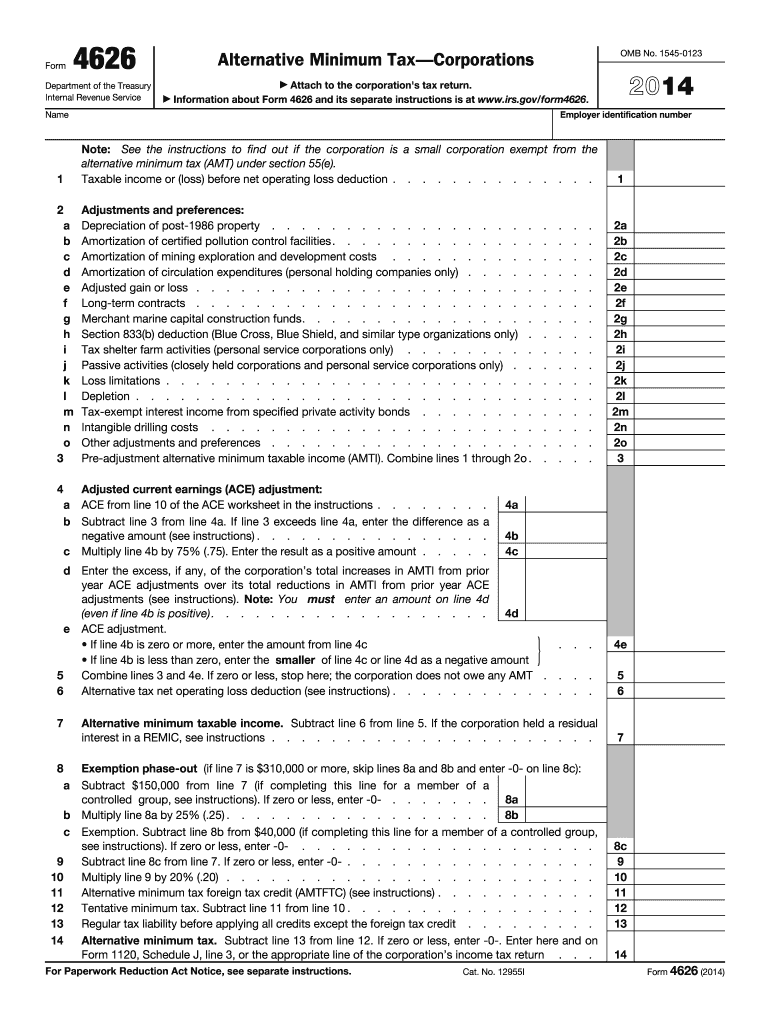





2014 form 4626-2025

Get Form
2014 form 4626 Preview on Page 1

Here's how it works

01. Edit your 2014 form 4626 online
Type text, add images, blackout confidential details, add comments, highlights and more.
02. Sign it in a few clicks
Draw your signature, type it, upload its image, or use your mobile device as a signature pad.
03. Share your form with others
Send it via email, link, or fax. You can also download it, export it or print it out.

Definition and Purpose of the 2014 Form 4626

The 2014 Form 4626 is critically important for corporations in the United States as it serves to calculate the Alternative Minimum Tax (AMT) for tax year 2014. This form is specifically designed for corporations to determine if they owe additional taxes under the AMT system, which serves as a parallel tax calculation to the regular income tax. Companies must compute their regular tax liability and then adjust this figure based on preferences and adjustments prescribed by the IRS.

The purpose of this form is twofold: first, it identifies the alternative minimum taxable income (AMTI), which is the income level that the AMT is applied against; and second, it captures any exemptions available to small corporations, which are exempt from the AMT if they meet specific criteria. In essence, the form helps maintain a minimum level of tax contribution to the federal government from high-income corporations that might otherwise reduce their tax liability through deductions and credits.

How to Complete the 2014 Form 4626

Filling out the 2014 Form 4626 involves several essential steps, each requiring careful attention to detail to ensure accuracy.

  1. Gather Necessary Information: Before starting the form, collect financial statements and details on corporate income, deductions, and credits that will affect the AMT calculation.

  2. Report Taxable Income: Enter the amount of taxable income on Line 1. This figure serves as the basis upon which adjustments will be made.

  3. Adjustments and Preferences: Lines 2 through 6 require adjustments to be made to the taxable income figure based on specific preferences and adjustments outlined in IRS guidelines.

  4. Calculate AMTI: Line 8 summarizes your AMTI. This is the income that will ultimately be tested against the AMT rate.

  5. Determine the Tentative Minimum Tax: Use the calculated AMTI to compute the tentative minimum tax on Line 11. This figure will dictate if any additional AMT is owed.

  6. Complete Additional Sections: Depending on your corporation's structure and unique circumstances, you may need to fill out additional lines or sections that address specific situations or exemptions.

Throughout the process, it is essential to refer to the provided IRS instructions, which clarify how each line should be filled and offer definitions for essential terms.

Steps for Filing the 2014 Form 4626

Filing the 2014 Form 4626 requires a structured approach to ensure compliance with IRS regulations.

  1. Complete the Form: Carefully fill out the required fields according to the instructions, ensuring all calculations are accurate.

  2. Double-Check Entries: Review the completed form for any mistakes or overlooked areas. Accuracy is crucial in avoiding penalties or non-compliance issues.

  3. Gather Additional Documentation: Collect any supporting documentation that substantiates the income and deductions reported on the form, as this may be required for IRS audits.

  4. Choose a Submission Method: Decide whether to file electronically or send the form via mail. Typically, electronic filing is faster and results in quicker processing.

  5. Submit Form by Deadline: Ensure that the form is filed by the IRS deadline, generally April 15 of the following year, unless an extension has been granted.

Following these steps carefully will help ensure a smooth filing process and minimize the likelihood of issues with the IRS.

Important Terms Related to the 2014 Form 4626

Understanding key terminology related to the 2014 Form 4626 is essential for proper completion and compliance. Here are some important terms:

  • Alternative Minimum Tax (AMT): A secondary tax calculation to ensure that taxpayers, particularly corporations, pay a minimum amount of tax even if deductions and credits significantly reduce their regular tax liability.

  • Alternative Minimum Taxable Income (AMTI): The income subject to the AMT after specific adjustments and preferences have been accounted for, effectively the income level against which the AMT rate is applied.

  • Exemption: A provision that allows certain small corporations to be exempt from AMT, contingent on fulfilling defined eligibility criteria.

  • Preferences: Specific items identified by the IRS that must be added back into taxable income when calculating AMTI since they may lower tax liability.

  • Tentative Minimum Tax: The amount calculated on the form, representing the tentative liability under AMT that a corporation may owe based on its AMTI.

Understanding these terms will facilitate a more comprehensive grasp of the form and the implications of the calculations involved.

Eligibility Criteria for Using the 2014 Form 4626

Not every corporation is required to use the 2014 Form 4626; specific eligibility requirements must be met:

  • Type of Corporation: The form is generally applicable to C Corporations. S Corporations and partnerships do not use this form for AMT calculation.

  • AMT Liability: Only corporations with a calculated AMTI above a certain threshold need to use Form 4626 to determine potential AMT.

  • Exemption Status: Small corporations with average annual gross receipts below a determined amount over the previous three years may qualify for an exemption from the AMT and therefore would not need to file this form.

Being aware of these criteria helps corporations understand their obligations and whether they need to proceed with filing the form.

decoration image ratings of Dochub

See more 2014 form 4626 versions

We've got more versions of the 2014 form 4626 form. Select the right 2014 form 4626 version from the list and start editing it straight away!
Versions Form popularity Fillable & printable
2023 4.5 Satisfied (35 Votes)
2017 4.8 Satisfied (216 Votes)
2016 4.4 Satisfied (476 Votes)
2015 4.1 Satisfied (29 Votes)
2014 4 Satisfied (59 Votes)
2013 4 Satisfied (58 Votes)
2012 4.2 Satisfied (65 Votes)
2011 4.1 Satisfied (42 Votes)
2010 4 Satisfied (20 Votes)
be ready to get more

Complete this form in 5 minutes or less

Get form

Got questions?

We have answers to the most popular questions from our customers. If you can't find an answer to your question, please contact us.
Contact us
your corporations average annual gross receipts did not exceed $7.5 million for the 3-year period (or the portion of that period it was in existence) ending before your tax period began (or $5 million if your corporation had only 1 prior tax year before your tax period began); and your corporation was exempt from
Corporations use this form to determine whether the corporation is an applicable corporation under section 59(k) and to calculate corporate alternative minimum tax under section 55.
Form 4626, Alternative Minimum Tax suppress print In Organizer, select. Taxes. , then. Alternative Minimum Tax. . Select. Form 4626. , then. Suppress Print. . Do a full recompute.
How to calculate CAMT Calculate AFSI. Multiply AFSI by 15% to determine tentative minimum tax. Subtract any CAMT foreign tax credit. Compare the result to the regular federal income tax liability (plus BEAT) Pay the greater of the two amounts.
CAMT generally applies to large corporations with average annual financial statement income exceeding $1 billion.
be ready to get more

Complete this form in 5 minutes or less

Get form

People also ask

Form 26AS provides important information about tax deducted/collected and deposited with the government tax authorities by the authorized deductors /collectors. A taxpayer can view all financial transactions involving TDS/TCS for the relevant financial year in Form 26AS.
Initially provided in IRS Notices and largely preserved in 2024 proposed regulations, the simplified method allows corporations to assess their status by applying modified rules.
The 2024 instructions to Form 4626 confirm that all corporations are required to file Form 4626 unless the corporation is an S corporation, a regulated investment company (RIC), a real estate investment trust (REIT), a tax-exempt entity that is not required to file Form 990-T (Exempt Organization Business Income Tax

Related links