




01. Edit your form online
Type text, add images, blackout confidential details, add comments, highlights and more.

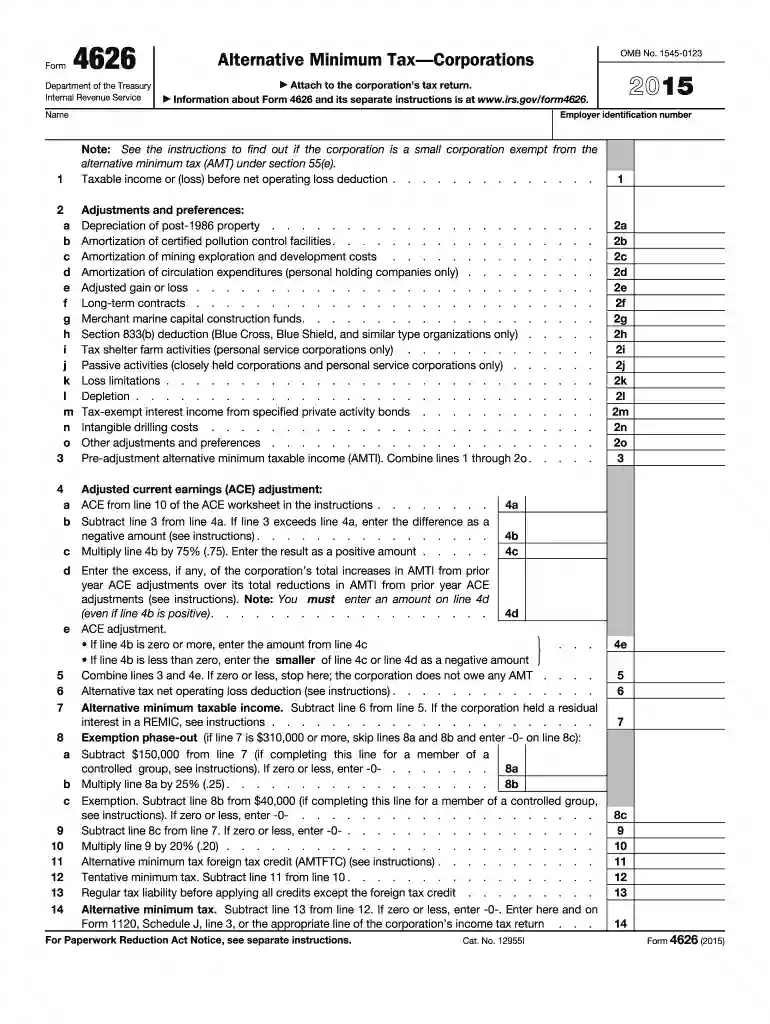
Type text, add images, blackout confidential details, add comments, highlights and more.

Draw your signature, type it, upload its image, or use your mobile device as a signature pad.

Send it via email, link, or fax. You can also download it, export it or print it out.
Form 4626, officially known as the Alternative Minimum Tax — Corporations, is used by corporations to compute their Alternative Minimum Tax (AMT). This form is essential because it ensures that corporations with significant income do not escape tax liabilities by using exclusions, deductions, and credits available under the regular tax system. The AMT serves as a parallel tax calculation that overrides traditional income tax calculations if the AMT amount is greater, thus requiring corporations to pay the higher of the two.
Corporations use the 2015 Form 4626 to report taxable income adjustments and preferences. This includes changes necessary for AMT due to limitations and exclusions. Corporations begin by calculating their regular taxable income, and then make adjustments for AMT purposes, reporting these changes on various lines within Form 4626. The form ultimately computes the corporation's AMT liability, determining the additional tax owed beyond regular tax obligations, if applicable.
Calculate Regular Taxable Income:
Compute Adjustments and Preferences:
Determine Alternative Minimum Taxable Income (AMTI):
Compute Tentative Minimum Tax:
Determine AMT Liability:
Compare with Regular Tax:
Regular Filing Deadline for Corporations:
Extensions:
Payment Due Date:
Online Submission:
Mail Submission:
In-Person Filing:
The Internal Revenue Service (IRS) is the issuing body for the 2015 Form 4626. It controls the guidelines and instructions for proper completion of the form, ensuring that corporations meet federal tax obligations appropriately.
Corporations failing to comply with AMT regulations face penalties and interest charges. Non-compliance includes underpayment due to incorrect calculations, failure to file by the deadline, or neglecting to pay taxes owed. Penalties are calculated based on the amount of tax underpaid and the length of the delay.
Example 1: Tech Corporation
Example 2: Mining Company
Understanding these practical applications helps corporations prepare and submit more accurate filings to the IRS, ensuring compliance and avoiding costly penalties.
We've got more versions of the 2015 form 4626 form. Select the right 2015 form 4626 version from the list and start editing it straight away!
| Versions | Form popularity | Fillable & printable |
|---|---|---|
| 2025 | 4.3 Satisfied (50 Votes) | |
| 2024 | 4.6 Satisfied (51 Votes) | |
| 2023 | 4.5 Satisfied (35 Votes) | |
| 2017 | 4.8 Satisfied (216 Votes) | |
| 2016 | 4.4 Satisfied (476 Votes) | |
| 2015 | 4.1 Satisfied (29 Votes) | |
| 2014 | 4 Satisfied (59 Votes) | |
| 2013 | 4 Satisfied (58 Votes) | |
| 2012 | 4.2 Satisfied (65 Votes) | |
| 2011 | 4.1 Satisfied (42 Votes) | |
| 2010 | 4 Satisfied (20 Votes) |
At DocHub, your data security is our priority. We follow HIPAA, SOC2, GDPR, and other standards, so you can work on your documents with confidence.
Jan 7, 2016 Use Form 4626 to figure the alternative minimum tax (AMT) under section 55 for a corporation that is not exempt from the. AMT. ConsolidatedRead more
2015 FORM 990-T (FORM 4626) FOR THE YEAR ENDED SEPTEMBER 30, 2016 Form 4626, Line 2, Adjustments and preferences Line 2a Line 2e Depreciation
Dec 9, 2024 Recognize the presence of, and avoid the use of, elderspeak, a form of communication used with older adults that is similar to baby-talk


