




01. Edit your ia 4626 2021 online
Type text, add images, blackout confidential details, add comments, highlights and more.

Type text, add images, blackout confidential details, add comments, highlights and more.

Draw your signature, type it, upload its image, or use your mobile device as a signature pad.

Send ia 4626 instructions via email, link, or fax. You can also download it, export it or print it out.
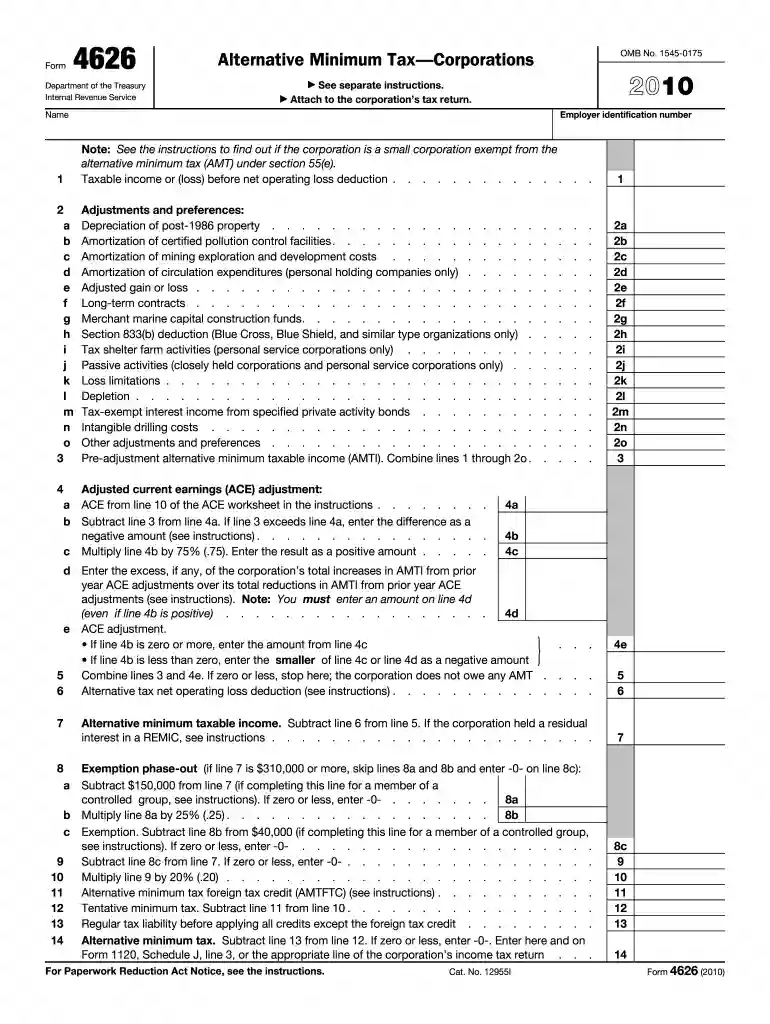
Form 4626, specifically designed for the year 2010, is a crucial document utilized by corporations to compute the Alternative Minimum Tax (AMT). It accommodates numerous sections necessary for compiling taxable income, making pertinent adjustments and preferences, and determining alternative minimum taxable income. This form assists corporations in understanding their tax liability by taking into account the adjusted current earnings and exemption phase-outs. Its structured methodology aids in identifying the precise AMT obligation a corporation may have to fulfill.
The prime users of the 2010 Form 4626 are corporations that anticipate paying the Alternative Minimum Tax. This includes both domestic and multi-national corporations operating within the United States. Companies with complex financial structures and those experiencing substantial income or numerous tax preferences are likely to engage with this form to meticulously assess their AMT liabilities and ensure compliance with the Internal Revenue Service (IRS) stipulations.


Corporations must submit Form 4626 within the appropriate fiscal year deadlines as mandated by the IRS. Generally, this falls on the 15th day of the third month following the end of a corporation's tax year. For calendar-year taxpayers, this typically aligns with March 15, 2011, for the 2010 form. Understanding these dates is essential to avoid penalties and ensure timely compliance.
Failing to comply with filing requirements may result in significant penalties. Corporations could face financial penalties, including interest charges on unpaid taxes and potential legal repercussions. Non-compliance compromises a corporation’s standing with the IRS, underscoring the significance of timely and accurate submission of Form 4626.
In 2010, corporations had the option to file Form 4626 either digitally or via paper submission. Digital filing options provide enhanced speed and efficiency, often allowing for faster processing and confirmation of receipt from the IRS. Paper submissions, on the other hand, may require longer processing times due to the manual handling involved. Choosing the submission type depends largely on organizational preference and resource availability.
Consider a corporation with substantial capital gains and multiple tax-preference items such as depreciation. By reporting these elements on the form accurately, they may discover an increase in AMT liability, underscoring the need for precise financial reporting. Another case might involve a corporation benefiting from specific tax credits, requiring careful navigation through the adjustment and preference sections to ensure correct AMT computation and compliance.
The IRS provides specific guidelines for completing Form 4626, emphasizing the importance of comprehensive and accurate financial reporting. Key directives include adhering to the precise structure of the form, utilizing the exact number inputs, and ensuring that all calculations reflect the necessary adjustments and exemptions applicable for the 2010 tax year. Understanding these guidelines fosters proper compliance and maximizes the accuracy of the filed form.
We've got more versions of the ia 4626 2021 form. Select the right ia 4626 2021 version from the list and start editing it straight away!
| Versions | Form popularity | Fillable & printable |
|---|---|---|
| 2025 | 4.3 Satisfied (50 Votes) | |
| 2024 | 4.6 Satisfied (51 Votes) | |
| 2023 | 4.5 Satisfied (35 Votes) | |
| 2017 | 4.8 Satisfied (216 Votes) | |
| 2016 | 4.4 Satisfied (476 Votes) | |
| 2015 | 4.1 Satisfied (29 Votes) | |
| 2014 | 4 Satisfied (59 Votes) | |
| 2013 | 4 Satisfied (58 Votes) | |
| 2012 | 4.2 Satisfied (65 Votes) | |
| 2011 | 4.1 Satisfied (42 Votes) | |
| 2010 | 4 Satisfied (20 Votes) |
At DocHub, your data security is our priority. We follow HIPAA, SOC2, GDPR, and other standards, so you can work on your documents with confidence.
Form 4626. Department of the Treasury. Internal Revenue For Paperwork Reduction Act Notice, see the instructions. Cat. No. 12955I. Form 4626 (2010)Read more
Paragraph (a)(4) of this section applies to returns filed for tax years beginning on or after January 1, 2010. Form 4626, shall file such form as part of itsRead more


