





Definition and Meaning
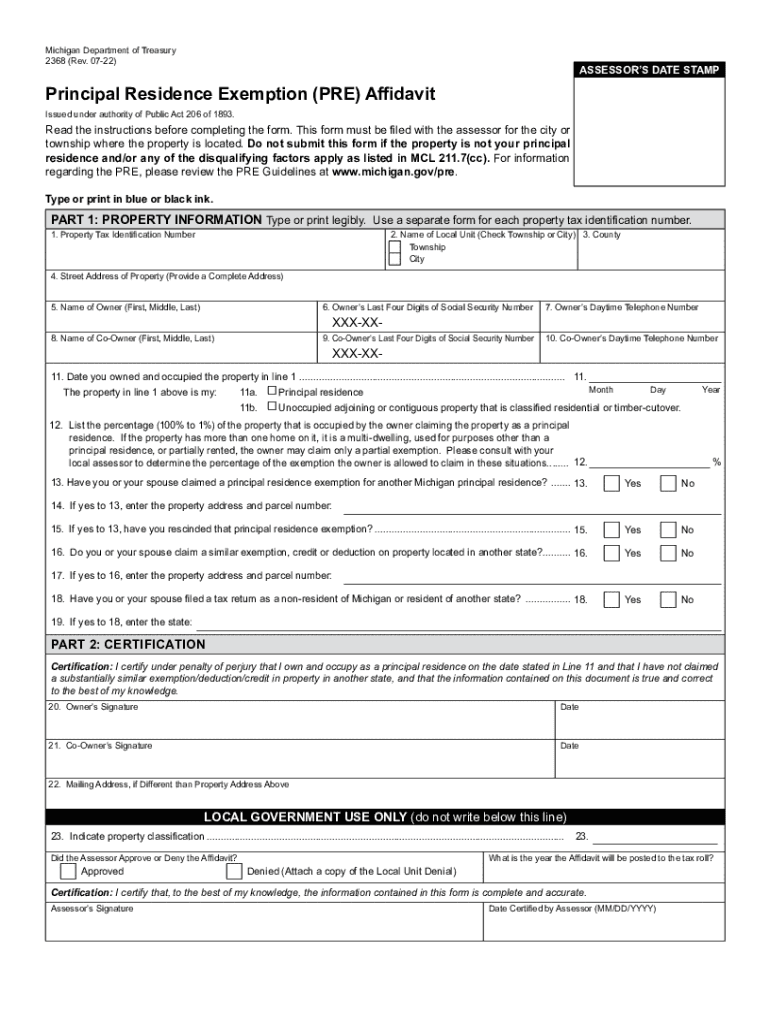
The "mi principal residence exemption," commonly referred to as the Principal Residence Exemption (PRE) Affidavit, is a form issued by the Michigan Department of Treasury. It allows homeowners to claim a tax exemption on their primary residence, effectively reducing or eliminating the local school district taxes. Understanding the nuances of this exemption is crucial, as it can lead to significant savings on property taxes.
The exemption is specifically designed to encourage homeownership by offering a financial incentive to individuals who occupy their homes as their principal residence. The affidavit requires detailed information about the property, such as the address and parcel number, as well as the owner's details to validate eligibility. It is essential to accurately complete this form to take full advantage of the tax savings.
Eligibility Criteria for the mi Principal Residence Exemption
To qualify for the Michigan Principal Residence Exemption, several criteria must be met. First and foremost, the property must be classified as residential and must serve as the homeowner's primary living place. The homeowner must occupy the property by June 1st of the calendar year for which the exemption is being claimed.
Additional requirements include the ownership of the property by the claimant, meaning the person applying for the exemption should be on the title deed as an owner. It's vital to note that only one property per homeowner can be declared as a principal residence within the state of Michigan at any one time. Rental properties, vacation homes, and business properties do not qualify for this exemption.


Steps to Complete the mi Principal Residence Exemption
Completing the Michigan Principal Residence Exemption form requires careful attention to detail. Here is a step-by-step guide to ensure accuracy:
- Obtain the PRE Affidavit form from the Michigan Department of Treasury's website or your local assessor's office.
- Fill in the property address and parcel identification number, which can be found on property tax statements or by contacting the local assessor.
- Provide the owner's full name and contact information. Ensure this information matches the records on the property deed.
- Certify that the property is used as your principal residence by checking the appropriate declaration boxes.
- Attach any required documentation that proves ownership and residency, such as utility bills or driver's license address.
- Sign and date the form to affirm the accuracy of the provided information before submitting to the local assessor.
State-Specific Rules for the mi Principal Residence Exemption
While the general guidelines for the Michigan PRE Affidavit apply statewide, certain municipalities may have additional rules or deadlines. Some areas might require supplementary documentation or have unique procedures for filing the exemption. It's necessary to contact the local assessor to verify any specific requirements that need to be fulfilled.
For instance, some localities may perform audits or verifications regularly to ensure compliance with the exemption rules. Homeowners should be prepared to provide supporting documents if requested by the local authorities.
Legal Use of the mi Principal Residence Exemption
The legal framework surrounding the Michigan Principal Residence Exemption is primarily geared towards tax fairness and consistency. It is critical for homeowners to use this exemption only in line with the prescribed regulations. Claiming the exemption on more than one property or providing inaccurate information on the affidavit could constitute tax fraud, leading to penalties.
Therefore, understanding legal disqualifications is paramount. These include transferring property ownership without notifying the local assessor, using the home for commercial purposes, or failing to reside in the property for the major part of the year.
Required Documents for the mi Principal Residence Exemption
The mi Principal Residence Exemption application demands several important documents to support the claim:
- A copy of the most recent property tax statement as proof of ownership.
- Evidence of residency, such as a Michigan driver's license or voter registration card with the property address.
- Any court documents if the property ownership was established via a will or legal proceedings.
Providing these documents along with the completed affidavit helps establish a clear case for the exemption and increases the chance of approval without delays.
Filing Deadlines and Important Dates for the Exemption
The Michigan Principal Residence Exemption has strict filing deadlines that must be met to qualify for the current tax year. The deadline is typically June 1st each year, with a secondary deadline of November 1st applicable in specific circumstances for partial exemptions.
Missing these dates could result in the homeowner having to wait for the next tax year, thus failing to benefit from the exemption during the intended period. It's advisable to keep track of these dates and submit the form well in advance to avoid last-minute issues or penalties.
Penalties for Non-Compliance with the Exemption
Failure to comply with the rules governing the Michigan Principal Residence Exemption can end in severe financial penalties. This includes fines or a demand for repayment of the exempted taxes with interest. Beyond the financial implications, there is also a risk of legal action for intentional misinformation.
Homeowners are advised to periodically review the terms of their exemption and promptly report any changes in their circumstances to the local assessor to maintain compliance. Regular checks ensure that any inadvertent discrepancies are rectified timely to prevent unwanted penalties.