
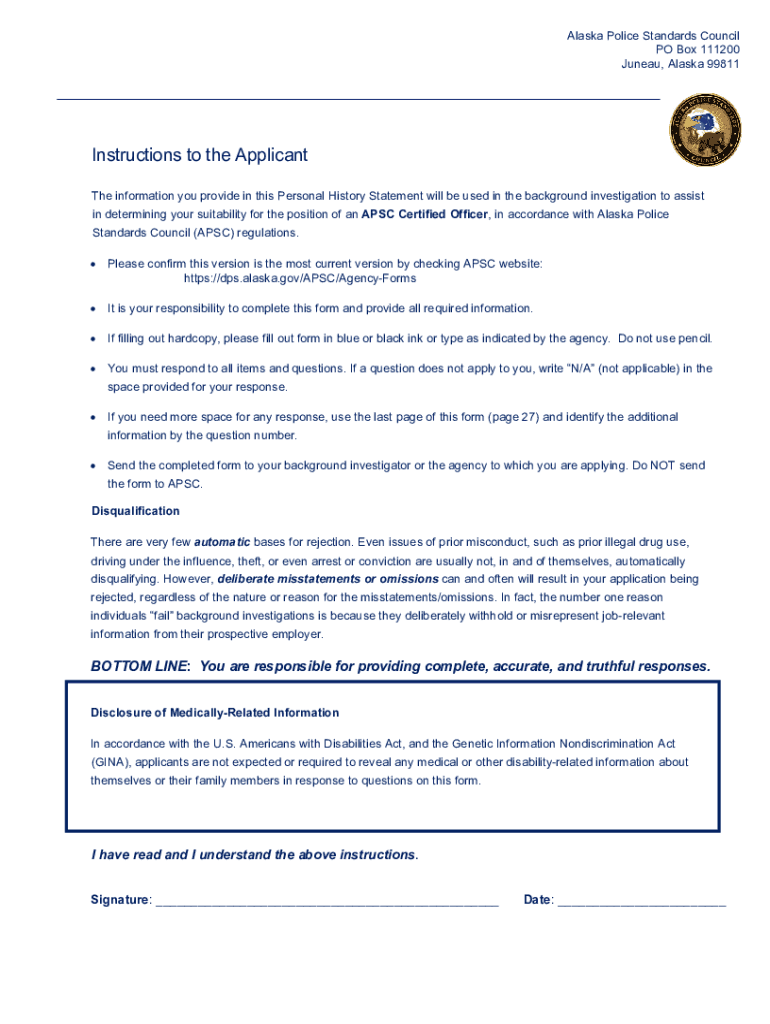







Definition and Meaning of the Alaska Police Standards Council
The Alaska Police Standards Council (APSC) is a regulatory body responsible for establishing and maintaining standards for the employment, training, and certification of police officers within the state of Alaska. This council ensures that law enforcement personnel demonstrate the requisite skills, integrity, and professionalism to effectively serve the community. Moreover, APSC plays a crucial role in maintaining public trust by enforcing ethical guidelines and providing oversight to law enforcement operations across the state.
Key Functions of the APSC
- Certification of Officers: The APSC certifies individuals as police officers, corrections officers, probation officers, parole officers, municipal correctional officers, and certain other categories of law enforcement personnel.
- Training Standards: It establishes training requirements to ensure officers are well-prepared to handle their duties safely and competently.
- Policy Development: The council formulates policies that guide the ethical behavior and professional conduct of law enforcement officials.
- Complaint Investigation: The APSC investigates allegations of misconduct to ensure accountability within the law enforcement community.
How to Use the Alaska Police Standards Council Form
The APSC form, commonly referred to as the Personal History Statement, is a comprehensive document that applicants need to complete during the background investigation process for becoming an APSC Certified Officer.
Filling Out the Form
- Personal Information: Fill in your full name, date of birth, and contact information. Ensure that all information is accurate and up-to-date.
- Family Background: Include details about your family, such as marital status, spouse's details, and dependents.
- Education History: List all educational institutions attended, degrees obtained, and any relevant certifications.
- Employment History: Provide a detailed account of your work experience, including employer details, job titles, and tenure.
Detailed Sections
- Legal Disclosures: Disclose any past or ongoing legal issues, such as criminal records or civil lawsuits.
- Financial Status: Submit information regarding your financial obligations and credit history.
- Medical Disclosure: State any medical conditions that might affect your ability to perform law enforcement duties.
Steps to Complete the Alaska Police Standards Council Form
Completing the APSC form requires careful attention to detail and an honest disclosure of all requested information.
-
Gather Necessary Information:
- Collect personal documents and records needed to complete the form.
- Ensure you have access to past employment and educational credentials.
-
Complete Each Section Thoroughly:
- Fill out every section as completely and accurately as possible.
- Double-check each entry for accuracy, ensuring spelling and numerical data are correct.
-
Review and Sign:
- Carefully review the entire form to check for any missing or incorrect information.
- Sign the form to certify that the information provided is true and accurate to the best of your knowledge.
-
Submit the Form:
- Follow the submission instructions carefully. This can vary between online, mail, or in-person methods.
Importance of Completing the APSC Form
The completion of the APSC form is a critical step in the certification process for police officers in Alaska. It serves multiple purposes, including:
- Ensuring Eligibility: Confirms that candidates meet the necessary criteria to serve as law enforcement officers.
- Establishing Trustworthiness: The thorough disclosure required by the form helps assure the council of the applicants' integrity and reliability.
- Facilitating Background Checks: Provides investigators with a baseline of information for conducting comprehensive background assessments.
Who Typically Uses the Alaska Police Standards Council Form
The APSC form is primarily utilized by individuals who wish to be certified as law enforcement officers in Alaska. This includes:
- New Recruits: Individuals applying for their first position in law enforcement.
- Current Officers Seeking Certification: Officers transitioning from other states or agencies, requiring certification within Alaska.
- Specialized Law Enforcement Roles: Positions such as parole or probation officers, who must comply with state regulatory standards.


Legalities Surrounding the Alaska Police Standards Council Form
The APSC form is governed by state regulations that demand accuracy and completeness in applicant responses.
Legal Requirements
- Honesty is Mandatory: Falsifying information on the form can result in disqualification or revocation of certification.
- Confidentiality: Personal information provided in the form is treated with confidentiality and only used for the purpose of background investigation and certification.
Potential Penalties
- Disqualification: Providing misleading or false information can lead to immediate disqualification.
- Legal Responsibility: Applicants may face legal repercussions should any intentional inaccuracies be discovered after appointment.
Key Elements of the Alaska Police Standards Council Form
Several critical elements define the structure and requirements of the APSC form:
- Detailed Personal History: Comprehensive coverage of educational, employment, and personal backgrounds.
- Legal and Financial Disclosures: Honest reporting of any criminal history or financial obligations.
- Medical Information: Disclosure of any health conditions relevant to law enforcement duties.
State-Specific Guidelines for the APSC Form
The APSC form is tailored to meet the specific regulatory requirements of Alaska, differing from similar documents in other states by:
- Custom Requirements: Adapting to unique state laws and specific knowledge areas relevant to Alaska’s legal and societal environment.
- Region-Specific Criteria: Certification and background checks may include state-specific criteria and regional knowledge.
Examples of Using the Alaska Police Standards Council Form
Real-world application of the APSC form involves various scenarios:
- Police Academy Entry: Applicants to the Alaska police academy must complete this form to confirm eligibility.
- Interstate Transfer: Officers moving to Alaska from other jurisdictions must fill out the form to gain state certification.
- Role Transition: Current officers changing roles within the state may need to update or complete new sections specific to their new responsibilities.
By thoroughly understanding and completing the APSC form, candidates ensure they meet the stringent standards required for law enforcement roles in Alaska, setting a foundation for a successful and legally compliant career in public service.




