




Definition & Meaning
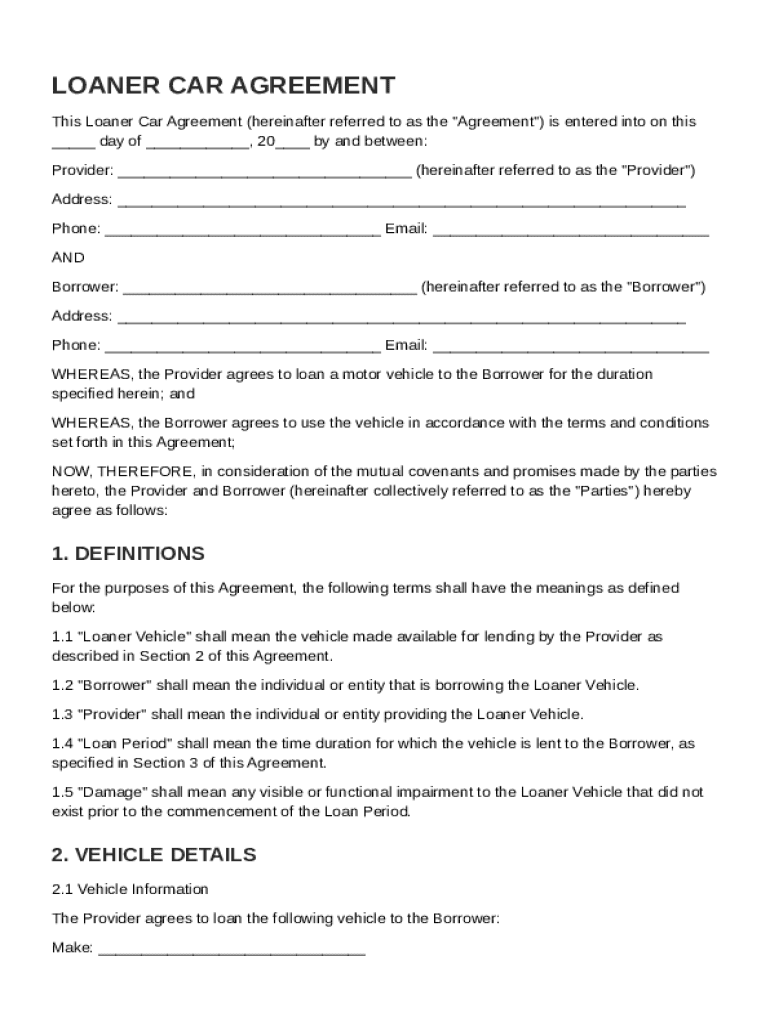
A Loaner Car Agreement Template is a legal document that outlines the terms and conditions under which a vehicle owner or dealership (the Provider) loans a vehicle to an individual or company (the Borrower). The document delineates various aspects such as vehicle details, the loan period, responsibilities of both parties, insurance requirements, and liability for damages. By clearly defining these elements, the template ensures that both parties are aware of their obligations and rights regarding the use of the loaned vehicle. This type of agreement is vital for preventing misunderstandings and legal disputes, providing a foundation for responsible vehicle use and maintenance during the loan period.
Key Elements of the Loaner Car Agreement Template
The Loaner Car Agreement Template contains several key elements that are essential for creating a comprehensive understanding between the Provider and the Borrower.
- Vehicle Details: This section includes information about the vehicle being loaned, such as make, model, year, Vehicle Identification Number (VIN), and registration details.
- Loan Period: Specifies the duration for which the vehicle is being loaned, including start and end dates.
- Responsibilities: Outlines the duties of the Borrower, such as maintaining the vehicle in good condition and adhering to specific usage restrictions (e.g., mileage limits, geographical boundaries).
- Insurance Requirements: Describes the required insurance coverage that the Borrower must maintain to protect against damage or liability.
- Liability and Damages: Details the procedures for handling any damages to the vehicle and assigns responsibility for repair costs.
- Termination Conditions: Specifies the circumstances under which the agreement can be terminated prematurely by either party.
Steps to Complete the Loaner Car Agreement Template
Completing a Loaner Car Agreement Template involves a step-by-step process to ensure all relevant information is accurately documented.
- Gather Information: Collect necessary details about the vehicle, the Provider, and the Borrower, including contact information and insurance policy details.
- Fill Out Vehicle Information: Enter the vehicle's make, model, year, VIN, and any other identifying information.
- Specify the Loan Period: Clearly denote the start and end dates for the loan period.
- Detail Borrower Responsibilities: Outline any specific duties and restrictions for the Borrower, such as mileage limits and maintenance requirements.
- Include Insurance Details: Record the Borrower's insurance policy information and ensure it meets the Provider's requirements.
- Define Liability Terms: Complete sections concerning liability for damages and procedures for reporting accidents or issues.
- Review and Sign: Both parties should carefully review the agreement, make any necessary adjustments, and sign the document to make it legally binding.
Legal Use of the Loaner Car Agreement Template
The Loaner Car Agreement Template serves a critical legal function by providing clear terms for the temporary use of a vehicle. It is a binding contract that can be used in legal proceedings to prove the agreed-upon terms between the Provider and Borrower. To ensure compliance with applicable laws, the document should include:
- Governing Law: Specify the jurisdiction or state laws under which the agreement is governed.
- Indemnification Clauses: Protect the Provider from claims arising from the Borrower's use of the vehicle.
- Entire Agreement: State that the written agreement constitutes the entire agreement between the parties, overriding any oral agreements or prior discussions.
By meeting these legal criteria, the template ensures that both parties are protected and that the agreement is enforceable in court.
Important Terms Related to Loaner Car Agreement Template
Understanding specific legal and industry terms is crucial when completing a Loaner Car Agreement Template. Some important terms include:
- Indemnification: An agreement by which one party agrees to compensate the other for certain damages or losses.
- Third-Party Liability: Refers to insurance coverage that protects against claims made by individuals other than the Borrower or Provider.
- Subrogation: A legal principle where one party steps into the shoes of another to pursue recovery from a third party.
These terms help facilitate better understanding of responsibilities and potential legal consequences within the agreement.
Who Typically Uses the Loaner Car Agreement Template
The Loaner Car Agreement Template is utilized by a variety of individuals and businesses, including:
- Car Dealerships: Loan vehicles to customers while their vehicles are being serviced or repaired.
- Rental Companies: Sometimes provide loaner vehicles when the originally rented vehicle is unavailable.
- Private Vehicle Owners: May offer their vehicle temporarily to friends, family, or other entities under specific conditions.
- Corporate Fleets: Companies with a fleet of vehicles may provide loaners to employees or business partners.
These use cases illustrate the flexibility and broad applicability of the template.

Examples of Using the Loaner Car Agreement Template
Real-world scenarios exemplify the utility of the Loaner Car Agreement Template:
- Auto Repair Scenario: A customer’s vehicle requires extensive repairs, and the dealership offers a loaner car to use during the service period.
- Business Travel: A company loans a vehicle to an employee traveling to a different location for work purposes.
- Insurance Claims: After an accident, an insurance company arranges a loaner car for the policyholder while their car is under repair.
These examples demonstrate how the agreement aids in smooth and clear vehicle exchanges, ensuring all parties are informed of their rights and duties.
State-Specific Rules for the Loaner Car Agreement Template
State-specific regulations can influence the terms and enforceability of a Loaner Car Agreement Template. It's essential to consider:
- Regulatory Requirements: Each state may have unique requirements for insurance coverage, liability limitations, and disclosures.
- Specific Limitations: Certain states might impose particular restrictions on loaner vehicles, like prohibiting their use for commercial purposes.
- State Law Compliance: Adapting the template to comply with local laws ensures it is legally valid and enforceable.
By taking into account these regional variations, users can prepare a more accurate and legally compliant agreement.