




01. Edit your it 216 gmu online
Type text, add images, blackout confidential details, add comments, highlights and more.

Type text, add images, blackout confidential details, add comments, highlights and more.

Draw your signature, type it, upload its image, or use your mobile device as a signature pad.

Send it via email, link, or fax. You can also download it, export it or print it out.
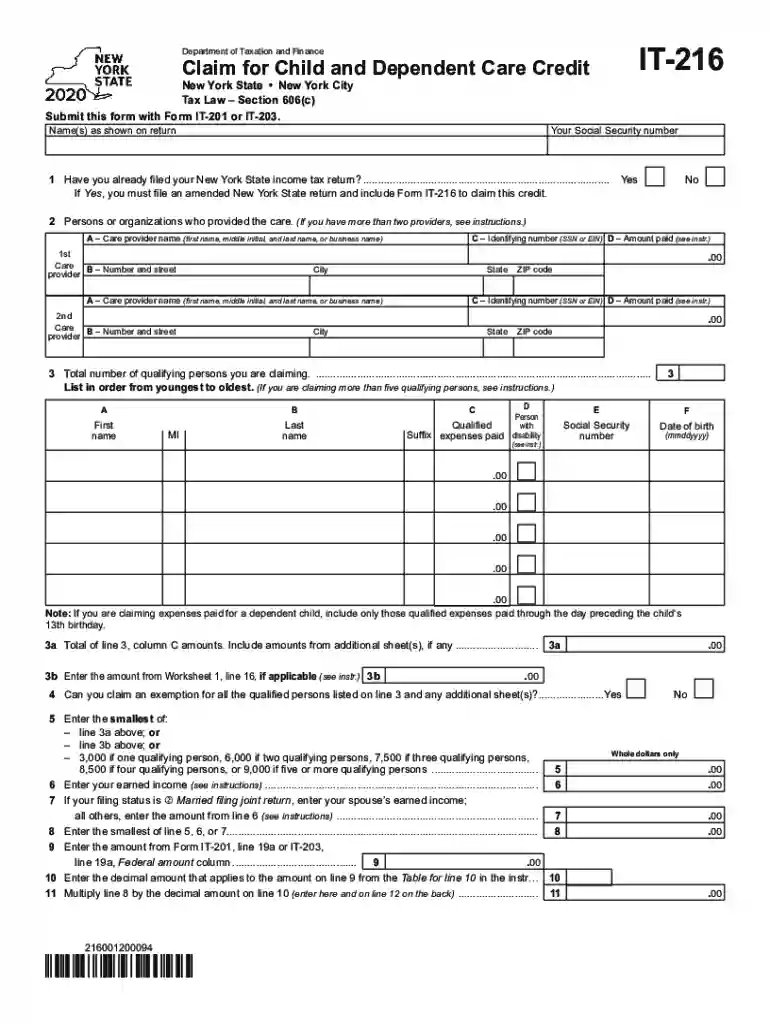
The IT-216 form, issued by the New York State Department of Taxation and Finance, is a document used to claim the Child and Dependent Care Credit. Its primary purpose is to assist taxpayers in reporting expenses related to the care of their children or other dependents while they work or look for work. The credit is especially beneficial for taxpayers with dependents requiring paid care services, as it provides financial relief by reducing overall tax liability.
Accessing the IT-216 form can be done online through the New York State Department of Taxation and Finance's official website. The form is readily available as a downloadable PDF, ensuring easy access for taxpayers.
Eligibility for claiming the Child and Dependent Care Credit using form IT-216 is defined by specific criteria, including financial and residential status.


New York State imposes particular rules regarding the filing of form IT-216. Compliance with these ensures legal correctness and maximizes potential credit amounts.
Non-compliance with the submission requirements or incorrect filing of form IT-216 can lead to penalties.
Adhering to critical deadlines ensures that taxpayers can claim the Child and Dependent Care Credit without delays or penalties.
Practical examples illustrate when and how the IT-216 can be most effectively used.
We've got more versions of the it 216 gmu form. Select the right it 216 gmu version from the list and start editing it straight away!
| Versions | Form popularity | Fillable & printable |
|---|---|---|
| 2025 | 4.6 Satisfied (35 Votes) | |
| 2024 | 4.5 Satisfied (35 Votes) | |
| 2023 | 4.1 Satisfied (61 Votes) | |
| 2022 | 4.1 Satisfied (55 Votes) | |
| 2021 | 4.8 Satisfied (131 Votes) | |
| 2020 | 4.3 Satisfied (108 Votes) | |
| 2019 | 4.3 Satisfied (170 Votes) | |
| 2018 | 4.3 Satisfied (138 Votes) | |
| 2016 | 4 Satisfied (43 Votes) | |
| 2015 | 4.3 Satisfied (184 Votes) | |
| 2014 | 4.2 Satisfied (45 Votes) | |
| 2013 | 4.4 Satisfied (59 Votes) | |
| 2010 | 4 Satisfied (28 Votes) |
At DocHub, your data security is our priority. We follow HIPAA, SOC2, GDPR, and other standards, so you can work on your documents with confidence.
Students survey and apply techniques in analyzing and modeling information systems. Requirements are derived in various domains and abstracted at conceptual,Read more
Note: The product has a low ink alert system. The accuracy of this system depends on the user refilling the ink tanks correctly. The product cannot directlyRead more
The New York State child and dependent care credit is calculated based on the amount of your New York adjusted gross income, the.Read more


