




01. Edit your it 216 online
Type text, add images, blackout confidential details, add comments, highlights and more.

Type text, add images, blackout confidential details, add comments, highlights and more.

Draw your signature, type it, upload its image, or use your mobile device as a signature pad.

Send it 216 instructions via email, link, or fax. You can also download it, export it or print it out.
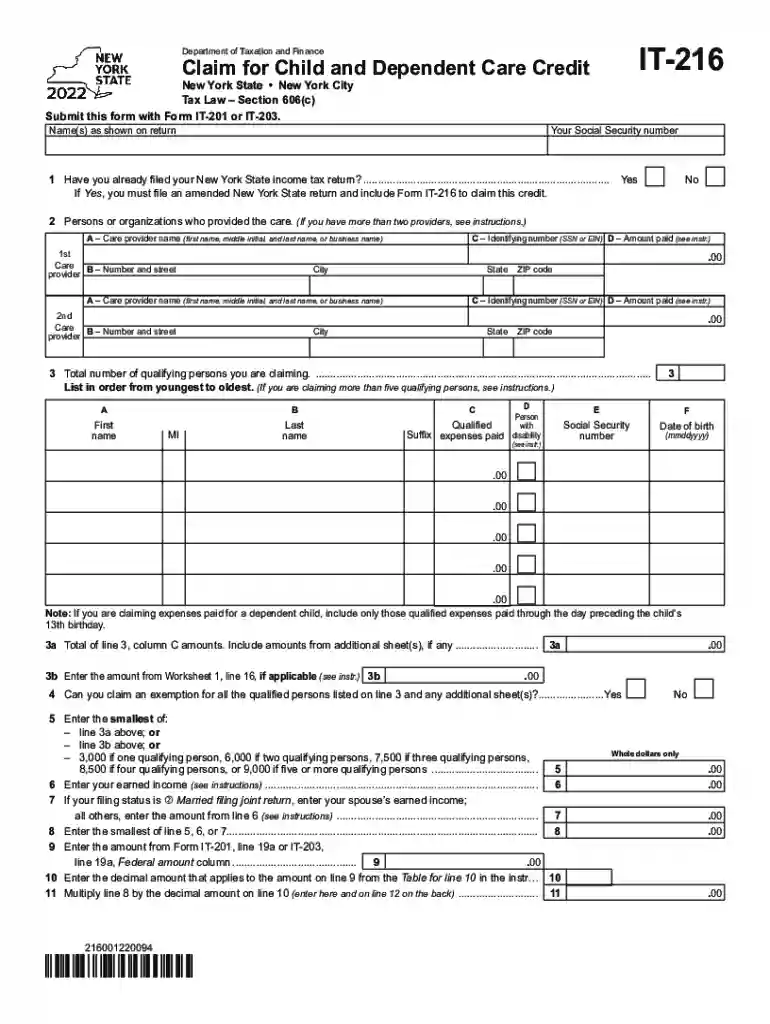
Form IT-216, known as the Claim for Child and Dependent Care Credit, is an essential tax document used by New York State residents. It is specifically designed to assist taxpayers in claiming credits for expenses incurred for the care of children and other dependents. The primary purpose of this form is to provide financial relief to taxpayers, reducing their overall tax liability through credits for eligible care expenses.
Determining eligibility for the Form IT-216 involves assessing multiple factors:


Completing Form IT-216 requires a precise approach:
Several elements of this form are critical:
Understanding specific terminology is essential:
New York State imposes rules unique to its jurisdiction:
To illustrate, consider a scenario in which a single parent with two children under age 13 incurs expenses for child care while they work. Using Form IT-216, they may claim these expenses to potentially reduce their tax bill. This example highlights how eligible taxpayers can leverage the form to lower their tax burden.
While Form IT-216 is specific to New York State, it aligns with broader IRS guidelines regarding child and dependent care expenses. Taxpayers should refer to federal guidelines for consistency and comprehensive understanding of their obligations and opportunities.
Failing to appropriately file Form IT-216 can result in:
This comprehensive overview provides actionable guidance on using Form IT-216 efficiently, ensuring compliance and maximizing available tax credits for child and dependent care expenses.
We've got more versions of the it 216 form. Select the right it 216 version from the list and start editing it straight away!
| Versions | Form popularity | Fillable & printable |
|---|---|---|
| 2025 | 4.6 Satisfied (35 Votes) | |
| 2024 | 4.5 Satisfied (35 Votes) | |
| 2023 | 4.1 Satisfied (61 Votes) | |
| 2022 | 4.1 Satisfied (55 Votes) | |
| 2021 | 4.8 Satisfied (131 Votes) | |
| 2020 | 4.3 Satisfied (108 Votes) | |
| 2019 | 4.3 Satisfied (170 Votes) | |
| 2018 | 4.3 Satisfied (138 Votes) | |
| 2016 | 4 Satisfied (43 Votes) | |
| 2015 | 4.3 Satisfied (184 Votes) | |
| 2014 | 4.2 Satisfied (45 Votes) | |
| 2013 | 4.4 Satisfied (59 Votes) | |
| 2010 | 4 Satisfied (28 Votes) |
At DocHub, your data security is our priority. We follow HIPAA, SOC2, GDPR, and other standards, so you can work on your documents with confidence.
Note: If you are claiming expenses paid for a dependent child, include only those qualified expenses paid through the day preceding the childs. 13th birthday.Read more
Dec 13, 2017 For additional information on claiming this credit, see Form IT-216, Claim for Child and Dependent Care Credit, and its instructions. New YorkRead more


