




01. Edit your form online
Type text, add images, blackout confidential details, add comments, highlights and more.

Type text, add images, blackout confidential details, add comments, highlights and more.

Draw your signature, type it, upload its image, or use your mobile device as a signature pad.

Send it via email, link, or fax. You can also download it, export it or print it out.
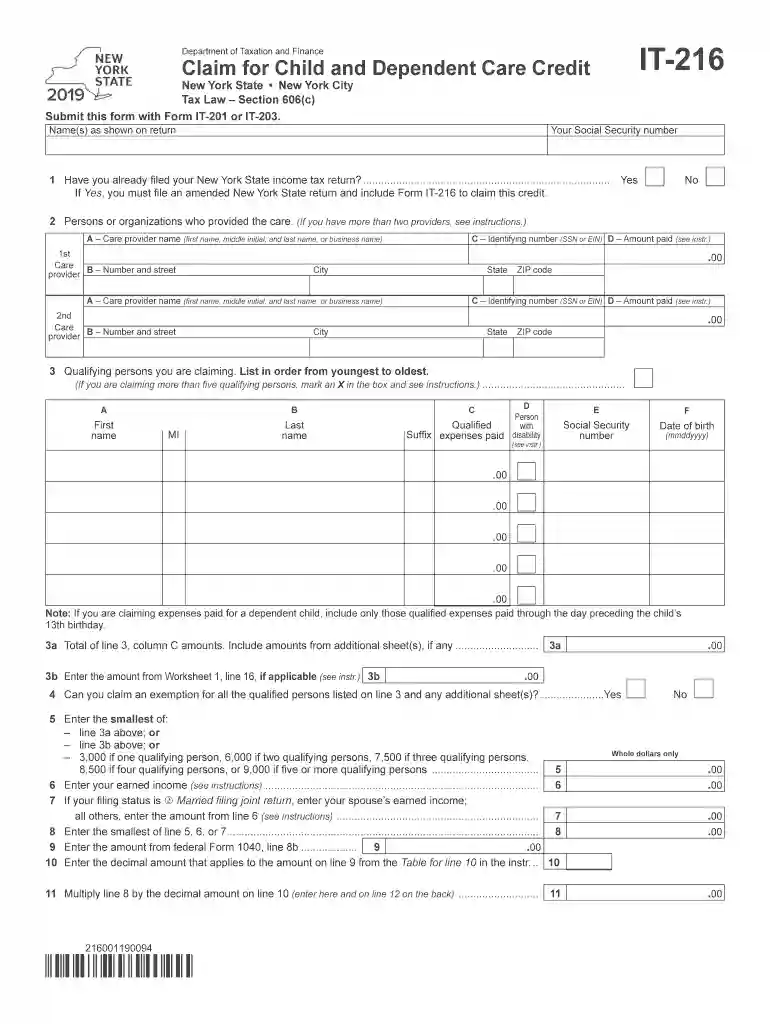
The IT-216 form is used by taxpayers in New York State to claim the Child and Dependent Care Credit. This credit aims to alleviate the financial burden of child and dependent care expenses, allowing individuals to deduct a portion of these costs from their overall state income tax liability. The form requires detailed information about the care providers, the dependents for whom the care is provided, and the associated expenses. By providing accurate information on the IT-216 form, taxpayers can maximize their eligibility for this credit, helping to reduce their tax payments.
Gather Necessary Information: Before filling out the IT-216 form, collect all necessary documentation, including receipts for care expenses, identification numbers for care providers, and details about the qualifying dependents.
Complete Personal Information: Enter your personal details, including name, address, and Social Security number, at the top of the form.
List Care Providers: Provide the names, addresses, and taxpayer identification numbers of all care providers used during the tax year. This includes daycare centers, babysitters, and any other qualified care services.
Enter Dependent Details: Fill in the information for each qualifying child or dependent, ensuring that their names, dates of birth, and Social Security numbers are correctly listed.
Calculate Expenses and Earned Income: Properly document and calculate all applicable care expenses and enter the amount of earned income. Follow the form’s instructions to determine the allowable percentage of expenses that can be claimed for the credit.
Complete the Calculation Section: Use the provided worksheets to calculate the credit amount. This involves multiplying eligible expenses by the relevant percentage based on your income bracket.
Eligibility for the IT-216 form revolves around several key criteria:
Income Requirements: The applicant must have earned income. The amount of credit varies depending on your total adjusted gross income.
Qualifying Persons: The dependents must be under the age of 13 or physically or mentally incapable of self-care.
Care Provider Criteria: The care must be provided by eligible providers who can furnish a taxpayer identification number.
Residency Requirements: Applicants must be full-year or part-year residents of New York State.


Understanding key terms can aid in properly completing the IT-216 form:
Qualifying Person: A child or dependent for whom the care expenses were incurred.
Eligible Expenses: Costs associated directly with the care of dependents, enabling taxpayers to work or seek employment.
Taxpayer Identification Number: A unique identifier required for each care provider for documentation and verification.
Adjusted Gross Income: The total income minus specific deductions, determining the percentage of eligible expenses that can be claimed.
New York State imposes specific rules that can impact the claiming of the Child and Dependent Care Credit:
Full-Year Residents: Must file using the NYS-1 tax return, incorporating the IT-216 form directly into their state tax filings.
Part-Year and Non-Residents: Must consider additional requirements and possibly adjusted credit amounts based on the period of residency within the state.
City Residents: Specific guidelines and potential credit adjustments may apply for residents of New York City due to overlapping jurisdictional tax requirements.
Preparing the IT-216 form efficiently requires a comprehensive set of documents:
Receipts for Care Expenses: Detailed records of payments made to care providers.
Taxpayer Identification Numbers: Documentation verifying the identification of each care provider.
Dependent Information: Proof of eligibility, such as birth certificates or disability statements for qualifying dependents.
Failure to accurately complete the IT-216 form can result in several penalties:
Monetary Fines: Potential underpayment penalties or interest on taxes owed due to incorrect credit claims.
Delayed Refunds: Errors can lead to processing delays, affecting tax refund timelines.
Legal Repercussions: Intentional misrepresentation may result in further legal actions by the New York State Department of Taxation and Finance.
Filing the IT-216 form with precision is often facilitated by software compatibility:
Tax Preparation Software: Platforms like TurboTax and QuickBooks can automate calculations and ensure accuracy.
Electronic Filing Systems: Many tax filing services integrate with New York State systems for seamless e-filing.
By understanding and applying these guidelines, individuals can effectively manage their tax liabilities with the IT-216, ensuring compliance and maximizing potential credits.
We've got more versions of the it 216 form. Select the right it 216 version from the list and start editing it straight away!
| Versions | Form popularity | Fillable & printable |
|---|---|---|
| 2025 | 4.6 Satisfied (35 Votes) | |
| 2024 | 4.5 Satisfied (35 Votes) | |
| 2023 | 4.1 Satisfied (61 Votes) | |
| 2022 | 4.1 Satisfied (55 Votes) | |
| 2021 | 4.8 Satisfied (131 Votes) | |
| 2020 | 4.3 Satisfied (108 Votes) | |
| 2019 | 4.3 Satisfied (170 Votes) | |
| 2018 | 4.3 Satisfied (138 Votes) | |
| 2016 | 4 Satisfied (43 Votes) | |
| 2015 | 4.3 Satisfied (184 Votes) | |
| 2014 | 4.2 Satisfied (45 Votes) | |
| 2013 | 4.4 Satisfied (59 Votes) | |
| 2010 | 4 Satisfied (28 Votes) |
At DocHub, your data security is our priority. We follow HIPAA, SOC2, GDPR, and other standards, so you can work on your documents with confidence.
Note: The product has a low ink alert system. The accuracy of this system depends on the user refilling the ink tanks correctly. The product cannot directlyRead more
The New York State child and dependent care credit is calculated based on the amount of your New York adjusted gross income, the.Read more
Students survey and apply techniques in analyzing and modeling information systems. Requirements are derived in various domains and abstracted at conceptual,Read more


