




01. Edit your form online
Type text, add images, blackout confidential details, add comments, highlights and more.

Type text, add images, blackout confidential details, add comments, highlights and more.

Draw your signature, type it, upload its image, or use your mobile device as a signature pad.

Send it via email, link, or fax. You can also download it, export it or print it out.
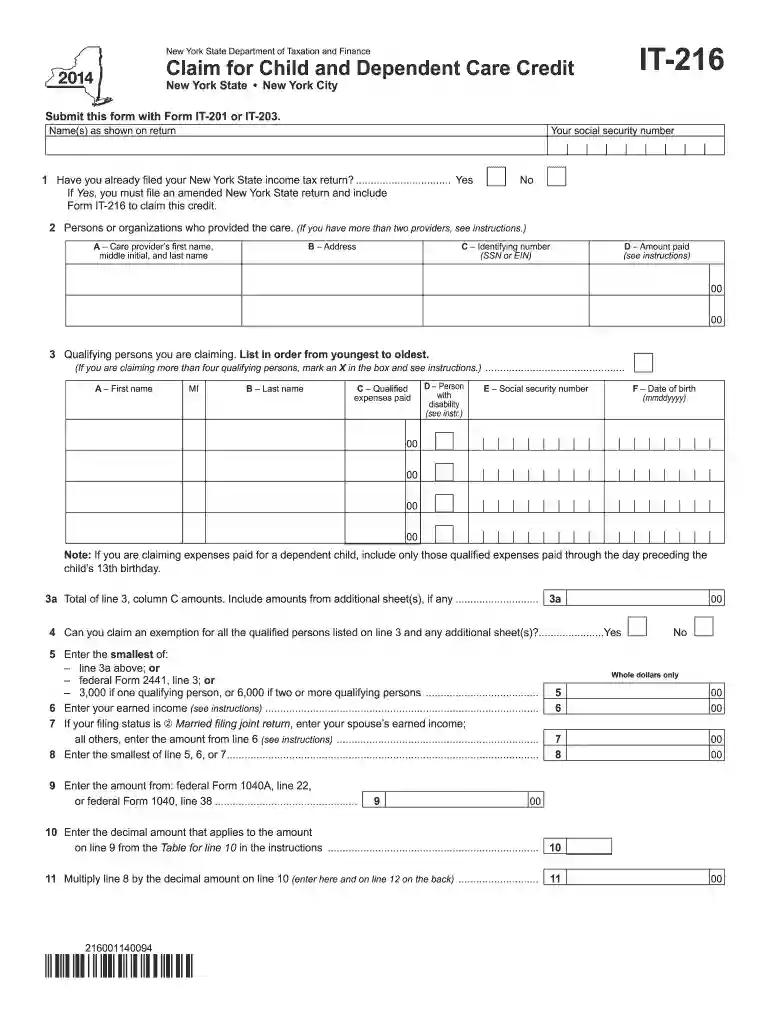
The 2013 216 Form, officially known as Form IT-216, is utilized by individuals within New York State to claim the Child and Dependent Care Credit. This form is essential for reporting expenses incurred for child and dependent care, which enables taxpayers to receive a tax credit. The form requires detailed information about care providers, qualifying dependents, and the expenses linked to their care, ensuring that taxpayers can accurately determine the credit amount to be claimed.
To utilize Form IT-216, taxpayers must meet specific eligibility criteria:
Submitting accurate information on the 2013 216 Form is crucial, as fraudulent claims may result in penalties or disqualification from future benefits. Verification of documentation may be required if audited by tax authorities.
Being informed about the terminology used in the 2013 216 Form can aid in accurately completing the form:
Practical examples can shed light on the application of the 2013 216 Form:
Many taxpayers utilize software for ease of tax form management:
Different states may enforce variant rules regarding tax credits:
Taxpayers must remain aware of both state and city stipulations to optimize their tax benefits accurately.
We've got more versions of the 2013 216 form form. Select the right 2013 216 form version from the list and start editing it straight away!
| Versions | Form popularity | Fillable & printable |
|---|---|---|
| 2025 | 4.6 Satisfied (35 Votes) | |
| 2024 | 4.5 Satisfied (35 Votes) | |
| 2023 | 4.1 Satisfied (61 Votes) | |
| 2022 | 4.1 Satisfied (55 Votes) | |
| 2021 | 4.8 Satisfied (131 Votes) | |
| 2020 | 4.3 Satisfied (108 Votes) | |
| 2019 | 4.3 Satisfied (170 Votes) | |
| 2018 | 4.3 Satisfied (138 Votes) | |
| 2016 | 4 Satisfied (43 Votes) | |
| 2015 | 4.3 Satisfied (184 Votes) | |
| 2014 | 4.2 Satisfied (45 Votes) | |
| 2013 | 4.4 Satisfied (59 Votes) | |
| 2010 | 4 Satisfied (28 Votes) |
Sign in to your DocHub account and add your 2013 216 form to our editor using one of its upload methods - from your device, cloud storage, protected URL, or your DocHub folders if you have already processed your document before. Open our editor, click the Sign button in the top toolbar, and decide on your signing method. You can use a picture of your handwritten signature, draw it, enter your name, or use a QR code instead.
Having a swift editing platform like DocHub, you do not need anything but a browser and connection to the internet to edit your 2013 216 form on the internet easily. Upload your document or get the appropriate form in DocHub’s catalog, open our editor with one click, and complete it electronically. To revise your forms anytime, register a free account with DocHub.
At DocHub, your data security is our priority. We follow HIPAA, SOC2, GDPR, and other standards, so you can work on your documents with confidence.
Revised 5/20/2013. 708.1.3f CUSTOMER REQUEST FOR A BRAND/VENDOR SPECIFIC WAIVER OF COMPETITION. Please check the appropriate justification(s) below for aRead more
Sep 16, 2013 Business Income Tax Return. September 16, 2013 216 201338. Estimated tax payments and alternative minimum tax (AMT) liability
Form IT-216 Claim for Child and Dependent Care Credit: The New York State child and dependent care credit is a minimum of 20% and as much as 110% of the


