




01. Edit your form online
Type text, add images, blackout confidential details, add comments, highlights and more.

Type text, add images, blackout confidential details, add comments, highlights and more.

Draw your signature, type it, upload its image, or use your mobile device as a signature pad.

Send it via email, link, or fax. You can also download it, export it or print it out.
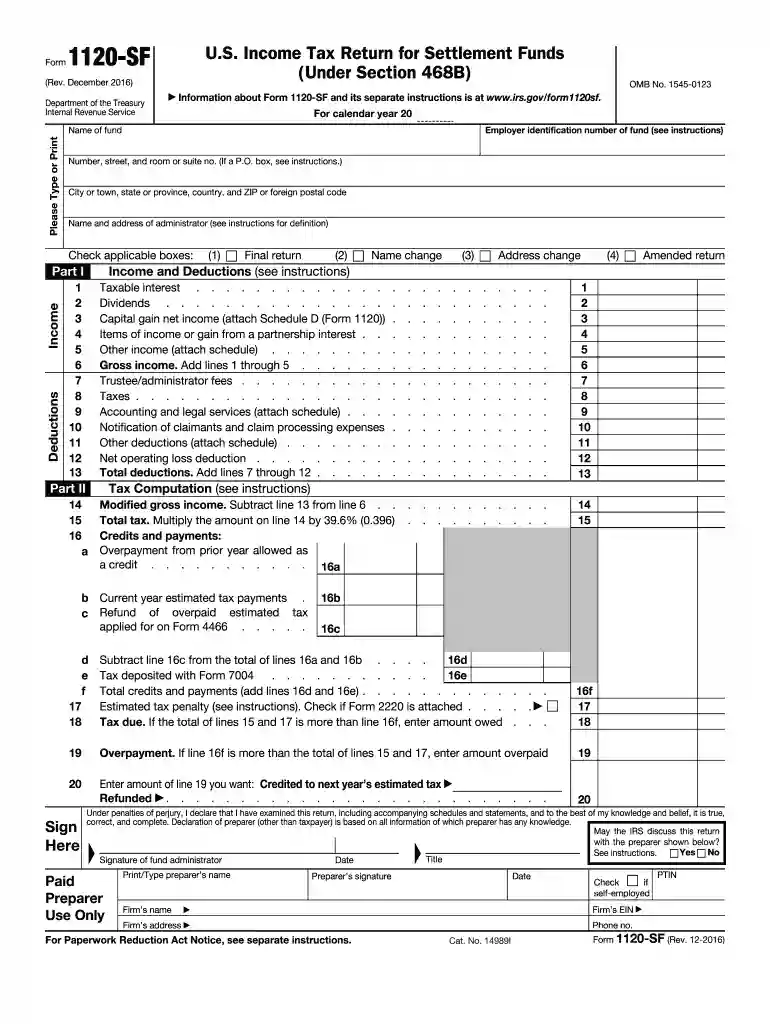
Form 1120-SF is the U.S. Income Tax Return for Settlement Funds under Section 468B of the Internal Revenue Code. This form is specifically designed for entities managing settlement funds established for litigation or other obligations to report their financial activities. It allows these funds to outline their income, deductions, and overall tax liabilities to the IRS. Such settlement funds might include those set aside for environmental cleanups or legal claims. The details in the form provide the IRS with the necessary information to determine the proper tax owed by these funds.
To use Form 1120-SF effectively, one must gather comprehensive financial information related to the settlement fund. This includes calculating gross income derived from various sources and identifying allowable deductions. The form is divided into sections that require specific financial data, such as operating expenses, management fees, and any income distributions to claimants. Accurate record-keeping throughout the fiscal year is crucial, as the information reported must reflect all financial transactions conducted by the fund. Reviewing IRS instructions included with the form is recommended to ensure correct completion.
Form 1120-SF must typically be filed by the 15th day of the third month following the end of the fund’s tax year. For funds using a calendar year, this usually means a filing deadline of March 15. Missing the deadline could result in penalties. Extensions may be requested using IRS Form 7004, which grants an additional six months. It's essential to stay informed about current IRS announcements, as dates may occasionally shift due to public holidays or specific IRS mandates.
Form 1120-SF includes several crucial sections:
Failure to timely file Form 1120-SF or inaccuracies in reported information can lead to penalties. The IRS may impose fines based on the degree of non-compliance, which can escalate with larger discrepancies between reported and actual financial statistics. Prompt correction of errors upon discovery can potentially mitigate some penalties. Entities are encouraged to consult tax professionals to ensure adherence to legal obligations.
The IRS provides comprehensive instructions for completing Form 1120-SF, available online and accompanying the form in filing packets. These guidelines outline who is eligible to file, the step-by-step process for filling out each section, and specific examples to illustrate common scenarios. Tax professionals often refer to these instructions to resolve complexities related to settlement fund taxation.
We've got more versions of the Form 1120-SF (Rev. December 2016) - irs form. Select the right Form 1120-SF (Rev. December 2016) - irs version from the list and start editing it straight away!
At DocHub, your data security is our priority. We follow HIPAA, SOC2, GDPR, and other standards, so you can work on your documents with confidence.
(Rev. December 2016). U.S. Income Tax Return for Settlement Funds. Department of the Treasury. Internal Revenue Service. Section references are to the InternalRead more
Do not enter SSN numbers on this form as it may be made public if your organization is a 501(c)(3). D Employer identification number. Name of organization (.Read more
May 19, 2025 Did there come a time in December -- in December 2012, what, if anything, happened with respect to your paychecks? A. Is there -- I dontRead more


