




01. Edit your form online
Type text, add images, blackout confidential details, add comments, highlights and more.

Type text, add images, blackout confidential details, add comments, highlights and more.

Draw your signature, type it, upload its image, or use your mobile device as a signature pad.

Send it via email, link, or fax. You can also download it, export it or print it out.
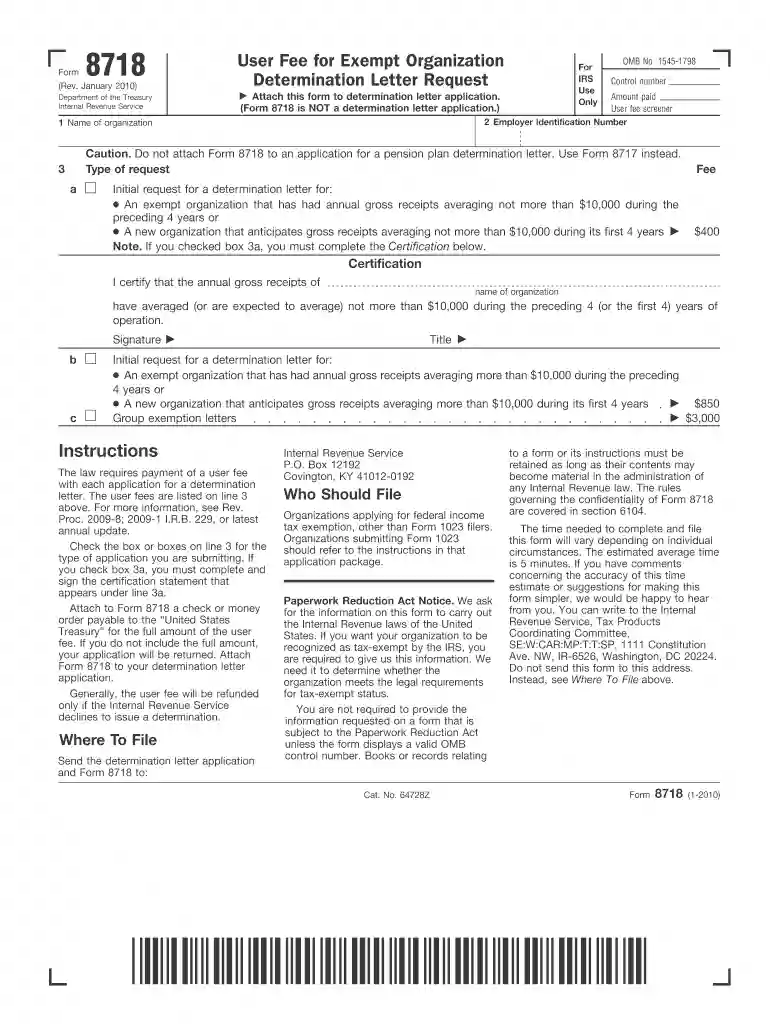
Form 8718, primarily used by organizations in the U.S. seeking to obtain federal tax-exempt status, serves as a user fee application submitted to the IRS. The form outlines the fee requirements based on the gross receipts of the organization. It clearly delineates the need for a separate application, emphasizing that it should not be attached to applications for pension plans or other non-related submissions.
Specified within this form, organizations that report low gross receipts may qualify for a certification section. This part of the form is crucial as it identifies organizations that do not have to pay the standard fee due to their financial size. This provision aims to support smaller entities in achieving tax-exempt status without incurring additional financial burden.
Completing Form 8718 efficiently requires attention to detail. Here is a step-by-step breakdown of the process:
Gather Required Information: Organizations should prepare by collecting details related to their gross receipts, federal tax identification number, and other pertinent organizational data.
Fill Out Part I: This involves entering the organization's identification details, such as the name, address, and federal ID number.
Complete Part II: State clearly the purpose of the request by selecting the corresponding option from the given choices on the form.
Determine the Applicable Fee in Part III: Based on the organization’s gross receipts, the correct fee category must be selected. This fee correlates directly with the size and financial capacity of the organization.
Certification in Part IV: For organizations with low gross receipts, fill out the certification section to affirm the eligibility for reduced fees.
Review and Submit: Review all entries to ensure accuracy before submission, as errors can delay processing or result in rejection.
Organizations can obtain Form 8718 through various methods:
Upon completing the form, organizations have several options for submission:
Organizations must adhere to the IRS's established guidelines when filing Form 8718. Essential components include:
Failing to file Form 8718 correctly can result in penalties, including a delay or denial of tax-exempt status. Incorrectly or inaccurately completed forms will require resubmission, extending the approval time and potentially incurring penalties. It's vital for organizations to ensure all information and fees are accurate to avoid these risks.
While Form 8718 covers federal tax-exempt status applications, organizations may encounter or require different forms depending on specific needs or contexts. It’s important for applicants to verify that Form 8718 is the correct form for their filing purpose, and they should consult with professionals if unsure whether an alternative document better suits their requirements.
Organizations have the flexibility to choose between a digital or paper version of Form 8718:
These distinctions accommodate different preferences and ensure that all organizations can meet filing requirements effectively.
We've got more versions of the form 8718 2010 form. Select the right form 8718 2010 version from the list and start editing it straight away!
At DocHub, your data security is our priority. We follow HIPAA, SOC2, GDPR, and other standards, so you can work on your documents with confidence.
In 2010, the PHMSA issued a final rule (known as Control Room Management/Human Factors Rule) requiring pipeline operators to write and institute certainRead more
Attach. Form 8718 to your determination letter application. Generally, the user fee will be refunded only if the Internal Revenue Service declines to issue aRead more
Ohio University Athens Campus Fall Tuition and Room Since the Civil War. Click here to download an excel spreadsheet of this data.Read more


