Get and handle Washington Juvenile Court online

Speed up your form administration with our Washington Juvenile Court library with ready-made document templates that suit your needs. Access your form template, modify it, fill it, and share it with your contributors without breaking a sweat. Start working more effectively together with your forms.

How to use our Washington Juvenile Court:

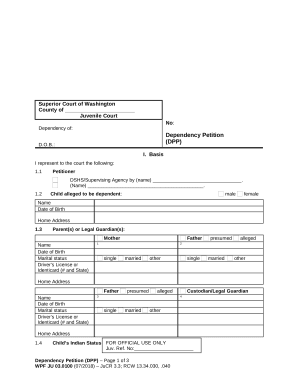
  1. Open our Washington Juvenile Court and search for the form you need.
  2. Preview your form to ensure it’s what you want, and click Get Form to start working on it.
  3. Modify, add new text, or highlight important information with DocHub features.
  4. Complete your form and save the modifications.
  5. Download or share your form template with other recipients.

Examine all the opportunities for your online file management using our Washington Juvenile Court. Get a free free DocHub account today!


Video Guide on Washington Juvenile Court management

video background

Commonly Asked Questions about Washington Juvenile Court

The Washington State Patrol is the official background repository for the State of Washington. WSP maintains a way for the public to access a criminal history online. There is a fee involved with this service and a credit card is required.
The official juvenile court file is open for public inspection until sealed or expunged, but the other juvenile court records are confidential. In addition to a juvenile court record, you have criminal history record information (CHRI) on file with the Washington State Patrol.
Ten (10) is the minimal age for secure detention of a juvenile unless it is a capital offense. Must be at least thirteen (13) years of age in order to be declared as a JSO. The age of 18 triggers adult court jurisdiction.
In Washington State, a juvenile is any individual between the ages of 8 and 18 and who has never been transferred to adult court. Persons younger than 8 years of age cannot commit crimes in Washington.
Juvenile trials in WA State are decided by a Juvenile Court judge and not by a jury. Trials (referred to as Adjudication Hearings) must be held within 30 days of the Arraignment Hearing if the juvenile is in detention or within 60 days if the juvenile is not in detention.
Juvenile records are automatically expunged when the individual docHubes 21 years of age, unless the person was previously classified as a serious or habitual juvenile offender, or he had been committed to a juvenile correctional facility or juvenile prison.