
Juvenile Law
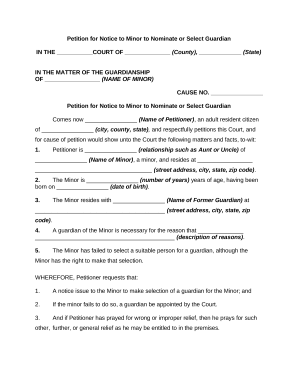
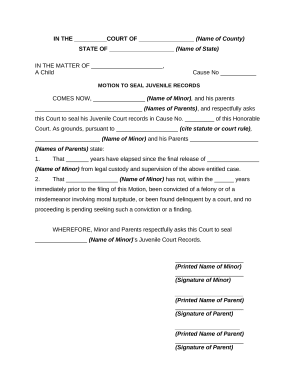
Get and handle Juvenile Law online
Accelerate your file management with our Juvenile Law category with ready-made templates that suit your requirements. Get your document template, alter it, complete it, and share it with your contributors without breaking a sweat. Start working more efficiently together with your forms.
The best way to use our Juvenile Law:
- Open our Juvenile Law and look for the form you require.
- Preview your form to ensure it’s what you want, and click on Get Form to start working on it.
- Modify, include new text, or highlight important information with DocHub features.
- Prepare your form and preserve the changes.
- Download or share your form template with other recipients.
Explore all of the possibilities for your online file management with our Juvenile Law. Get your free free DocHub profile right now!
Video Guide on Juvenile Law management

Commonly Asked Questions about Juvenile Law
What is the definition of juvenile law?
Juvenile justice is the area of criminal law applicable to persons not old enough to be held fully responsible for criminal acts. In most states, the age for adult criminal culpability is set at 18. In cases of extreme violence or other anti-social behavior, the age a child can be charged as an adult is lowered.
What are three types of juveniles?
Many states have created three categories for juveniles: delinquents, abused or neglected children, and children in need of services. Delinquents are juveniles who have committed acts that would result in criminal prosecution if committed by an adult.
What are the rights of juveniles?
The United States Supreme Court has held that in juvenile commitment proceedings, juvenile courts must afford to juveniles basic constitutional protections, such as advance notice of the charges, the right to counsel, the right to confront and cross-examine adverse witnesses, and the right to remain silent.
What is the juvenile delinquency law in the US?
The Juvenile Court System As a general rule, a juvenile is not charged with a crime but instead faces prosecution for an act of delinquency. In some circumstances, though, where the crime is egregious or severe, the prosecution may ask the court to allow the minor to be tried as an adult.
Purpose What is the purpose of juvenile law?
The term juveniles as used in this Act means persons under 19 years of age, and the term guardian means any person who has the legal obligation to take care of, supervise and protect, and educate juveniles, or any person who is presently supervising and protecting juveniles. Juvenile Act - Statutes of the Republic of Korea klri.re.kr engmobile viewer klri.re.kr engmobile viewer
What is the definition of a juvenile crime?
A juvenile is a person who has not attained his eighteenth birthday, and juvenile delinquency is the violation of a law of the United States committed by a person prior to his eighteenth birthday which would have been a crime if committed by an adult.
What is the youngest age to go to juvenile court?
A: On a national level, there is no youngest age to go to juvenile court. The United States has not set a minimum age for juvenile court jurisdiction, and neither have twenty-eight states. However, California is one of the few to have done sothe states minimum age is 12.
Type of law What type of law is juvenile law?
The Juvenile Justice Act of 2015 is a law in India that deals with the care and protection of children. It was enacted in 2015 and replaced the previous Juvenile Justice Act, 1986. The Act defines a child as a person who is below the age of 18 years. It also defines different categories of children. Juvenile Justice (Care and Protection of Children) Act, 2015 - Testbook testbook.com ias-preparation juvenile-justice-act testbook.com ias-preparation juvenile-justice-act
What is the explanation of a juvenile?
a person who is not old enough to be considered an adult: He was still a juvenile when the crime was committed.