Custody juvenile order 2026

Get Form
custody juvenile order Preview on Page 1

Here's how it works

01. Edit your form online
Type text, add images, blackout confidential details, add comments, highlights and more.
02. Sign it in a few clicks
Draw your signature, type it, upload its image, or use your mobile device as a signature pad.
03. Share your form with others
Send it via email, link, or fax. You can also download it, export it or print it out.

How to use or fill out custody juvenile order with our platform

Form edit decoration
9.5
Ease of Setup
DocHub User Ratings on G2
9.0
Ease of Use
DocHub User Ratings on G2
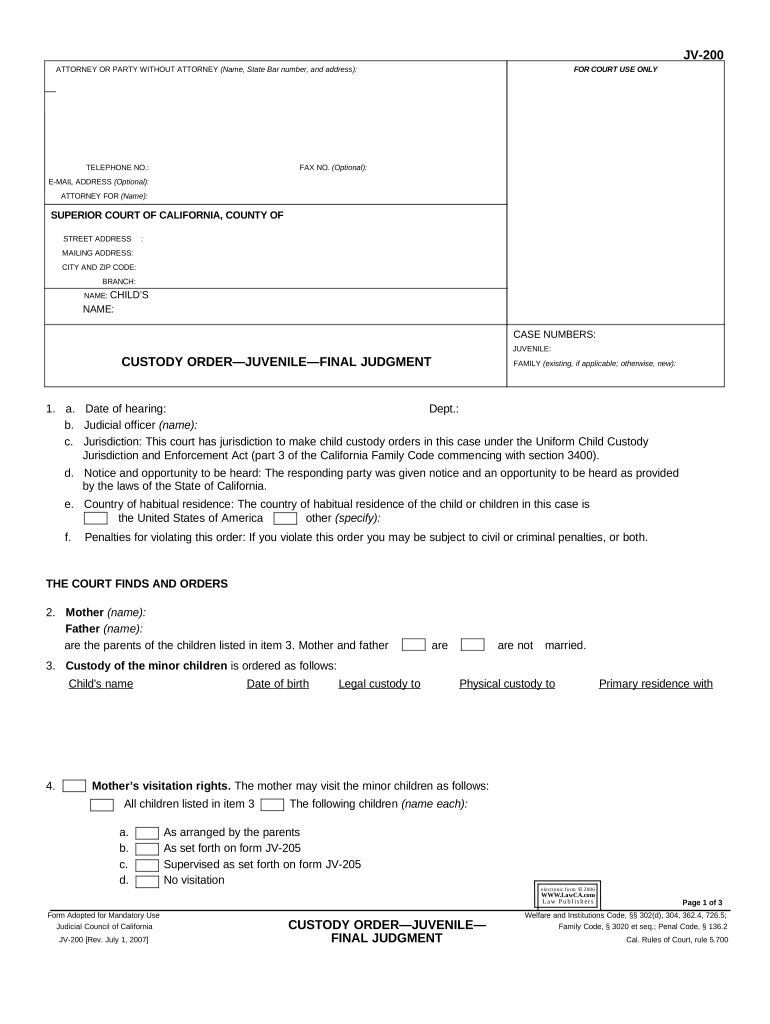
  1. Click ‘Get Form’ to open the custody juvenile order in the editor.
  2. Begin by entering your information in the 'Attorney or Party Without Attorney' section, including your name, state bar number, and contact details.
  3. Fill in the court's details such as the Superior Court of California, county, street address, and mailing address.
  4. In the 'Child’s Name' section, provide the names of all children involved along with their case numbers.
  5. Complete the hearing details including date, department, judicial officer's name, and jurisdiction information.
  6. Specify custody arrangements for each child listed under item 3. Indicate legal and physical custody assignments clearly.
  7. Detail visitation rights for both parents in sections 5 and 6. Be specific about arrangements or any limitations.
  8. Review all entries for accuracy before saving or exporting your completed form for submission.

Start using our platform today to easily fill out your custody juvenile order online for free!

be ready to get more

Complete this form in 5 minutes or less

Get form

Got questions?

We have answers to the most popular questions from our customers. If you can't find an answer to your question, please contact us.
Contact us
The judge will review the motion, and if the evidence supports your claims, they may find the custodial parent in contempt. This ruling can lead to various consequences, including fines, make-up visitation time, or even jail time for the offending parent in severe cases.
The Juvenile Court Process: What You Should Know 1) Investigation. 2) Diversion. 3) First Appearance. 4) Arraignment. 5) Pre-Trial Hearing (also known as Pretrial Conference or a Case Setting Hearing) 6) Fact Finding Hearing (also known as an adjudication hearing or trial) 7) Disposition. 8) After Disposition.
In most custody battles, the winner is the parent who can best demonstrate that they serve the childs best interests. While mothers still win more cases overall, the gap has narrowed as fathers play a greater role in raising their children.
Probation. By far the most common disposition for youth adjudicated delinquent is probation.
Juvenile justice court cases start with the filing of a petition. The Probation Department or the District Attorney can file the petition. A petition asks the court to get involved. It says what the state thinks the youth did.

People also ask

In California, the juvenile justice system aims to rehabilitate rather than punish, but this doesnt mean you can expect mild consequences. Offenses can lead to formal probation, detention, fines, or even a transfer to adult court.
Juvenile Court Process The Juvenile Arrest Process. A juvenile court case typically begins with the minor being arrested by a law enforcement officer. The Juvenile Petition. The Detention Hearing. The Fitness Hearing. Pretrial/Motion Hearings. Jurisdiction Hearing/Adjudication. Disposition Hearing.

Related links