Improve your file operations with Bankruptcy Documentation

Your workflows always benefit when you are able to obtain all the forms and files you may need on hand. DocHub delivers a huge selection of form templates to ease your day-to-day pains. Get hold of Bankruptcy Documentation category and quickly find your form.

Begin working with Bankruptcy Documentation in a few clicks:

  1. Browse Bankruptcy Documentation and get the document you need.
  2. Click Get Form to open it in our editor.
  3. Begin changing your form: add fillable fields, highlight sentences, or blackout sensitive details.
  4. The application saves your adjustments automatically, and after you are all set, you are able to download or distribute your file with other contributors.

Enjoy fast and easy form managing with DocHub. Check out our Bankruptcy Documentation collection and get your form right now!


Commonly Asked Questions about Bankruptcy Documentation

The disclosure statement is a document that must contain information concerning the assets, liabilities, and business affairs of the debtor sufficient to enable a creditor to make an informed judgment about the debtors plan of reorganization.
Chapter 7 Bankruptcy Also known as liquidation or straight bankruptcy, Chapter 7 is the most common type of bankruptcy for individuals. A court-appointed trustee oversees the liquidation (sale) of your assets (anything you own that has value) to pay off your creditors (the people you owe money to).
The most common types of bankruptcy are chapter 7, which are liquidating bankruptcy, and chapter 13 cases, often used by individuals who want to catch up on past due mortgage or car loan payments and keep their assets.
Generally, Chapter 7 is more appropriate for simple cases while Chapter 13 for more complicated bankruptcies. Or somewhat more accurately, Chapter 13 can give you more power over and flexibility with certain kinds of creditors, and if you have non-exempt assets.
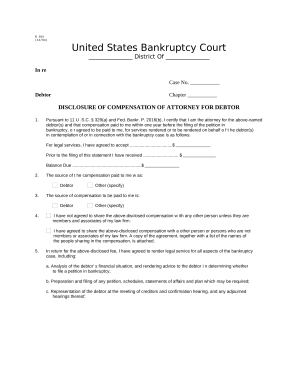
A bankruptcy case normally begins when the debtor files a petition with the bankruptcy court. A petition may be filed by an individual, by spouses together, or by a corporation or other entity.
These documents have various titles including: Schedules Exhibits and then a combination of other forms titled Statements, Declarations, Summary, Disclosure, Verification, Notice, Debtors Certification, Plan (chapter 13 only), and Venue Disclosure (chapter 11 only).
Chapter 7 is the most common form of bankruptcy for individuals. Chapter 11 bankruptcy is usually for corporations because of its complexity, but individuals can file too.
Chapter 7 and Chapter 13 bankruptcy are the most commonly filed types of bankruptcy, likely because theyre available to individuals.