Colorado Bankruptcy Guide and Forms Package for Chapters 7 or 13 - Colorado 2026

Get Form
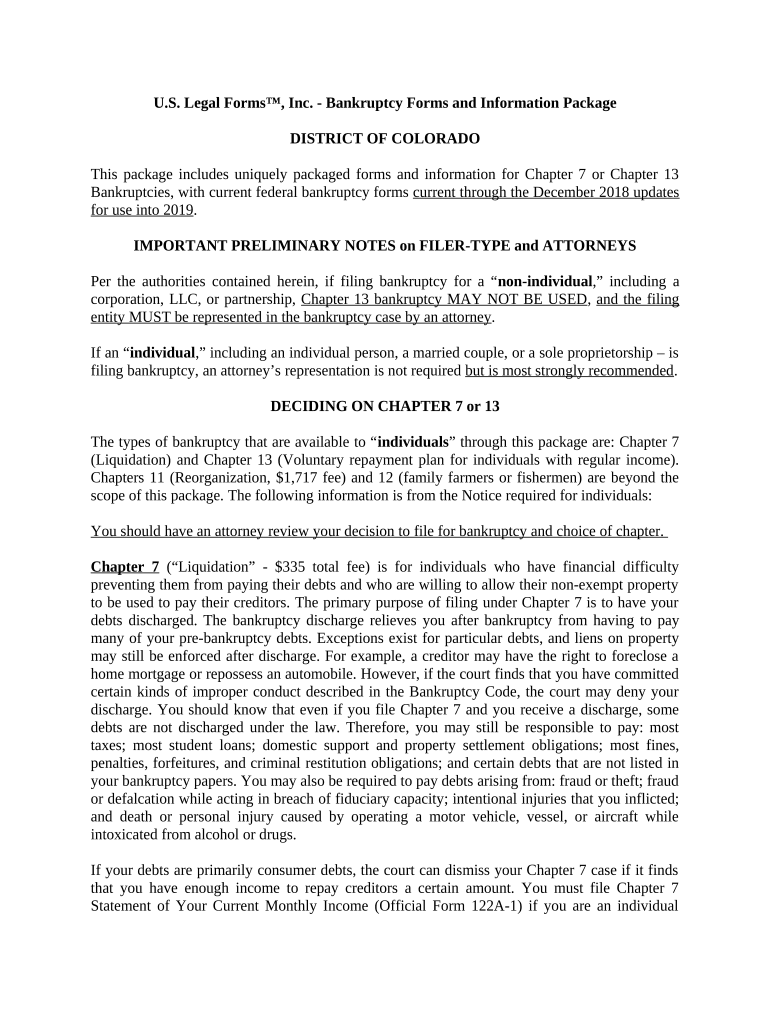
Colorado Bankruptcy Guide and Forms Package for Chapters 7 or 13 - Colorado Preview on Page 1

Here's how it works

01. Edit your form online
Type text, add images, blackout confidential details, add comments, highlights and more.
02. Sign it in a few clicks
Draw your signature, type it, upload its image, or use your mobile device as a signature pad.
03. Share your form with others
Send it via email, link, or fax. You can also download it, export it or print it out.

How to use or fill out Colorado Bankruptcy Guide and Forms Package for Chapters 7 or 13 - Colorado

Form edit decoration
9.5
Ease of Setup
DocHub User Ratings on G2
9.0
Ease of Use
DocHub User Ratings on G2
  1. Click ‘Get Form’ to open the Colorado Bankruptcy Guide and Forms Package in our editor.
  2. Begin by reviewing the preliminary notes regarding filer types. Ensure you understand whether you are filing as an individual or a non-individual entity.
  3. Decide between Chapter 7 and Chapter 13 based on your financial situation. For Chapter 7, complete the Statement of Your Current Monthly Income (Official Form 122A-1) to determine eligibility.
  4. If filing under Chapter 7, fill out the Means Test Calculation (Official Form 122A-2) if your income exceeds the state median. This will help assess your ability to repay debts.
  5. For Chapter 13, draft a repayment plan detailing how you intend to pay off your debts over time. Make sure it aligns with court requirements.
  6. Review all completed forms for accuracy before submission. Utilize our platform’s features to save and edit as needed.

Start using our editor today to simplify your bankruptcy form completion process!

be ready to get more

Complete this form in 5 minutes or less

Get form

Got questions?

We have answers to the most popular questions from our customers. If you can't find an answer to your question, please contact us.
Contact us
If your total monthly income over the course of the next 60 months is less than $7,475 then you pass the means test and you may file a Chapter 7 bankruptcy. If it is over $12,475 then you fail the means test and dont have the option of filing Chapter 7.
The biggest difference between Chapter 7 and Chapter 13 is that Chapter 7 focuses on discharging (getting rid of) unsecured debt such as credit cards, personal loans and medical bills while Chapter 13 allows you to catch up on secured debts like your home or your car while also discharging unsecured debt.
In a Chapter 7 bankruptcy you wipe out your debts and get a Fresh Start. Chapter 7 bankruptcy is a liquidation where the trustee collects all of your assets and sells any assets which are not exempt. (see Colorado Exemptions) The trustee sells the assets and pays you, the debtor, any amount exempted.
If youre filing Chapter 7 bankruptcy in Colorado, the court charges a $338 filing fee.
The district court or the bankruptcy court may waive the chapter 7 filing fee for an individual debtor who: (a) has income less than 150 percent of the income official poverty line applicable to a family of the size involved; and (b) is unable to pay that fee in installments.

Security and compliance

At DocHub, your data security is our priority. We follow HIPAA, SOC2, GDPR, and other standards, so you can work on your documents with confidence.

Learn more
ccpa2
pci-dss
gdpr-compliance
hipaa
soc-compliance

People also ask

Common types of assets and nonexempt property a debtor could potentially lose in Chapter 7 bankruptcy include: Vacation properties. Investment accounts. Stocks and bonds. Rental properties. Luxury items. Valuable artwork. Jewelry. Antiques.

Related links