




01. Edit your form online
Type text, add images, blackout confidential details, add comments, highlights and more.

Type text, add images, blackout confidential details, add comments, highlights and more.

Draw your signature, type it, upload its image, or use your mobile device as a signature pad.

Send it via email, link, or fax. You can also download it, export it or print it out.
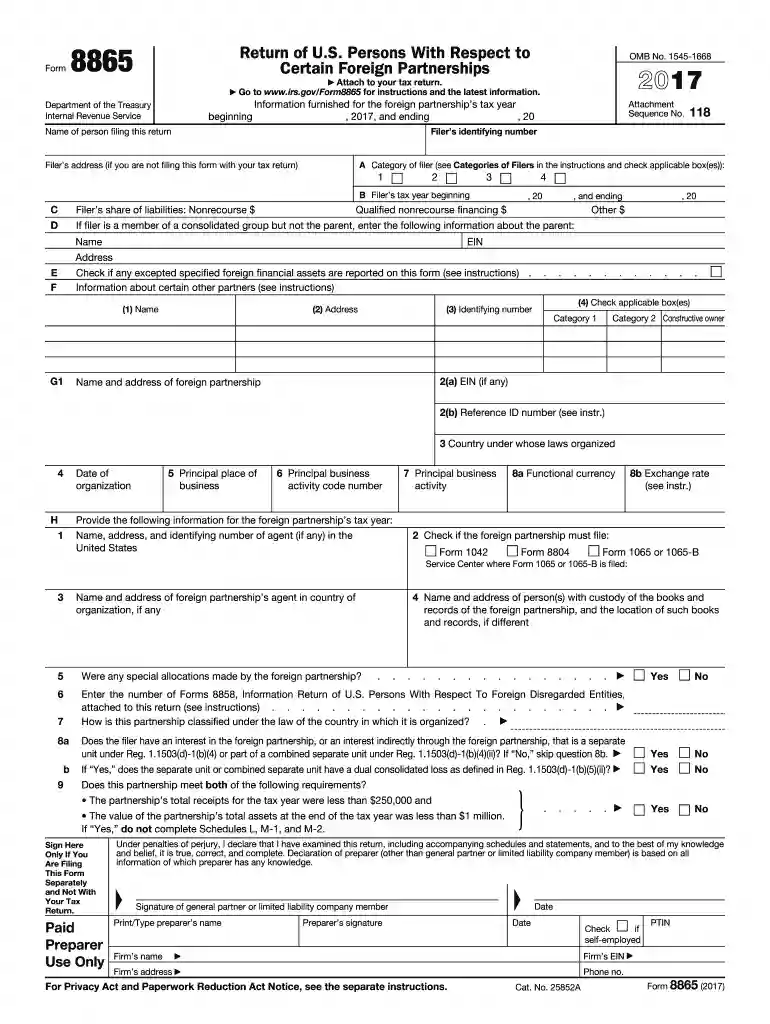
Form 8865, formally known as the "Return of U.S. Persons With Respect to Certain Foreign Partnerships," is used to report information about these foreign partnerships to the IRS. The responsibility falls on U.S. persons who have a certain level of ownership or control, to disclose financial relationships and activities. The 2017 version of this form captures key details necessary for compliance with U.S. tax laws pertaining to foreign partnerships. Through this form, filers disclose income, deductions, and ownership interests in foreign partnerships, ensuring that the IRS has transparency regarding international financial dealings.
Gather Required Information:
Complete the Identifying Information:
Report Financial Data:
Attach to U.S. Tax Return:
Filing Form 8865 is crucial to remain compliant with IRS regulations regarding foreign partnerships. It's designed to keep the IRS informed about U.S. taxpayers’ holdings and financial activities involving foreign partnerships. Compliance helps avoid penalties or future audits by demonstrating transparency. This form also allows accurate taxation of income derived from foreign entities, ensuring that taxpayers and the IRS can account for international revenues and liabilities correctly.
The form is specifically designed for U.S. persons with interests in foreign partnerships. This includes:
These individuals and entities must disclose their roles to ensure the IRS has complete oversight of all cross-border financial activities.
Form 8865 must adhere to the regulations outlined by the IRS under the Internal Revenue Code. Compliance with legal standards is essential:
Ensure that every section is filled out in accordance with IRS guidelines to avoid potential compliance issues.
The IRS mandates that Form 8865 be filed alongside a taxpayer's tax return when a U.S. person holds qualifying investments in a foreign partnership. Key guidelines include:
Consult IRS documentation for detailed filing instructions and updates related to specific tax years.
Failure to accurately file Form 8865 invites significant penalties:
Ensuring compliance by accurately completing and submitting the form mitigates these risks, fostering both transparency and good standing with the IRS.
Understanding the filing deadlines associated with Form 8865 is paramount:
Meeting these deadlines ensures compliance and avoids the associated penalties for late filing.
We've got more versions of the form 8865DocHubcom 2017 form. Select the right form 8865DocHubcom 2017 version from the list and start editing it straight away!
| Versions | Form popularity | Fillable & printable |
|---|---|---|
| 2025 | 4.7 Satisfied (51 Votes) | |
| 2024 | 4.5 Satisfied (21 Votes) | |
| 2023 | 4.3 Satisfied (48 Votes) | |
| 2022 | 4.9 Satisfied (47 Votes) | |
| 2021 | 4.8 Satisfied (119 Votes) | |
| 2020 | 4.3 Satisfied (169 Votes) | |
| 2019 | 4.3 Satisfied (148 Votes) | |
| 2018 | 4.3 Satisfied (91 Votes) | |
| 2017 | 4.4 Satisfied (153 Votes) | |
| 2016 | 4.4 Satisfied (325 Votes) | |
| 2015 | 4 Satisfied (42 Votes) | |
| 2014 | 4 Satisfied (22 Votes) | |
| 2009 | 4.2 Satisfied (42 Votes) |
At DocHub, your data security is our priority. We follow HIPAA, SOC2, GDPR, and other standards, so you can work on your documents with confidence.


