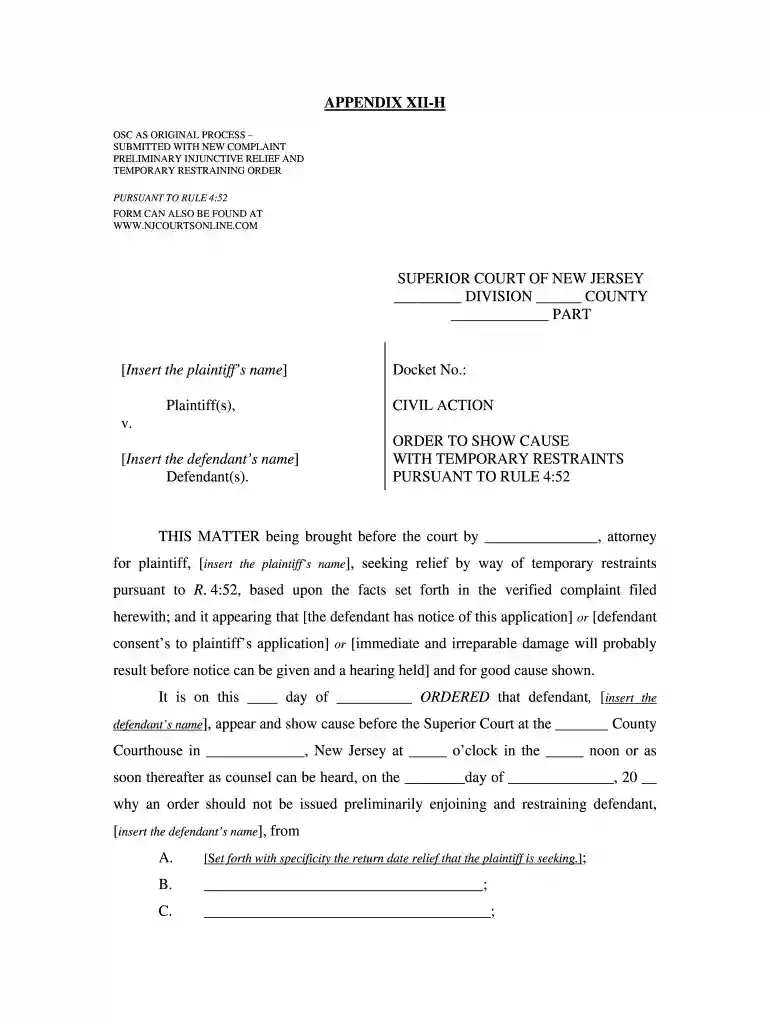
Rule to show cause form new jersey 2008-2026

Get Form
rule to show cause form new jersey 2008 Preview on Page 1

Here's how it works

01. Edit your form online
Type text, add images, blackout confidential details, add comments, highlights and more.

02. Sign it in a few clicks
Draw your signature, type it, upload its image, or use your mobile device as a signature pad.

03. Share your form with others
Send it via email, link, or fax. You can also download it, export it or print it out.

How to use or fill out rule to show cause form new jersey 2008 with DocHub

Form edit decoration
9.5
Ease of Setup
DocHub User Ratings on G2
9.0
Ease of Use
DocHub User Ratings on G2
  1. Click ‘Get Form’ to open the rule to show cause form in our editor.
  2. Begin by entering the plaintiff's name and defendant's name in the designated fields at the top of the form. Ensure accuracy as this information is crucial for court proceedings.
  3. Fill in the docket number and civil action details, which are essential for identifying your case within the court system.
  4. In the section regarding temporary restraints, specify what relief you are seeking. Clearly outline each request (A, B, C) with detailed descriptions to support your application.
  5. Complete any additional sections that require information about service of process and deadlines for responses. This ensures compliance with court rules.
  6. Review all entries for accuracy before saving or printing your completed form. Use our platform’s features to make edits easily if needed.

Start using our editor today to fill out your rule to show cause form efficiently and for free!

See more rule to show cause form new jersey 2008 versions

We've got more versions of the rule to show cause form new jersey 2008 form. Select the right rule to show cause form new jersey 2008 version from the list and start editing it straight away!
Versions Form popularity Fillable & printable
2019 4.8 Satisfied (89 Votes)
2012 4.4 Satisfied (104 Votes)
2008 4.3 Satisfied (119 Votes)
be ready to get more

Complete this form in 5 minutes or less

Get form

Got questions?

We have answers to the most popular questions from our customers. If you can't find an answer to your question, please contact us.
Contact us
Evidence is Everything Show Cause hearings are very evidentiary based. You must be able to show the judge the ways in which the opposing party has not complied with the order currently in place. If the other side has not complied with the order, they will be found guilty.
The plaintiff must file and serve any written reply to the defendants order to show cause opposition by . The reply papers must be filed with the Clerk of the Superior Court in the county listed above and a copy of the reply papers must be sent directly to the chambers of Judge .
An order to show cause (O.S.C.), is a court order or the demand of a judge requiring a party to justify or explain why the court should or should not grant a motion or a relief. For example, if a party requests a restraining order from a judge, the judge may need more information.
To obtain an Order to Show Cause for injunctive relief, the requesting party must show the court that the situation at hand could cause serious and irreparable harm to the moving party if the court does not act. This has also been described as immediate and irreversible harm to the movant.
Orders to Show Cause are generally used to avert or prevent irreparable harm to a child or to protect their health, safety, and welfare. Prevention of harm is the reason to seek emergent remedy with the court. The court, in its discretion, may issue an emergency order.

Security and compliance

At DocHub, your data security is our priority. We follow HIPAA, SOC2, GDPR, and other standards, so you can work on your documents with confidence.

Learn more
ccpa2
pci-dss
gdpr-compliance
hipaa
soc-compliance
be ready to get more

Complete this form in 5 minutes or less

Get form

People also ask

Rule 3:13-3(b) of the New Jersey Rules of Court directs, in relevant part, that the prosecutors discovery for a defendant named in an indictment is to be provided or made available within seven days of the return or unsealing of the indictment.
4:43-1. Entry of Default If a party against whom a judgment for affirmative relief is sought has failed to plead or otherwise defend as provided by these rules or court order, or if the answer has been stricken with prejudice, the clerk shall enter a default on the docket as to such party.

Related links