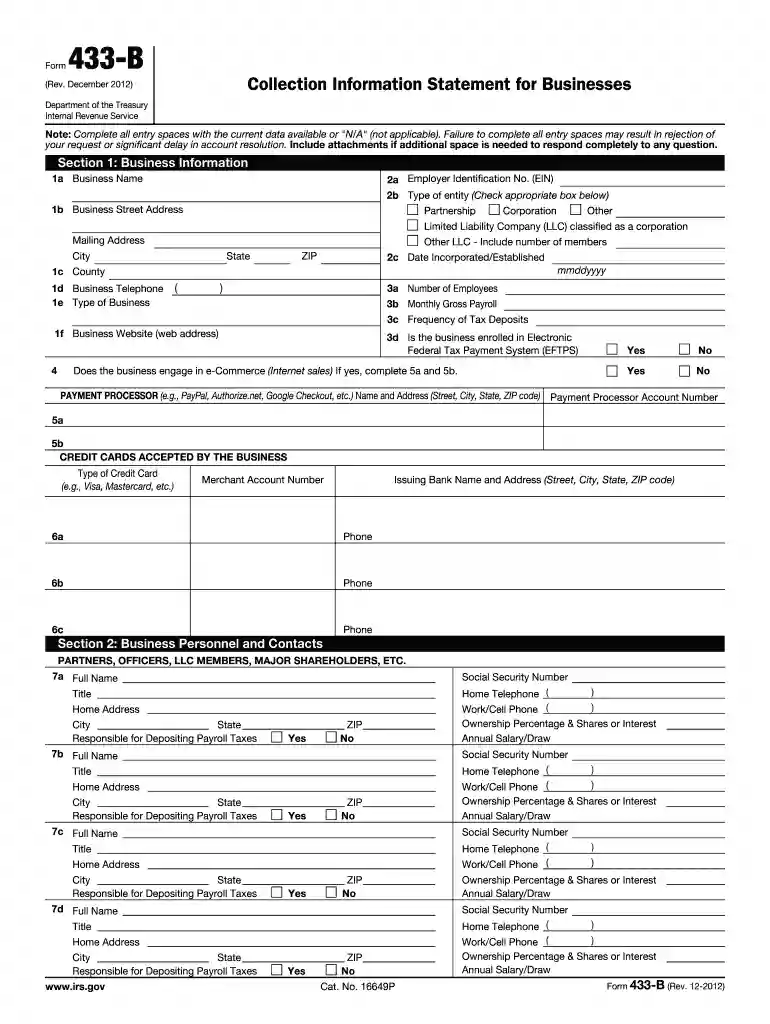
Definition and Purpose of Form 433-B
Form 433-B, the Collection Information Statement for Businesses, is an essential document issued by the IRS designed to collect comprehensive financial data from businesses. This form is crucial for tax account resolutions, as it involves providing detailed information on business finances, assets, liabilities, income, and expenses. It serves to offer the IRS a snapshot of a business's financial situation, enabling it to make informed decisions concerning payment plans and compliance.
Sections Covered in Form 433-B
The document features several sections where businesses must report specific details:
- Business Information: This section includes basic information about the entity, such as legal name, business address, type of business entity, and EIN (Employer Identification Number).
- Personnel Details: Here, businesses must list their officers, partners, members, or shareholders, providing their names, titles, and Social Security Numbers.
- Financial Status: This includes a breakdown of the business's assets and liabilities, ensuring the IRS can assess the company's fiscal health accurately.
- Monthly Income and Expenses: Detailed records of monthly revenue and operating costs are necessary for the IRS to understand cash flow and financial obligations.
How to Obtain Form 433-B
To acquire Form 433-B, businesses can access it directly from the IRS website, ensuring they have the most recent version available. Alternatively, physical copies can be requested from the IRS by mail. It is imperative for businesses to use the correct form version, especially given its historical updates from 2012 to 2019.
Steps to Complete Form 433-B
Completing Form 433-B involves a series of detailed steps:
- Read the Instructions Carefully: Before starting, reviewing the IRS's guidance notes will help understand the required information.
- Gather Financial Documents: Compile all relevant financial records, including bank statements, profit and loss statements, balance sheets, and payroll information.
- Fill Out Personal and Business Information: Provide accurate details in the designated sections, ensuring no errors that could delay processing.
- Detailing Assets and Liabilities: Carefully assess and record the business's current assets and liabilities.
- Income and Expense Breakdown: Calculate and report all monthly income sources and expenses to provide a complete financial picture.
- Review and Attach Required Documents: Double-check for completeness and attach any necessary financial records as supporting evidence.
- Submit the Form to the IRS: Depending on preferences, submit the completed form via mail or a relevant IRS-approved electronic of the method.
Who Typically Uses Form 433-B
Form 433-B is primarily utilized by various business entities that need to negotiate tax resolutions or establish payment plans with the IRS. These entities typically include:
- Sole Proprietorships: Independent businesses owned and operated by individual entrepreneurs.
- Partnerships: Businesses owned by two or more people who share responsibilities and profits.
- Corporations: Larger, incorporated businesses that may face complex tax obligations.
- Limited Liability Companies (LLCs): Business structures combining the operational flexibility of a partnership with the limited liability features of a corporation.
Key Elements of Form 433-B
Certain elements are pivotal in Form 433-B, affecting its interpretation and submission:
- Accuracy of Information: Precise and up-to-date financial details are essential to avoid discrepancies that can lead to delays.
- Supporting Documentation: Including all relevant attachments is crucial for validating the form's accuracy.
- Adherence to Deadlines: Timely completion and submission are vital for avoiding potential penalties or disputes with the IRS.
IRS Guidelines for Completing Form 433-B
The IRS provides explicit guidelines to ensure that the form is completed accurately and efficiently. These include:
- Complete All Sections: The form must be filled in entirely, with no sections left incomplete.
- Clarity and Legibility: Ensure that all details are clear and legible, using print or typed text if necessary.
- Accuracy of Financial Data: Any fiscal inaccuracies can lead to IRS auditors requesting additional explanations or corrections.
- Attach Necessary Documents: Follow IRS instructions on required supporting documents, such as financial statements and tax returns.
Penalties for Non-Compliance
Non-compliance with the submission of Form 433-B can have significant repercussions, including:
- Fines and Interest: Delayed or inaccurate filings may result in accruing interest on unpaid taxes or additional fines.
- IRS Enforcement Actions: Serious consequences such as liens or levies on business assets may follow non-compliance.
- Possible Legal Action: In severe cases, the IRS can initiate legal proceedings for failure to comply with tax filing obligations.
State-by-State Differences
While Form 433-B is a federal document, some state-specific rules and procedural variations may apply, particularly concerning state tax compliance and additional documentation requirements. Businesses must consult a tax advisor or legal expert familiar with their state's tax laws to ensure comprehensive compliance with both federal and state obligations.
Business Types Benefiting Most from Form 433-B
Certain business types find significant utility in using Form 433-B:
- Small Businesses: They often require assistance in negotiating manageable payment plans.
- New Enterprises: Start-ups and emerging businesses benefit from structuring tax obligations given their volatile early financial stages.
- Financially Distressed Companies: Businesses facing financial difficulties may use this form to communicate their situation to the IRS and seek relief options.