




01. Edit your c 2019 online
Type text, add images, blackout confidential details, add comments, highlights and more.

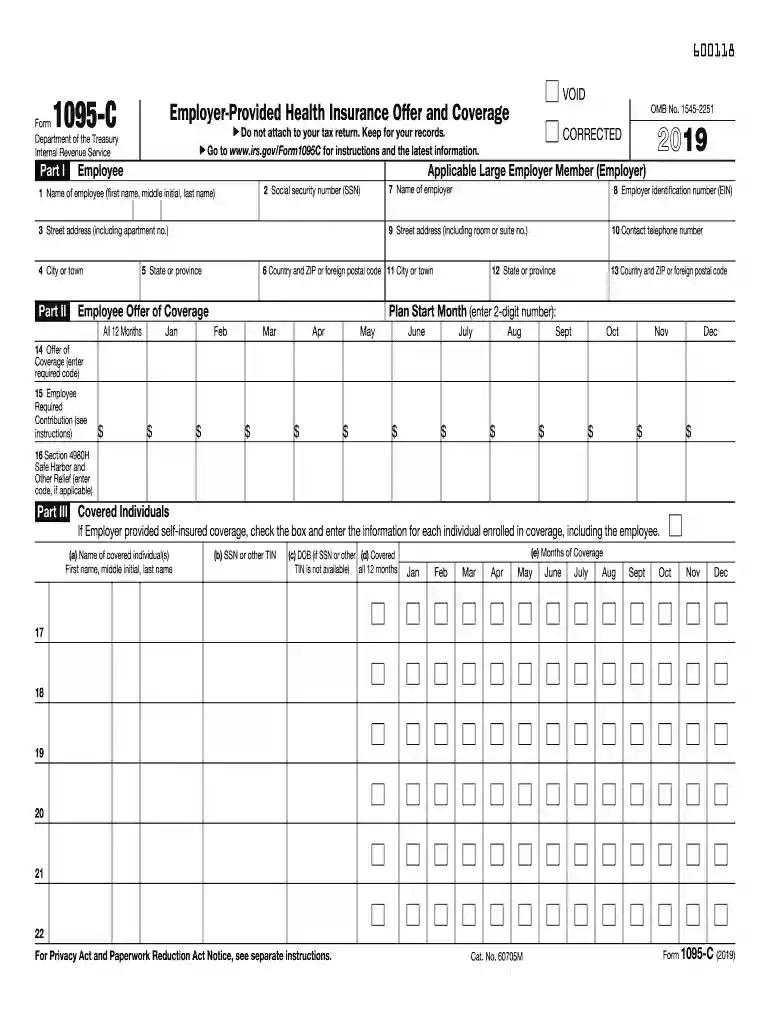
Type text, add images, blackout confidential details, add comments, highlights and more.

Draw your signature, type it, upload its image, or use your mobile device as a signature pad.

Send 2019 1095 c form via email, link, or fax. You can also download it, export it or print it out.
Form 1095-C is an essential tax document utilized by Applicable Large Employers (ALEs) in the United States to report information regarding employee health insurance coverage under the Affordable Care Act (ACA). This form is a significant component of ensuring compliance with ACA regulations, as it provides both employees and the Internal Revenue Service (IRS) with details about the type of health coverage offered, the period it was available, and the costs involved. The data captured on the 1095-C form assists in determining eligibility for premium tax credits and helps the IRS verify individual health care coverage mandates.
Employers classified as ALEs are responsible for issuing Form 1095-C to each full-time employee. Typically, these forms are mailed directly to the employee's home address. But, employees can also access their Form 1095-C electronically if the employer provides such an option through a secure online platform. It is crucial for employees to have their current mailing information updated with their employer to ensure timely delivery. If the form is not received, employees should contact their employer’s HR department to request a copy.
The IRS requires that Form 1095-C be provided to employees by January 31st following the reporting year. Employers must also file copies of these forms with the IRS by February 28th if filing by paper or March 31st if filing electronically. It is imperative to adhere to these deadlines to avoid potential penalties.
To properly complete Form 1095-C, employers will need access to:
The ACA mandates ALEs to file Form 1095-C to enforce transparency in employer-provided health insurance offerings. Employers must comply to avoid penalties under the employer shared responsibility provisions. Failing to issue a 1095-C form or inaccurate filings may result in fines imposed by the IRS.
Non-compliance with Form 1095-C filing requirements can lead to significant penalties. Failure to furnish the form to employees or file with the IRS can result in a fine of up to $280 per form, per failure. Penalties may increase if errors are corrected after IRS audit initiation. Employers should implement strict review processes to ensure accuracy and timely submission of Form 1095-C.
Consider a corporation with 150 employees. The company, classified as an ALE, must issue Form 1095-C to all full-time employees offered health coverage, indicating each individual's coverage terms, duration, and contributions. Employees, in turn, use this form to verify their health coverage while filing their individual income tax returns. Additionally, a smaller business transitioning to ALE status must adapt their internal processes to scale up compliance and reporting for their growing workforce.
We've got more versions of the c 2019 form. Select the right c 2019 version from the list and start editing it straight away!
| Versions | Form popularity | Fillable & printable |
|---|---|---|
| 2025 | 4.9 Satisfied (51 Votes) | |
| 2024 | 4.3 Satisfied (52 Votes) | |
| 2023 | 4.5 Satisfied (35 Votes) | |
| 2022 | 4.9 Satisfied (50 Votes) | |
| 2021 | 4.8 Satisfied (40 Votes) | |
| 2020 | 4.4 Satisfied (85 Votes) | |
| 2019 | 3.9 Satisfied (39 Votes) | |
| 2018 | 4.4 Satisfied (103 Votes) | |
| 2017 | 4.3 Satisfied (71 Votes) | |
| 2016 | 4.4 Satisfied (362 Votes) | |
| 2015 | 4.3 Satisfied (191 Votes) | |
| 2014 | 4 Satisfied (44 Votes) |
At DocHub, your data security is our priority. We follow HIPAA, SOC2, GDPR, and other standards, so you can work on your documents with confidence.

Apr 15, 2015 It will help you figure your premium tax credit. If you did not receive a Form 1095-A, contact the. Marketplace. Medicaid waiver payments. IfRead more
The Affordable Care Act requires employers to send Form 1095-C to certain employees. This form contains detailed information about your health care coverage.Read more
Sep 27, 2018 When To File. You will meet the requirement to file Forms 1094-C and 1095-C if the forms are properly addressed and mailed on or before the.Read more


