






Definition & Meaning
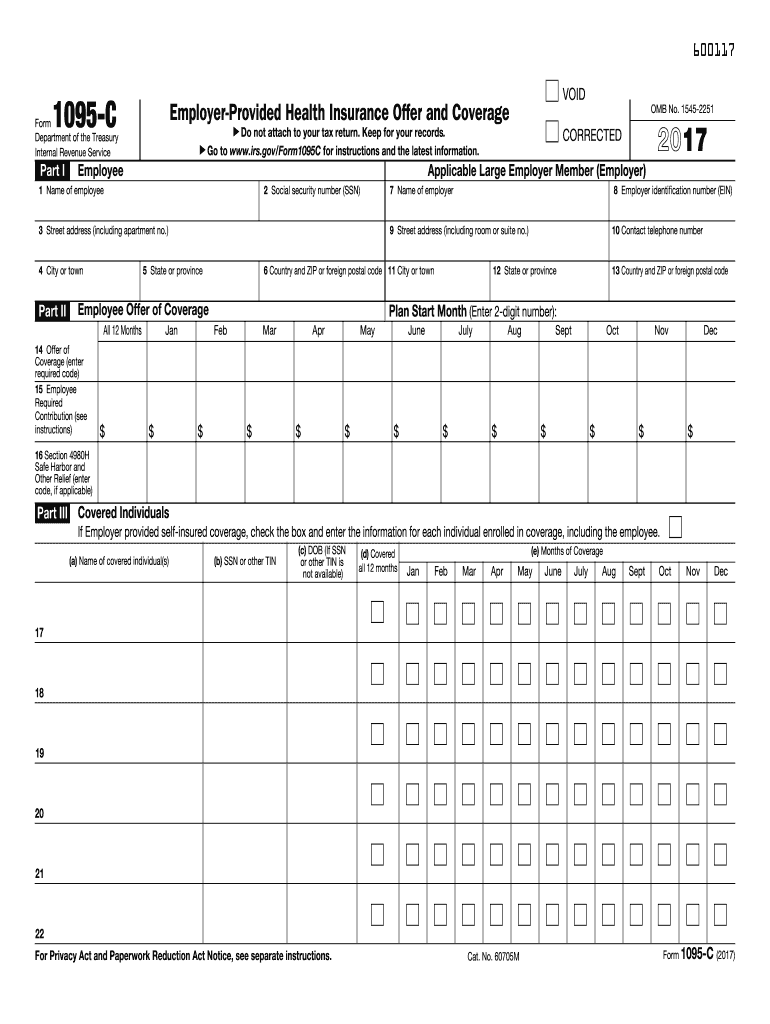
Form 1095-C, issued by the IRS, is a tax document that provides information about health insurance coverage offered by an Applicable Large Employer (ALE) to its employees. It is crucial for understanding an employer's compliance with the Affordable Care Act's (ACA) employer mandate. The form details the type and duration of health coverage provided, including specifics such as the employee's health coverage status and the amount paid by the employer. Employees use this form to verify the details of their health coverage when filing their taxes.
Steps to Complete the 1095-C Form 2017
-
Gather Personal Information: Collect your employer's identification details, such as the Employer Identification Number (EIN) and your own Social Security Number.
-
Detail Coverage Information: Note the months you were offered health insurance coverage and the cost of the cheapest monthly premium for self-only coverage.
-
Check for Accuracy: Verify that all information regarding the coverage offered and received, including covered dependents, is accurate.
-
Complete Part III if Needed: Only if self-insured, complete Part III to list covered individuals.
-
Review the Form: Double-check all entries to ensure that personal data and coverage details are accurately reflected.
How to Obtain the 1095-C Form 2017
Form 1095-C is typically issued by your employer if they qualify as an Applicable Large Employer. Employers are responsible for distributing this form to their employees annually. Employees can expect to receive their copies by mail or, in some instances, electronically, depending on the employer's distribution methods and employee consent for electronic receipts. If you do not receive a form, contact your human resources or benefits department.
Key Elements of the 1095-C Form 2017
-
Part I - Employee Details: This section includes the employee's contact information and the employer's details, illustrating the relationship and context of the health coverage.
-
Part II - Offer of Coverage: Records the months during which the employee received an offer of health coverage and the cost of the plan.
-
Part III - Covered Individuals: Required only for self-insured plans, detailing every person covered under the policy, including family members.
IRS Guidelines for the 1095-C Form 2017
The IRS requires that Form 1095-C be filed as part of the employer's annual reporting obligations under the ACA. Employers must file these forms with the IRS, reporting their compliance with the employer shared responsibility mandate. Employees should retain their copies for personal records and tax filing purposes, though it may not be necessary to attach it to their tax returns.
Filing Deadlines / Important Dates
The deadline for employers to furnish the 1095-C forms to employees is typically at the beginning of the year following the coverage year, around January 31. The corresponding deadlines for filing these forms with the IRS generally fall in late February for paper submissions and late March for electronic submissions.
Penalties for Non-Compliance
Failure to provide employees with Form 1095-C or filing incorrect information can lead to substantial penalties. The IRS enforces fines per form not provided to an employee or per form with errors filed with the IRS. Employers can face additional fines if issues are not promptly corrected.
Software Compatibility
Form 1095-C can be prepared using various tax software, such as TurboTax and QuickBooks. These programs facilitate electronic filing and help ensure compliance with IRS requirements by guiding users through the detailing of health coverage information accurately. Most software applications offer step-by-step instructions, auto-completion features, and e-filing options to streamline the process for both employers and employees.
Taxpayer Scenarios


Self-employed and Unemployed Individuals
Although generally not required, self-employed individuals may reference Form 1095-C if transitioning from an employed status to self-employment for continuity in health coverage documentation. The form can be useful for those who had employer-sponsored health insurance for part of the year.
Corporations and Partnerships
Both corporations and partnerships categorized as ALEs must comply with the distribution and filing of Form 1095-C to report employee health benefits. These entities often employ dedicated human resources teams to manage compliance with ACA reporting requirements.