






Definition & Meaning
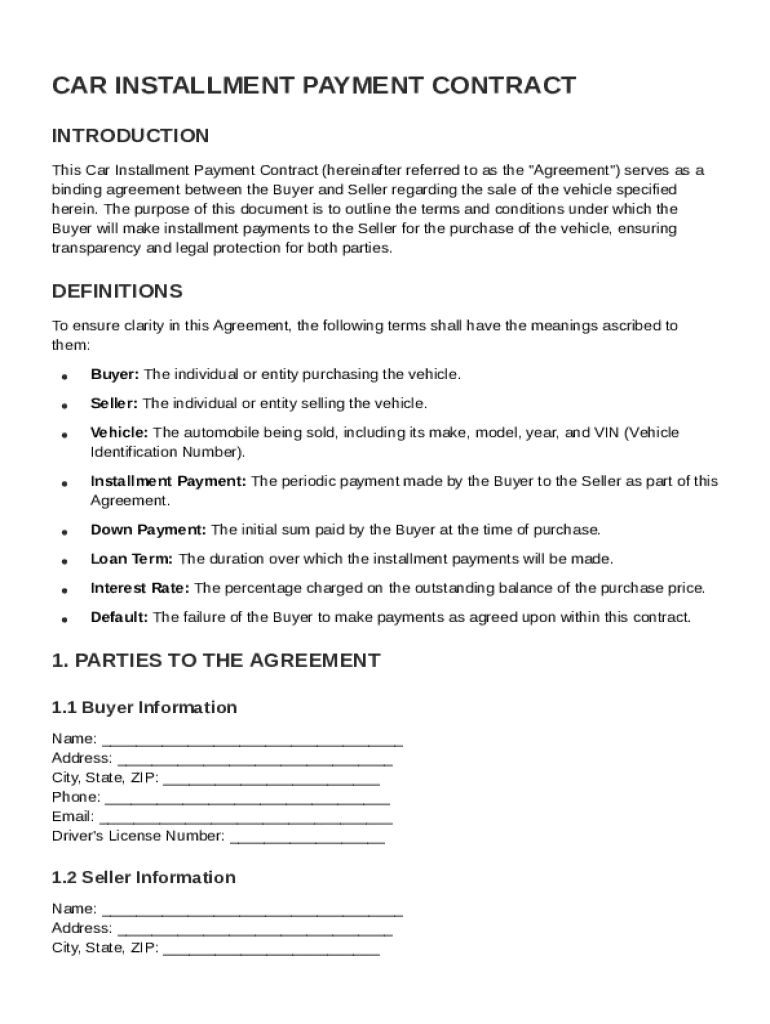
The Car Installment Payment Contract is a formal agreement that outlines the financing terms between a vehicle buyer and seller. This contract specifies the total purchase price, down payment, payment schedule, and interest rates, ensuring both parties understand their financial obligations. It serves as a legal document that protects the interests of both buyer and seller in the transaction, providing a clear record of agreed-upon terms.
Key Components
- Total Purchase Price: The agreed amount for the vehicle.
- Down Payment: Initial payment made by the buyer.
- Installment Schedule: A breakdown of payment timelines.
- Interest Rate: The cost of borrowing, expressed as a percentage.
- Governing Law: Which state laws will apply to the contract.
Practical Example
Consider a scenario where a buyer agrees to pay $12,000 for a vehicle with a $2,000 down payment, leaving a $10,000 balance. The installment schedule might dictate $500 monthly payments at a 5% interest rate over 20 months.
Steps to Complete the Car Installment Payment Contract Template
Completing a Car Installment Payment Contract involves a series of clear and structured steps, ensuring all details are captured accurately.
-
Identify Parties Involved:
- Include full legal names and contact details for both buyer and seller.
-
Detail Vehicle Information:
- VIN, make, model, year, and mileage.
-
Outline Financial Terms:
- Record the agreed purchase price, down payment, and remaining balance.
-
Establish Payment Schedule:
- Set due dates for each installment and details on payment methods accepted.
-
Specify Additional Clauses:
- Include provisions for late payments or default.
-
Sign and Secure Copies:
- Both parties must sign, and each should retain a copy for their records.
Real-World Scenario
A buyer purchasing a sedan might agree to a $15,000 price, with a $3,000 down payment, paying the remaining $12,000 over two years.
Key Elements of the Car Installment Payment Contract Template
A comprehensive Car Installment Payment Contract Template must include several critical elements to ensure it covers all necessary legal and practical aspects of the transaction.
Essential Components
- Buyer and Seller Details: Names, addresses, and contact information.
- Vehicle Description: Details that uniquely identify the vehicle.
- Payment Terms: Purchase price, down payment, number of installments, and interest rate.
- Security Interest: If applicable, stating the seller’s right to repossess the vehicle upon default.
- Default Clause: Conditions under which the buyer is considered in default and remedies available to the seller.
Example
A contract may state that failure to pay within 10 days after the due date results in default, at which point the seller can repossess the vehicle.
Legal Use of the Car Installment Payment Contract Template
The Car Installment Payment Contract serves a legal purpose, establishing rights and obligations and ensuring clarity in vehicle transactions between private parties.
Legal Compliance
- Jurisdictional Variations: Terms must comply with state-specific laws.
- Consumer Protection: Ensures the buyer understands their financial obligations and rights.
- Enforcing Contracts: Provides grounds for legal recourse in case of breaches.
Edge Case
In a state where specific disclosure requirements apply, the contract must reflect these to remain enforceable.
Important Terms Related to Car Installment Payment Contract Template
To fully understand a Car Installment Payment Contract, familiarizing oneself with key terminology is essential.
Glossary of Terms
- Principal Amount: The original sum borrowed before interest.
- Amortization: The process of paying off debt over time in installments.
- Grace Period: An allowance after the due date to make payment without penalties.
- Prepayment Penalty: A fee for paying off the loan early.
State-Specific Rules for the Car Installment Payment Contract Template
States may impose unique rules on vehicle installment contracts, affecting aspects like financing terms and disclosure requirements.
Variations by State
- Interest Rate Caps: Maximum allowable interest rates differ by state.
- Disclosure Requirements: Some states mandate specific financial disclosures.
- Repossession Rules: Procedures for repossession can vary, impacting the enforcement of security interests.
Example
California may require additional financial disclosures compared to Florida, affecting how contracts are drafted and signed.
Digital vs. Paper Version
Car Installment Payment Contracts can be managed either digitally or in traditional paper form, each offering distinct advantages and considerations.
Digital Contracts
- Accessibility: Easily share and store online, offering convenience.
- Real-Time Collaboration: Enables edits and comments from both parties.
- Security Measures: Digital signatures enhance security and are legally binding.
Paper Contracts
- Tangible Record: Physical copies can feel more secure for some parties.
- Preference: Some users may prefer traditional formats due to familiarity.
Who Typically Uses the Car Installment Payment Contract Template
This template is crucial for various stakeholders within the automotive sales and financing sectors.


Common Users
- Individual Buyers/Sellers: For private vehicle sales transactions.
- Car Dealerships: To manage customer financing agreements.
- Financial Institutions: Banks and credit unions use contracts for auto loans.

Case Study
A person buying a car from a private seller may use the template to set terms clearly, reducing the risk of future misunderstandings.
Versions or Alternatives to the Car Installment Payment Contract Template
There are various forms and templates available, catering to different transaction types and complexity levels.
Common Variations
- Simple Sale Agreement: For transactions without financing.
- Lease Agreements: For leasing rather than purchasing vehicles.
- Dealer-specific Contracts: Tailored templates specific to dealerships or financial institutions.
Selection Criteria
Choosing the appropriate template depends on transaction complexity and whether financing is involved.