




01. Edit your form online
Type text, add images, blackout confidential details, add comments, highlights and more.

Type text, add images, blackout confidential details, add comments, highlights and more.

Draw your signature, type it, upload its image, or use your mobile device as a signature pad.

Send it via email, link, or fax. You can also download it, export it or print it out.
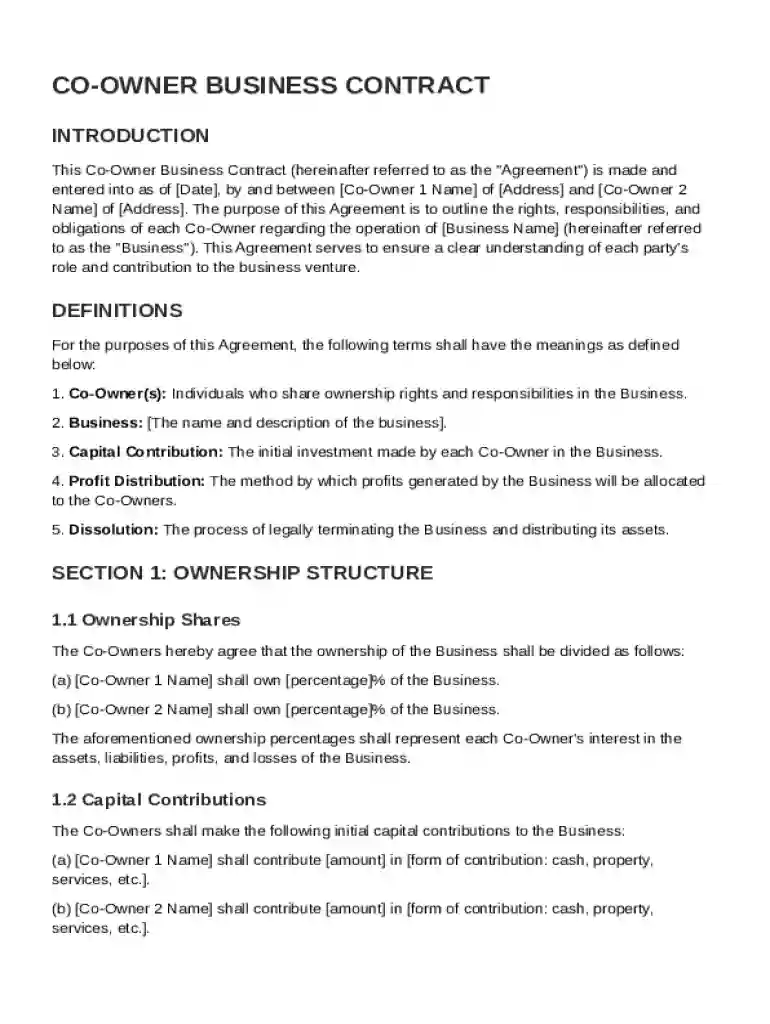
A co-owner business contract is a vital legal document outlining the partnership between two individuals who jointly own a business. This agreement specifies the roles, responsibilities, and obligations of each party involved. Key elements typically addressed include the ownership structure, capital contributions, and management duties. The document also outlines how profits and losses will be allocated, the protocol for business meetings, and the procedures for resolving disputes. In essence, this contract is designed to provide clarity and governance for the co-owners, ensuring that each individual's interests are protected throughout the operation of the business.
Using a co-owner business contract template effectively involves several key steps. Start by downloading the template from a trusted provider, such as DocHub, which offers streamlined editing capabilities. Once you have the template, carefully review each section to understand the information required. Customize the template to reflect the specific terms and conditions agreed upon with your business partner. Pay special attention to sections outlining management responsibilities and profit-sharing arrangements. After customization, both parties should review the entire document to ensure all relevant details are accurately captured. Lastly, ensure both parties sign the contract, ideally in the presence of a legal advisor or notary.
Gather Necessary Information: Begin by collecting all relevant information, including each co-owner's full name, business name, and address.
Define Ownership and Contributions: Clearly outline each co-owner's percentage of ownership and initial capital contributions to the business.
Detail Management Roles: Specify the management roles and responsibilities for each co-owner, including decision-making processes and dispute resolution mechanisms.
Outline Financial Arrangements: Include details on profit and loss distribution, alongside any methods for bookkeeping and financial reporting.
Draft Miscellaneous Provisions: Incorporate clauses related to intellectual property, confidentiality, and termination conditions.
Legal Review: Have a legal professional review the completed document to ensure compliance with applicable laws.
Sign and Store: Once verified, both parties should sign the contract and store it securely, either digitally or in hard copy.
The legal enforceability of a co-owner business contract is integral to its effectiveness. This contract forms a binding agreement between parties, making it essential to adhere to the ESIGN Act for electronic signatures if using platforms like DocHub. Ensure that the document complies with both federal and state-specific regulations. It is advisable to engage a legal professional to verify the template's adherence to legal standards, thereby safeguarding the co-owners' business interests. A well-drafted contract not only provides a structured framework for the business relationship but also mitigates potential legal disputes.
This template is commonly utilized by two or more individuals embarking on a joint business venture. It is particularly beneficial for small business owners, partners in a limited liability company (LLC), and even informal partnerships seeking a formalized agreement. Entrepreneurs engaging in startups and family businesses also find this document crucial for delineating each party's rights and responsibilities. The contract is used to prevent misunderstandings and ensure smooth collaboration, making it indispensable for anyone entering a shared business endeavor.


While the co-owner business contract provides a general framework, certain state-specific rules may apply. These often include variations in business registration requirements, tax obligations, and dispute resolution regulations. For instance, some states have unique statutes regarding non-compete clauses or the treatment of intellectual property. It is crucial for co-owners to familiarize themselves with the legislation specific to their state, ideally with the guidance of a legal expert. This ensures that the contract is fully compliant and enforceable in the jurisdiction where the business operates.
At DocHub, your data security is our priority. We follow HIPAA, SOC2, GDPR, and other standards, so you can work on your documents with confidence.






THIS PARTNERSHIP AGREEMENT is made this day of . 2XXX , by and between Partner 1 and Partner 2. Explanatory Statement. The parties hereto desire to
Mar 24, 2022 The consulting agreement should be in writing and include several essential elements, such as the nature of the consulting services provided, the fee structure


